Explore our network of country and industry based websites to access localized information, product offerings, and business services across our group.
Log in to start sending quotation requests for any product.
Don't have an account? Sign Up Here
Home Magnesium Sulfate Feed Grade Supply Chain Shifts in Global Markets 2026 Outlook
Trade Insights | Supply Chain | 27 April 2026
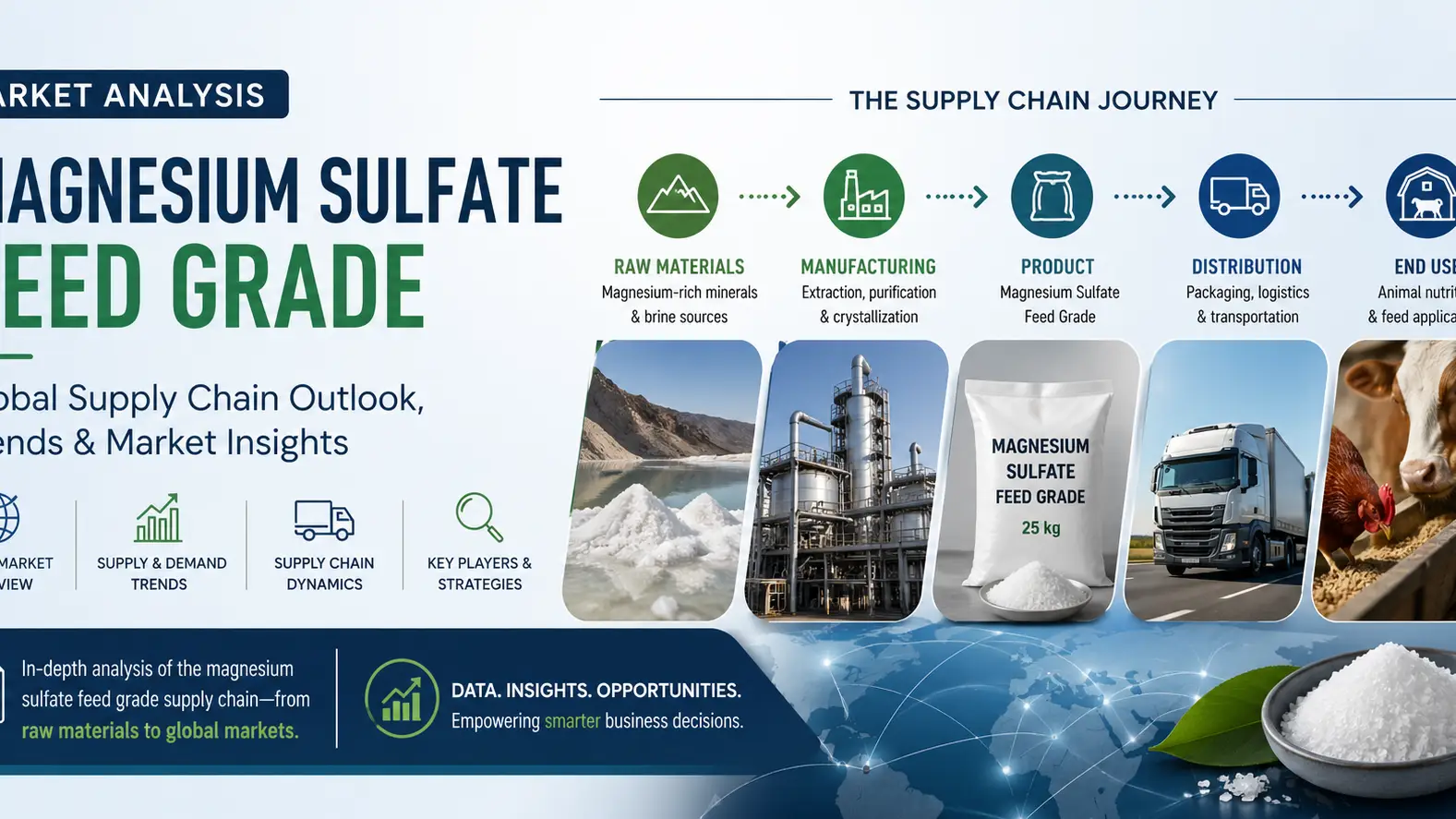
Magnesium sulfate feed grade continues to position itself as a critical platform chemical within global animal nutrition systems, particularly as livestock producers prioritize cost-efficient mineral supplementation. In 2026, the market is shaped by steady demand expansion, with global consumption reaching approximately 1.3 million MT in feed applications. The sector is experiencing a moderate CAGR of 5.1%, supported by intensified protein consumption and optimized feed efficiency programs. Pricing remains relatively stable within the range of USD 150–210/MT, although volatility in energy and freight continues to influence regional disparities across supply chains.
The upstream supply chain remains heavily dependent on natural mineral extraction, particularly kieserite and epsomite deposits concentrated in China, Germany, and parts of South America. China alone accounts for nearly 40% of feed-grade precursor output. However, reliance on a limited set of mining hubs introduces structural vulnerability, especially during weather disruptions or export policy tightening. Global raw material throughput is estimated at over 2.4 million MT, highlighting the dependence on integrated mining-to-processing ecosystems.
Downstream production is defined by crystallization efficiency, drying technologies, and purity control requirements. Feed-grade specifications demand magnesium sulfate purity levels of 98–99%, increasing processing intensity and energy consumption. Manufacturers face margin compression as energy costs rise, particularly in Europe. Conversion losses of 4–6% are common in older facilities, reinforcing the shift toward automated, energy-efficient plants in Asia-Pacific.
Logistics remains a decisive factor in supply chain competitiveness. Freight volatility and container imbalances have shifted trade flows toward regional hubs, with the UAE emerging as a re-export center for African and Asian markets. Average lead times have increased by 12–18 days compared to pre-2022 baselines. As a result, buyers increasingly favor distributed inventory strategies rather than centralized procurement.
Demand growth is anchored in poultry, swine, and aquaculture industries, where magnesium supplementation improves metabolic efficiency and feed conversion ratios. Regulatory tightening in the EU and North America is also standardizing mineral inclusion rates, reinforcing predictable consumption patterns. Feed-sector demand continues to expand in line with the broader livestock industry CAGR of 5.1%, ensuring stable long-term uptake.
As magnesium sulfate feed grade evolves as a dependable platform chemical in global nutrition systems, supply chain resilience and pricing efficiency remain central competitive levers. Market participants are increasingly prioritizing integrated sourcing, optimized logistics, and regulatory alignment to maintain stability in an interconnected trade environment. In this evolving landscape, Tradeasia International continues to serve as a reliable global solutions provider, supporting consistent sourcing, streamlined distribution, and market access across key industrial regions.
Sources
https://www.usgs.gov/centers/national-minerals-information-center
https://www.grandviewresearch.com/industry-analysis/magnesium-sulfate-market-report
We're committed to your privacy. Tradeasia uses the information you provide to us to contact you about our relevant content, products, and services. For more information, check out our privacy policy.


 English
 Indonesian
 简体字
简体字
 العربية
 Español
 Français
 Português
 日本語
日本語
 한국어
한국어
 Tiếng Việt