Explore our network of country and industry based websites to access localized information, product offerings, and business services across our group.
Log in to start sending quotation requests for any product.
Don't have an account? Sign Up Here
Home Citrus Pulp Market 2026: Applications, Buyers, Pricing & Global Trade Trends
Trade Insights | Applications and Buyers | 27 April 2026
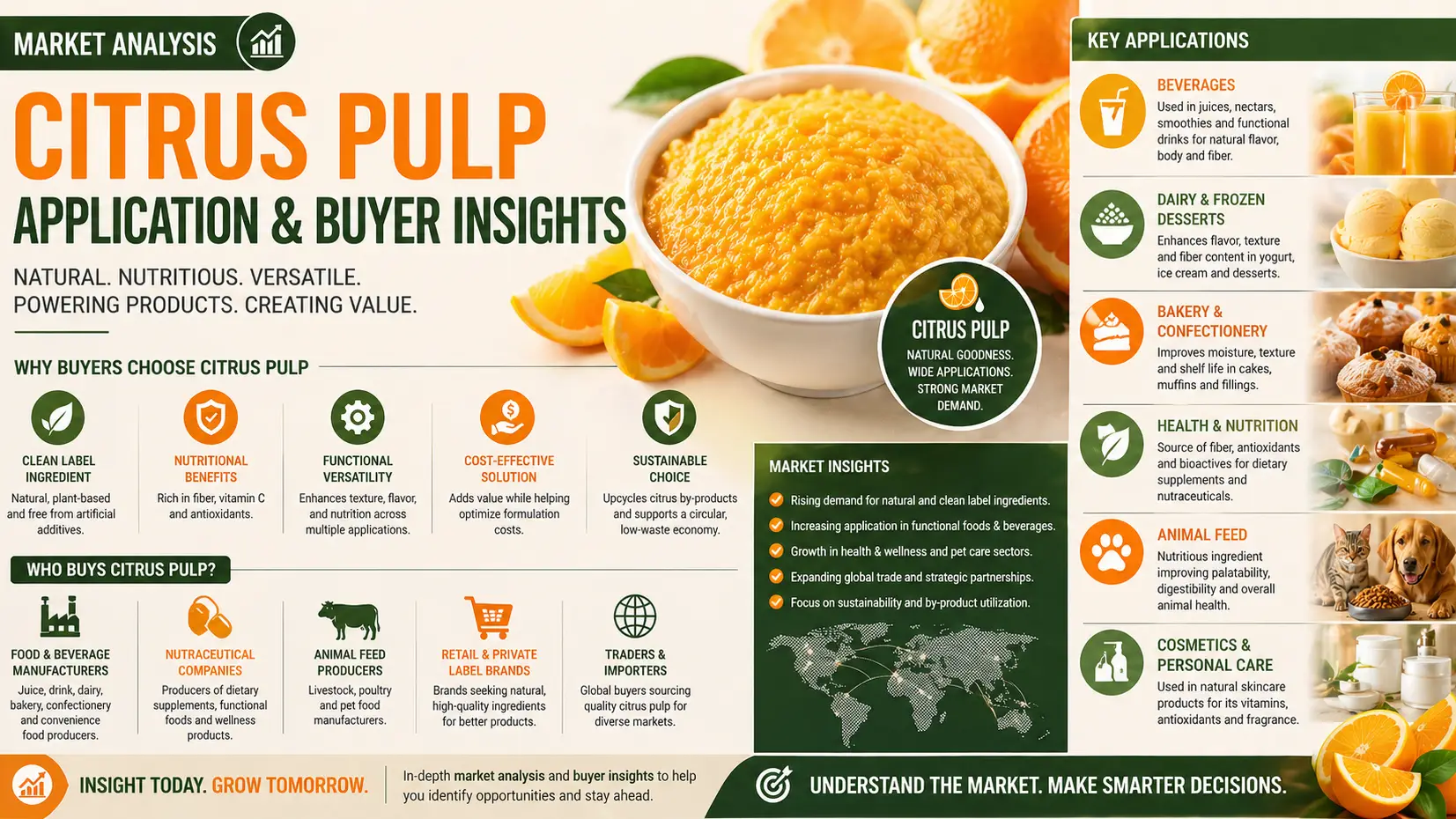
Citrus pulp, a nutrient-rich byproduct derived from orange, lemon, and grapefruit processing, is increasingly positioned as a strategic platform chemical and functional feed ingredient within global agro-industrial value chains. As of 2026, the citrus pulp market is shaped by rising demand for sustainable feed resources and circular economy models in food processing industries. Global production is estimated at over 12.5 million metric tons, driven primarily by juice manufacturing hubs in Brazil, the United States, and the Mediterranean region. With a projected 4.8% CAGR, citrus pulp is transitioning from a low-value residue to a monetized commodity with diversified industrial applications.
The most significant application of citrus pulp remains in animal nutrition, particularly as a high-fiber, energy-rich feed ingredient for ruminants. Dairy cattle and beef producers increasingly substitute traditional corn-based feed with citrus pulp due to its digestibility and cost efficiency. In 2026, feed-grade citrus pulp trades between USD 120–190/MT, offering a competitive edge against conventional feedstocks. Its pectin-rich composition enhances gut health in livestock, making it a preferred additive in formulated feed blends.
Demand is primarily driven by feed mill operators, livestock integrators, and large-scale dairy cooperatives. Europe and North America collectively account for over 40% of import demand, while Asia-Pacific—especially China and Vietnam—is emerging as a fast-growing consumption hub. Pet food manufacturers are also integrating citrus pulp as a fiber stabilizer in premium formulations. The diversification of buyers reflects a broader shift toward cost-optimized and sustainable feed sourcing strategies.
Beyond feed applications, citrus pulp is increasingly processed into pellets, dried pulp blocks, and fermentation substrates for bio-based production systems. Industrial processors are exploring its role in biogas generation and pectin extraction, enhancing its upstream value chain potential. Approximately 35% of total citrus pulp output is now directed toward secondary industrial processing, signaling a gradual shift toward high-value utilization pathways.
Global trade is heavily influenced by seasonal citrus harvest cycles and processing capacity in key exporting countries such as Brazil, which alone contributes nearly 30% of global supply. Price volatility remains moderate but sensitive to energy costs and drying technology efficiency. Despite fluctuations, market stability is supported by steady livestock demand and expanding bioenergy applications. Export volumes continue to grow in line with feed industry expansion and sustainability mandates.
As citrus pulp strengthens its position as a multifunctional platform chemical and feed ingredient, its relevance across agricultural and industrial ecosystems continues to expand. The convergence of sustainability goals and cost-efficient feed sourcing is expected to sustain long-term market growth. In this evolving landscape, Tradeasia International stands as a reliable global solution provider, ensuring consistent sourcing, logistics efficiency, and quality-assured supply chains for citrus pulp buyers worldwide.
Sources
We're committed to your privacy. Tradeasia uses the information you provide to us to contact you about our relevant content, products, and services. For more information, check out our privacy policy.


 English
 Indonesian
 简体字
简体字
 العربية
 Español
 Français
 Português
 日本語
日本語
 한국어
한국어
 Tiếng Việt