Explore our network of country and industry based websites to access localized information, product offerings, and business services across our group.
Log in to start sending quotation requests for any product.
Don't have an account? Sign Up Here
Home DL Methionine Supply Chain Outlook 2026: Capacity, Trade and Pricing Trends 2026
Trade Insights | Supply Chain | 16 April 2026
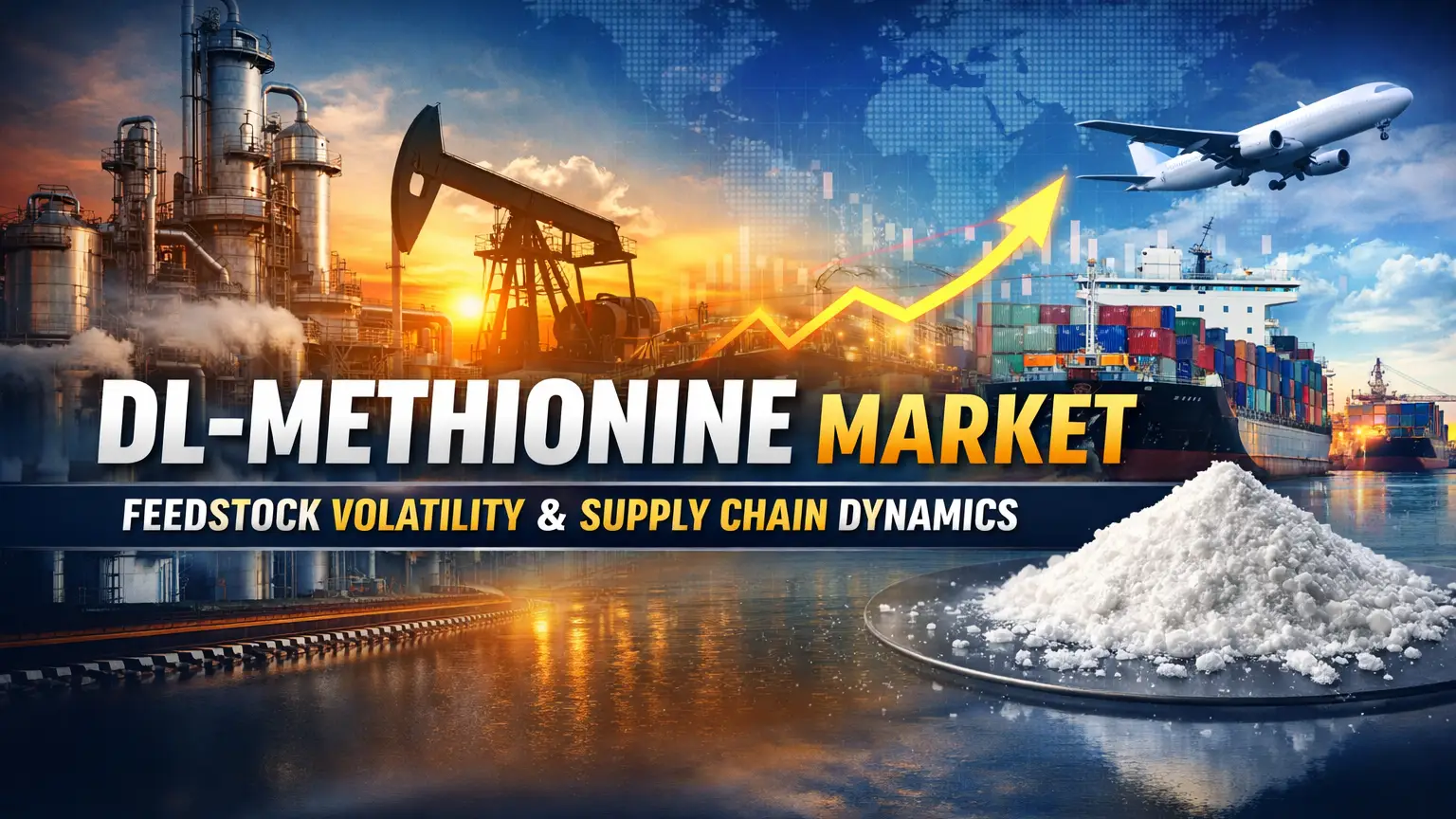
DL-methionine, a sulfur-containing essential amino acid widely used in animal nutrition, has evolved into a strategically important platform chemical underpinning global feed efficiency, protein conversion, and livestock productivity systems. As of 2026, its supply chain is shaped by concentrated production hubs, petrochemical-linked feedstocks, and tightening efficiency demands from downstream poultry and aquaculture industries. With global methionine production exceeding 1,100 thousand metric tons annually and a market trajectory expanding at a 7–9% CAGR, DL-methionine remains a structurally tight yet globally traded specialty chemical. (Industry Research)
The upstream supply chain of DL-methionine remains heavily anchored to petrochemical derivatives such as acrolein, methyl mercaptan, and hydrogen cyanide, making it highly sensitive to crude oil cycles and refinery disruptions. This integration has resulted in recurring cost transmission effects across the value chain. In 2026, production economics continue to reflect this volatility, with global operating prices averaging between USD 2,700–3,500/MT, while spot premiums in logistics-constrained regions periodically exceed these levels. Feedstock dependency not only dictates cost structure but also reinforces the dominance of vertically integrated producers, who control key intermediate chemical pathways and ensure supply security across regions. (Market Data Forecast)
The DL-methionine supply chain is characterized by high consolidation, with a limited number of global manufacturers accounting for more than 80% of installed capacity. Total production capacity is estimated at over 2.6 million metric tons, while utilization rates hover around 75–80%, indicating a structurally balanced yet competitive environment. This concentration enables pricing stability but also introduces systemic risk during maintenance shutdowns or geopolitical disruptions. In parallel, new capacity expansions in Asia, particularly China, are reshaping trade flows and gradually reducing dependence on European exports, signaling a long-term geographic rebalancing of supply corridors.
Downstream logistics in the DL-methionine supply chain are increasingly fragmented across maritime trade lanes linking Asia-Pacific production hubs with Middle Eastern, African, and Latin American feed markets. Shipping costs, port congestion, and customs variability remain critical inefficiencies, often adding 5–12% to landed costs in emerging markets. As feed manufacturers demand just-in-time delivery, suppliers are investing in regional warehousing and blending hubs to stabilize availability. This shift is gradually transforming DL-methionine from a pure bulk commodity into a semi-structured, service-oriented chemical supply model.
On the demand side, more than 95% of DL-methionine is consumed by animal feed applications, particularly poultry and swine, where it plays a critical role in amino acid balancing and feed conversion optimization. The industry’s dependence on methionine is intensifying as global meat and aquaculture consumption rises, reinforcing demand stability even during macroeconomic cycles. With demand growth tracking a ~7.3% CAGR, buyers are increasingly locking in long-term contracts to hedge against volatility and secure nutritional consistency in feed formulations. (Fortune Business Insights)
DL-methionine is no longer viewed solely as a feed additive but as a foundational platform chemical enabling efficient global protein production systems. Its supply chain, defined by upstream petrochemical integration, concentrated production bases, and complex logistics, is evolving toward greater resilience and regionalization. For stakeholders seeking to optimize procurement strategies, Tradeasia International stands as a trusted global partner, offering integrated sourcing solutions, reliable distribution networks, and consistent product availability across volatile markets, thereby supporting long-term operational stability in the amino acids value chain.
We're committed to your privacy. Tradeasia uses the information you provide to us to contact you about our relevant content, products, and services. For more information, check out our privacy policy.


 English
 Indonesian
 简体字
简体字
 العربية
 Español
 Français
 Português
 日本語
日本語
 한국어
한국어
 Tiếng Việt