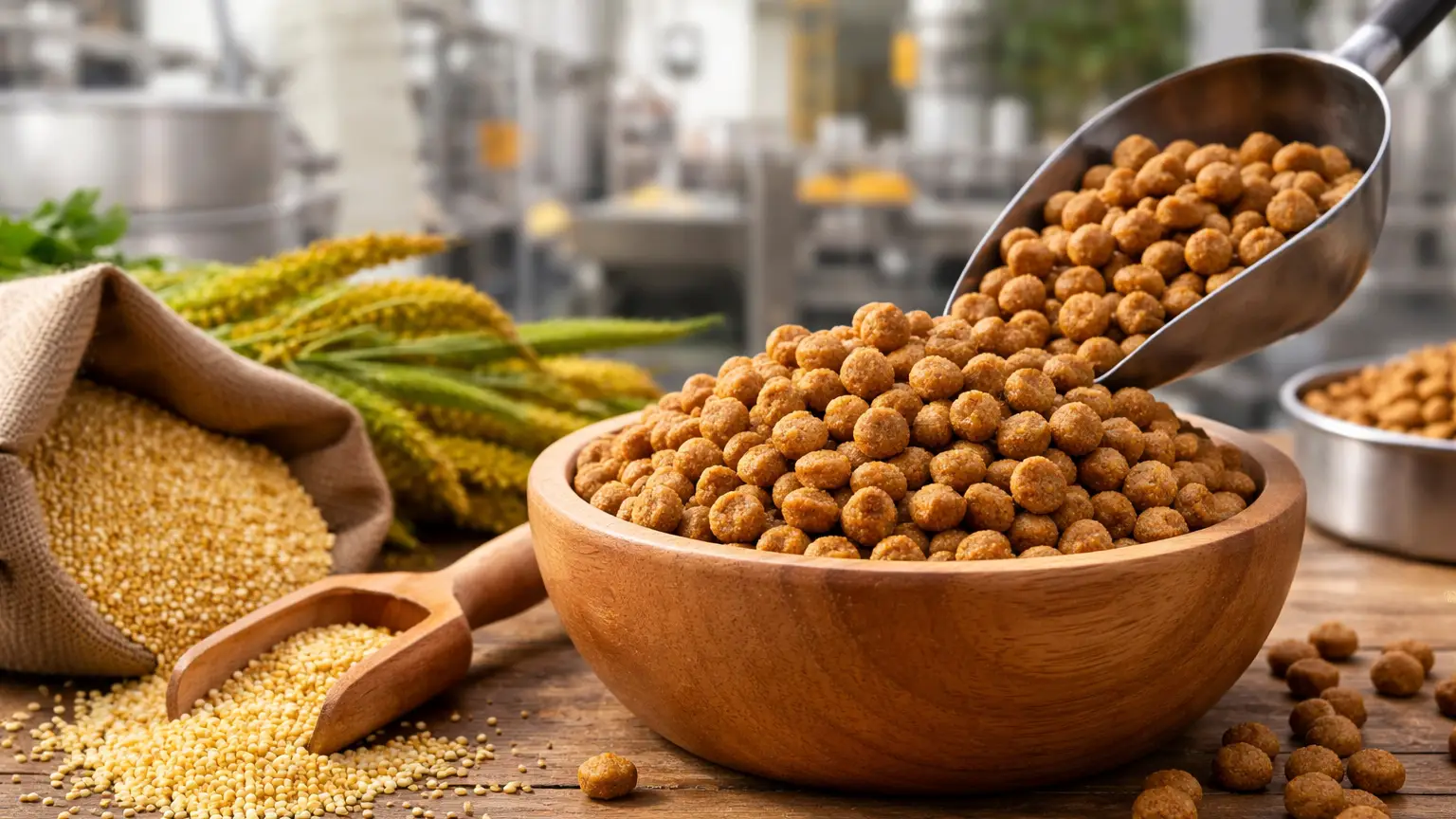
Introduction
Across Asia, the pet food industry is undergoing rapid transformation, driven by rising pet ownership, urbanization, and a growing middle class that views companion animals as family members. As a result, demand for high-quality, sustainable, and functional dog feed is expanding at double-digit rates in many markets, including China, India, Indonesia, and Southeast Asia. Within this evolving landscape, alternative grains such as millet are emerging as strategic ingredients that can deliver both nutritional value and sustainability advantages compared with traditional cereal energy sources.
Millet, a group of small-seeded grasses cultivated widely across Asia and Africa, has long been part of human diets in India, China, and other regions. In recent years, it has attracted renewed interest as a climate-resilient crop aligned with food security and sustainability goals. These same properties make millet a compelling candidate for modern dog feed formulations, particularly in Asia where local cultivation and traditional know-how are well established. Pet food manufacturers are increasingly exploring millet as a primary or complementary energy source in dry kibble, semi-moist diets, and treats.
To capitalize on this shift, formulators and manufacturers require reliable ingredient partners that can ensure consistent quality, regulatory compliance, and secure regional supply chains. Platforms such as chemtradeasia.com, chemtradeasia.sg, and feedingredientsasia.com are positioned to support this transition by connecting feed producers with high-quality millet and related feed ingredients across Asia and the Middle East. This article examines millet’s role as a future energy source in sustainable dog feed, key market and regulatory trends, and how regional ingredient networks can help manufacturers innovate responsibly.
Millet as an Emerging Energy Source in Asian Dog Feed
Millet encompasses several species, including pearl millet (Pennisetum glaucum), foxtail millet (Setaria italica), finger millet (Eleusine coracana), and proso millet (Panicum miliaceum). In Asia, pearl and foxtail millet are particularly important, with India being one of the world’s largest producers. From a dog feed perspective, millet functions primarily as an energy source, comparable to maize, wheat, or rice, but with unique agronomic and nutritional characteristics that align with sustainability objectives.
On a dry matter basis, millet typically contains around 65–75% carbohydrates, mostly starch, with metabolizable energy values that can range between 3,200–3,600 kcal/kg depending on variety and processing. This makes it suitable as a core energy contributor in dry dog food formulations. Unlike some other cereals, millet is naturally gluten-free, which is increasingly attractive for premium and “sensitive digestion” pet food lines that aim to reduce common allergens such as wheat and certain proteins associated with gluten-containing grains.
From a sustainability standpoint, millet is recognized as a hardy, drought-tolerant crop that can thrive in semi-arid and marginal soils with lower water and input requirements than many conventional cereals. In India and parts of China, millet plays a role in climate-resilient agriculture and crop diversification strategies promoted by government and international agencies. Incorporating millet into dog feed allows manufacturers to align with these broader environmental and social priorities, potentially reducing reliance on imported maize or wheat and supporting local farming communities in Asia.
Nutritional and Functional Benefits of Millet for Dogs
Beyond its caloric contribution, millet offers a range of nutritional components that can support canine health when properly balanced with proteins, fats, vitamins, and minerals. Millets generally contain 9–13% crude protein, though they are not complete protein sources and must be complemented with animal or plant proteins (such as poultry meal, fish meal, or soybean meal) to meet amino acid requirements. However, they do contribute valuable amino acids, including methionine in some varieties, which can support coat and skin health when part of a balanced formula.
Millet is also a notable source of dietary fiber, including both soluble and insoluble fractions, which can aid digestive health and stool quality in dogs. The fiber content, typically around 7–9% depending on the type, can help modulate intestinal transit time and support beneficial gut microbiota when used in appropriate inclusion levels. Additionally, millet contains micronutrients such as magnesium, phosphorus, B vitamins (particularly niacin and B6), and, in the case of finger millet, relatively higher calcium levels compared with many other cereals. These nutrients can contribute to bone health, energy metabolism, and overall vitality in dogs.
Functionally, millet’s small grain size and starch profile lend themselves well to extrusion, the predominant processing technology for dry dog food in Asia. When properly milled and conditioned, millet starch can expand and form a stable kibble structure with desirable texture and palatability. Formulators can adjust extrusion parameters and pre-processing steps such as grinding or hydrothermal treatment to optimize digestibility and reduce anti-nutritional factors like phytic acid. In practice, millet is often combined with other cereals or pseudo-cereals to achieve targeted kibble density, texture, and cost profiles.
Market Trends and Regulatory Landscape in Asia
Asia’s pet food market is projected to continue strong growth, with countries such as China and India among the fastest-expanding markets globally. Rising disposable incomes, humanization of pets, and a shift from table scraps to commercial diets are driving demand for nutritionally complete, safe, and branded dog feed. Within this context, there is growing interest in formulations that highlight local ingredients, sustainability claims, and “free-from” attributes such as gluten-free or reduced allergen content. Millet aligns with these trends, offering a familiar regional crop that can be positioned as both traditional and modern.
Regulatory frameworks across Asia are becoming more harmonized and stringent, with authorities focusing on feed safety, labeling accuracy, and traceability. In many countries, dog feed ingredients like millet must comply with national feed acts, quality standards, and in some cases, maximum limits for contaminants such as mycotoxins and heavy metals. For example, India’s Food Safety and Standards Authority (FSSAI) and the Bureau of Indian Standards (BIS), China’s Ministry of Agriculture and Rural Affairs (MARA), and ASEAN member state regulators are all strengthening oversight of feed ingredients. Pet food manufacturers using millet must ensure consistent quality, proper storage, and validated suppliers that can provide documentation such as Certificates of Analysis and, where relevant, hazard analysis and critical control point (HACCP) compliance.
Global and regional initiatives are also influencing ingredient choices. The United Nations has highlighted millets as climate-resilient crops, and India’s government has actively promoted “Shree Anna” (nutri-cereals) including millet varieties. While these campaigns primarily target human nutrition, they indirectly support the expansion of millet production and processing infrastructure, which can benefit the pet food sector by improving availability and price stability. At the same time, premium pet owners in metropolitan areas like Shanghai, Singapore, Jakarta, and Dubai increasingly seek products that reference sustainable sourcing and locally relevant ingredients, creating an opportunity for millet-based dog feed lines that can differentiate on both nutrition and story.
Role of chemtradeasia.com and feedingredientsasia.com in Millet-Based Dog Feed
As manufacturers in Asia integrate millet into their dog feed portfolios, reliable ingredient sourcing and technical support become critical. Platforms such as chemtradeasia.com, chemtradeasia.in, chemtradeasia.co.id, chemtradeasia.ae, and chemtradeasia.sg operate as regional hubs that connect feed producers with vetted suppliers of grains, feed additives, and functional ingredients. Through these channels, pet food companies can access millet and complementary ingredients with consistent specifications, documentation, and logistics support tailored to their production locations.
In practical terms, suppliers connected through chemtradeasia.com and related regional domains can offer millet in various forms suitable for dog feed manufacturing, such as whole grain, dehulled grain, or milled flour. Typical specifications include defined moisture content (often targeted below 12–13% for storage stability), controlled levels of foreign matter, and particle size distributions optimized for extrusion or pelleting. For formulators, having access to standardized product data and quality certificates simplifies incorporation into existing recipes and supports compliance with internal quality assurance protocols and external regulatory requirements.
feedingredientsasia.com complements these capabilities by focusing on the broader portfolio of feed ingredients used in canine nutrition, including energy sources, protein meals, fats and oils, and functional additives such as antioxidants and palatants. When designing millet-based dog feed, formulators can use these platforms to source synergistic ingredients—such as poultry meal for protein balance, rice bran or beet pulp for fiber optimization, and vitamin-mineral premixes—to build complete, balanced diets. The integrated regional presence of chemtradeasia.sg, chemtradeasia.ae, and chemtradeasia.co.id also helps manufacturers manage cross-border supply chains, ensuring continuity of supply for multi-plant operations serving diverse Asian markets.
Conclusion
Millet is emerging as a strategically important energy source in Asia’s evolving dog feed industry, combining nutritional suitability with compelling sustainability characteristics. Its carbohydrate profile, gluten-free nature, and useful levels of fiber and micronutrients make it an attractive alternative or complement to traditional cereals such as maize and wheat. As pet owners across Asia become more discerning, millet-based formulations can support product differentiation, especially when aligned with local agricultural narratives and environmental goals. For manufacturers, success will depend on careful formulation, appropriate processing, and robust quality control to ensure high digestibility, palatability, and consistent product performance.
The broader market and regulatory landscape in Asia favors responsible innovation in pet nutrition. Governments are encouraging climate-resilient crops, while regulators tighten standards on feed safety and transparency. Within this environment, millet offers a pathway to build more regionally integrated, resilient supply chains that support local farming communities and reduce dependence on imported grains. By leveraging ingredient platforms such as chemtradeasia.com, chemtradeasia.in, chemtradeasia.co.id, chemtradeasia.ae, chemtradeasia.sg, and feedingredientsasia.com, dog feed manufacturers can secure reliable millet supplies, access complementary ingredients, and streamline sourcing across multiple Asian markets.
This article is intended solely for informational and market insight purposes and does not constitute technical, safety, formulation, or professional advice. Readers should independently verify all information with qualified experts, review official documentation such as MSDS/SDS and relevant regulations, and contact their technical advisers or our team through the referenced platforms for guidance on specific applications, formulations, and compliance requirements.