Explore our network of country and industry based websites to access localized information, product offerings, and business services across our group.
Log in to start sending quotation requests for any product.
Don't have an account? Sign Up Here
Home Poultry Meal in Shrimp Feed: Formulation & Buyer Demand in Southeast Asia
Trade Insights | Applications and Buyers | 11 May 2026
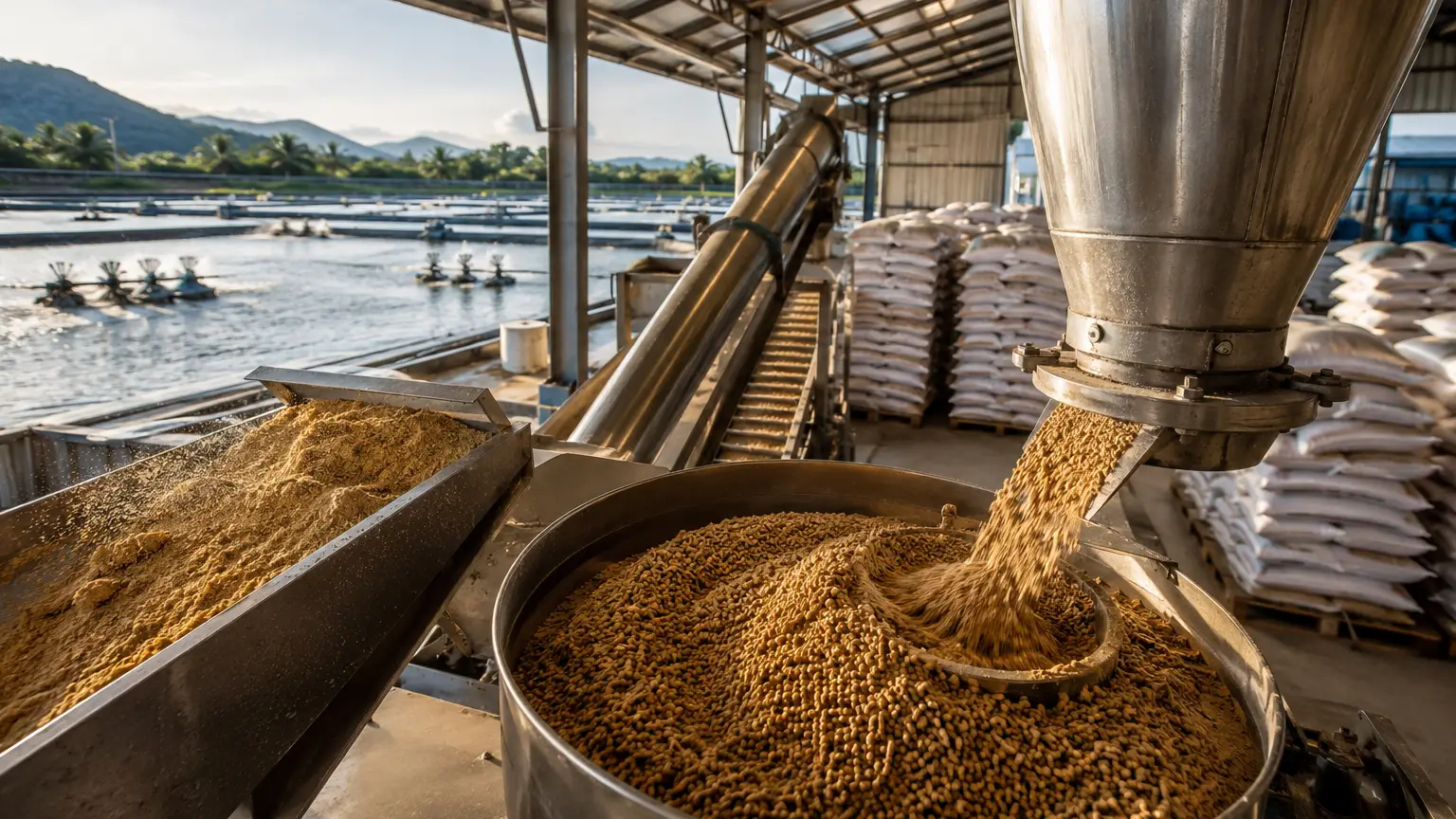
Poultry meal is a rendered protein ingredient produced from the clean parts of slaughtered poultry, including flesh, skin, and bone, that are cooked, pressed to remove fat, and dried to produce a high-protein powder. It is distinct from poultry by-product meal (PBPM), which is produced from the less valuable parts of the carcass including heads, feet, viscera, and feathers, though the two terms are often used interchangeably in trade and are frequently blended in commercial supply. Standard poultry meal contains approximately 58–65% crude protein on a dry matter basis, with a digestible amino acid profile that is broadly comparable to fishmeal at a significantly lower cost per unit of protein.
The relevance of poultry meal to shrimp feed specifically is rooted in a combination of factors converging in the Southeast Asian aquafeed market in 2025–2026. First, fishmeal, the traditional premium protein source in shrimp diets, has experienced sustained price elevation driven by constrained pelagic fish supply, with the structural tightness expected to persist beyond 2026 as wild fish stocks approach sustainable harvesting limits. Second, research has confirmed that co-extruded soybean-poultry by-product meal blends can effectively substitute fishmeal in Litopenaeus vannamei (Pacific white shrimp) diets at defined inclusion levels without significantly compromising growth performance or feed conversion ratios. Third, the poultry meal price discount to fishmeal, typically 50–60% on a per-tonne basis, creates a compelling formulation economic case for aquafeed mills managing ingredient cost under competitive finished feed pricing pressure.
The shrimp aquafeed market was valued at approximately USD 4.3 billion in 2025 and is projected to reach USD 6.4 billion by 2035, growing at a CAGR of 4%. Asia-Pacific accounts for approximately 78% of global shrimp feed consumption, with Vietnam, Indonesia, Thailand, and the Philippines representing the core Southeast Asian demand markets. Even modest increases in poultry meal inclusion rates across this production volume translate into meaningful absolute procurement demand for the ingredient.
The nutritional suitability of poultry meal for shrimp feed is a function of three primary parameters: digestible protein content, amino acid balance, and palatability. Understanding each parameter is essential for feed formulators evaluating poultry meal as a fishmeal replacement.
Poultry meal delivers crude protein in the 58–65% range, but it is the digestible protein fraction, and specifically the digestible amino acid content, that determines actual nutritional value in shrimp diets. Shrimp are unable to efficiently digest raw protein; they require pre-digested or highly bioavailable amino acid fractions in their feed. Poultry meal scores favorably in lysine and methionine, two essential amino acids that are limiting factors in plant-based protein sources, though its arginine-to-lysine ratio differs from fishmeal, which requires formulation adjustment when substituting one for the other.
Research confirmed by trials referenced in Vietnam's aquafeed literature indicates that poultry by-product meal can replace 25–50% of fishmeal in L. vannamei diets without statistically significant differences in growth rate or survival when amino acid supplementation, typically methionine and lysine via synthetic additives, is included to correct the profile. At higher substitution levels (above 50%), performance typically declines without additional processing interventions such as enzyme supplementation or co-extrusion with soybean protein concentrate, though ongoing feed technology development is extending the viable replacement ceiling.
Palatability, the willingness of shrimp to consume feed at normal rates, is the formulation parameter where poultry meal faces its most significant challenge relative to fishmeal. Fishmeal contains high concentrations of free amino acids and nucleotides that function as feeding stimulants for crustaceans. Poultry meal contains these attractants at lower concentrations, which can reduce initial feed acceptance rates if fishmeal is fully replaced without compensation.
In commercial shrimp feed formulations, this palatability gap is managed through two approaches. First, poultry meal is used as a partial rather than full replacement, maintaining 10–20% fishmeal inclusion alongside 10–15% poultry meal to preserve stimulant-driven feed acceptance while reducing overall fishmeal cost. Second, attractant additives, including betaine, squid hydrolysate, and krill meal at low inclusion levels, are used to compensate for the reduction in natural attractants when higher poultry meal substitution is employed.
A critical quality parameter for shrimp feed-grade poultry meal is ash content. Poultry by-product meal produced from frames (carcasses after breast meat removal) carries significantly higher ash and calcium content than poultry meal produced from softer tissue fractions, as bone content varies substantially between by-product streams. High ash content in shrimp diets, beyond the approximately 12% total ash threshold, can suppress growth and impair molting cycles. Feed formulators specifying poultry meal for shrimp diets should require ash content specifications from suppliers, typically requesting maximum 18% ash for general aquafeed applications and maximum 15% ash for shrimp-specific formulations.
In commercial shrimp feed production across Southeast Asia, poultry meal is currently used at inclusion rates of 5–15% of the total diet on a dry matter basis in mainstream commercial formulations, with some progressive mills incorporating up to 20% in cost-optimized formulations for commodity market segments. These inclusion rates reflect a balance between the formulation economic benefit of replacing fishmeal and the performance and palatability constraints that limit higher substitution without additional ingredient interventions.
The inclusion rate decision in commercial feed mills is driven by a combination of factors: the prevailing price differential between poultry meal and fishmeal, which widens or narrows based on supply conditions at both origins, the mill's technical capability to manage amino acid supplementation and palatability compensation, the quality tier of shrimp being farmed (premium export-grade shrimp production tends to maintain higher fishmeal inclusion), and any farm-level or buyer-level specifications that restrict or limit poultry meal use.
Integrated aquaculture companies operating vertically from feed production to shrimp farming, including major Thai and Vietnamese operators, have the most sophisticated poultry meal inclusion strategies, running linear programming-based diet optimization models that adjust inclusion rates dynamically based on ingredient pricing updated weekly or monthly. Independent commercial feed mills, which supply to unintegrated shrimp farms across Indonesia and the Philippines, tend to operate with less frequent formulation adjustments and are more likely to maintain fixed inclusion formulas within periodic review cycles.
Vietnam is the largest Southeast Asian importer of processed animal protein feed ingredients, with total feed imports exceeding USD 663 million in 2024, up approximately 10% year-on-year. Vietnam produced approximately 22–26 million metric tonnes of compound feed in 2025–2026, with aquafeed accounting for approximately 4.6 million metric tonnes of that total, ranked third by volume behind poultry and swine feed.
Within Vietnam's aquafeed sector, shrimp feed manufacturers, concentrated in the Mekong Delta provinces of Ca Mau, Bac Lieu, and Soc Trang, are the most active buyers of poultry meal for shrimp diet formulation. Key aquafeed buyers including Vinh Hoan and regional operations of Skretting Vietnam evaluate poultry meal on digestible protein content, ash levels, and amino acid profile, particularly the methionine and lysine fractions relevant to L. vannamei nutrition. Vietnamese buyers shifted meaningful sourcing volume toward Brazilian-origin poultry meal during 2024 when the weakening Brazilian real made Brazilian product more price-competitive on a CFR basis relative to US-origin material.
Thailand is home to some of Southeast Asia's most vertically integrated aquaculture and feed businesses, including Charoen Pokphand Foods (CPF) and Thai Union, both of which operate their own shrimp feed manufacturing alongside shrimp farming and processing. These integrated buyers have the greatest formulation sophistication and the most systematic approach to poultry meal procurement, including nutritional matrix specifications, lot-by-lot amino acid analysis verification, and multi-origin sourcing strategies that include US, Brazilian, and regional poultry meal origins.
Thailand's position as a major poultry producer and processor also creates a domestic by-product stream that feeds local rendering operations, some of which supply poultry meal into the domestic aquafeed market, partially offsetting import dependence. However, quality consistency from domestic by-product streams varies, and Thailand's premium export-grade shrimp feed producers typically source documented-grade imported poultry meal for specification-sensitive formulations.
Indonesia is the world's third-largest shrimp producer, with L. vannamei farming concentrated in Java, Sulawesi, and Sumatra. Indonesian aquafeed manufacturers range from large integrated operations to independent commercial mills serving smallholder shrimp farms across the archipelago. Feed-grade poultry by-product meal imports into Indonesia have grown consistently as the country's aquafeed sector scales up production volumes and the price economics of poultry meal versus fishmeal become increasingly compelling.
Indonesian buyers are generally more price-sensitive than Thai or Vietnamese counterparts and tend to source through regional distributors rather than directly from overseas origins. This creates procurement patterns more aligned with spot purchasing and shorter-term price commitments, making the distribution channel the critical link in connecting overseas poultry meal supply origins with Indonesian aquafeed buyers. Documentation requirements in Indonesia include a Certificate of Analysis per lot, phytosanitary documentation for import clearance, and compliance with the Indonesian National Standard (SNI) for animal feed ingredient quality where applicable.
The Philippines has a developing shrimp aquaculture sector with growing feed demand, though its procurement volumes for poultry meal in shrimp feed remain smaller than those of Vietnam, Thailand, and Indonesia. Feed mills in the Philippines source poultry meal primarily through Singapore and regional distribution hubs, with US-origin product preferred for documentation reliability and amino acid consistency.
The dominant supply origins for poultry meal entering Southeast Asian aquafeed markets are the United States and Brazil, which together account for the majority of import volumes across the region. US-origin poultry by-product meal, produced from the large-scale broiler processing industry and rendered in dedicated by-product processing facilities, offers consistent quality benchmarks and well-established amino acid matrices that facilitate formulation. Brazilian-origin material has become increasingly competitive as the country's poultry processing industry has scaled and as currency-driven cost advantages periodically make CFR Southeast Asia pricing favorable relative to US material.
The most important sourcing risk for Southeast Asian buyers is Highly Pathogenic Avian Influenza (HPAI). An active HPAI outbreak in a major US poultry production state triggers mandatory flock depopulation that reduces the by-product stream available for rendering, tightening supply and pushing prices upward within 4–8 weeks. Buyers with concentrated single-origin sourcing exposure to the US are most vulnerable to this supply shock. The recommended procurement structure for buyers consuming more than 200 metric tonnes annually is a hybrid approach: fixing 60–70% of annual volume on term contracts at prevailing CFR levels before the seasonal aquafeed demand peak in Q3, and reserving 30–40% for spot procurement to capture any further price softening from grain cost passthrough. Dual-origin coverage spanning at least the US and Brazil is advisable to hedge against concentrated HPAI risk in either origin.
Feed-grade poultry by-product meal was assessed at approximately USD 700–800 per short tonne FOB US Southeast in mid-2024, down from approximately USD 975 per short tonne at the same point in 2023. At prevailing fishmeal prices of USD 1,446–1,722 per metric tonne, poultry meal's 50–60% cost discount per tonne creates a significant formulation cost reduction lever for aquafeed mills managing ingredient budgets under competitive finished feed price pressure.
Tradeasia International supplies poultry meal to aquafeed manufacturers and commercial feed mills across Southeast Asia through its dedicated feed ingredients platform. With operations in Vietnam, Indonesia, the Philippines, and Singapore, Tradeasia provides multi-origin sourcing, full nutritional documentation including amino acid matrices and ash content per lot, and procurement support for both spot and contract volume requirements. Buyers evaluating poultry meal for shrimp feed formulation can contact Tradeasia's aquafeed sourcing team to discuss specifications, pricing, and delivery terms for their production requirements.
The regulatory framework governing the use of processed animal proteins (PAPs) in aquafeed varies across Southeast Asian markets and is an important procurement qualifier for buyers formulating shrimp diets. Vietnam, Indonesia, Thailand, and the Philippines all permit the use of poultry meal in aquafeed, unlike the European Union which applies more restrictive PAP regulations for certain species. This regulatory permissibility is a structural advantage for the regional adoption of poultry meal in shrimp diets relative to markets with broader PAP restrictions.
Quality specifications that shrimp feed formulators should require from poultry meal suppliers include: crude protein minimum 58% (dry matter basis), ash maximum 18% (preferably maximum 15% for shrimp diets), moisture maximum 10%, fat maximum 12%, acid value below defined limits to confirm freshness, and salmonella-negative status per lot. Suppliers serving shrimp feed manufacturers in export-oriented operations may additionally be required to provide documentation supporting compliance with feed safety standards aligned with Global Aquaculture Alliance (GAA) BAP certification requirements.
The trajectory for poultry meal in Southeast Asian shrimp feed is one of gradual but sustained demand growth through 2030, underpinned by the structural mismatch between fishmeal supply constraints and expanding shrimp aquaculture production volumes. Asia-Pacific aquaculture compound feed is projected to grow at a CAGR of 6.8% through 2031, with shrimp and pangasius proliferation in Vietnam and offshore cage expansion in Indonesia among the key drivers. As shrimp production volumes scale upward and the fishmeal price premium versus alternative proteins remains structurally wide, poultry meal's formulation economics become more compelling, not less, over time.
The key enabler of higher poultry meal inclusion rates in shrimp diets through 2030 will be advances in feed processing technology, specifically extrusion and enzymatic hydrolysis, that improve the digestibility and palatability performance of poultry meal in crustacean diets. Feed mills investing in precision formulation infrastructure and species-specific digestibility data will be the buyers that move first and fastest toward higher poultry meal inclusion, capturing the cost advantage while managing performance outcomes. For ingredient suppliers, this means that technical support, providing digestibility matrices, amino acid profiles, and formulation trial data, is increasingly the differentiator that determines supplier selection, independent of price alone.
We're committed to your privacy. Tradeasia uses the information you provide to us to contact you about our relevant content, products, and services. For more information, check out our privacy policy.


 English
 Indonesian
 简体字
简体字
 العربية
 Español
 Français
 Português
 日本語
日本語
 한국어
한국어
 Tiếng Việt