Explore our network of country and industry based websites to access localized information, product offerings, and business services across our group.
Log in to start sending quotation requests for any product.
Don't have an account? Sign Up Here
Home Circular Feed Economies Expand Through High-Value Feather Meal Applications
Trade Insights | Applications and Buyers | 11 May 2026
Introduction Feather Meal
Global Market Outlook for Feather Meal in Feed Ingredients
Product Overview: Feather Meal as a High-Value Feed Ingredient
Key Applications and Benefits of Feather Meal in Feed Formulation
Buyer Profiles, Sourcing Strategies, and the Role of chemtradeasia
Conclusion
The global feed industry is undergoing rapid transformation as producers seek cost-effective, high-protein ingredients that also support sustainability goals. Within this context, feather meal has emerged as a strategic feed ingredient, converting what was once a low-value poultry by-product into a functional, nutrient-dense component of animal diets. As demand for animal protein continues to rise worldwide, understanding the dynamics of feather meal buyers 2026 and their evolving requirements is critical for producers, traders, and formulators.
By 2026, the interplay between environmental regulation, raw material availability, and feed cost volatility will increasingly shape the market for feather meal feed ingredients. Buyers are no longer focused solely on crude protein levels; they are looking for consistent quality, traceability, digestibility enhancements, and compliance with regional feed and food safety legislation. This creates both challenges and opportunities for suppliers and intermediaries operating in the global marketplace.
This article provides a detailed, forward-looking view of the feather meal landscape, with a focus on global buyers, key applications in feed, and the role of international platforms such as chemtradeasia in connecting supply and demand. It explores product features, market trends, buyer profiles, and sourcing strategies that will define the sector through 2026 and beyond.
The worldwide feed ingredients market is projected to surpass USD 500 billion by the mid-2020s, driven by population growth, urbanization, and rising per-capita animal protein consumption. Within this broader context, animal by-product meals, including feather meal, represent an important category of high-protein, cost-competitive feed inputs. Estimates from industry analyses suggest that the global feather meal market is growing at a moderate compound annual growth rate (CAGR) in the low to mid-single digits, supported by expansion in poultry processing and improved rendering capabilities.
Regionally, Asia-Pacific remains the largest producer of poultry by-products, including feathers, due to the scale of poultry meat production in countries like China, India, Thailand, Indonesia, and Vietnam. North America, the European Union, and Latin America also contribute significant volumes, with Brazil and the United States playing leading roles in both poultry processing and rendered product exports. By 2026, trade flows of feather meal are expected to remain robust, with surplus-producing regions exporting to feed-deficit markets in Africa, the Middle East, and parts of South Asia.
Several structural trends are influencing buyer behavior. First, the volatility of traditional protein meals such as soybean meal and fishmeal is encouraging feed formulators to diversify their protein sources. Second, sustainability and circular-economy principles are encouraging the use of rendered by-products, which reduce waste and improve overall resource efficiency. Third, regulatory frameworks—such as EU feed hygiene regulations, U.S. FDA feed rules, and various national standards—are tightening requirements around traceability, contaminants, and processing conditions. Buyers of feather meal feed ingredients in 2026 will thus be more selective, placing a premium on certified quality, documented origin, and reliable logistics.
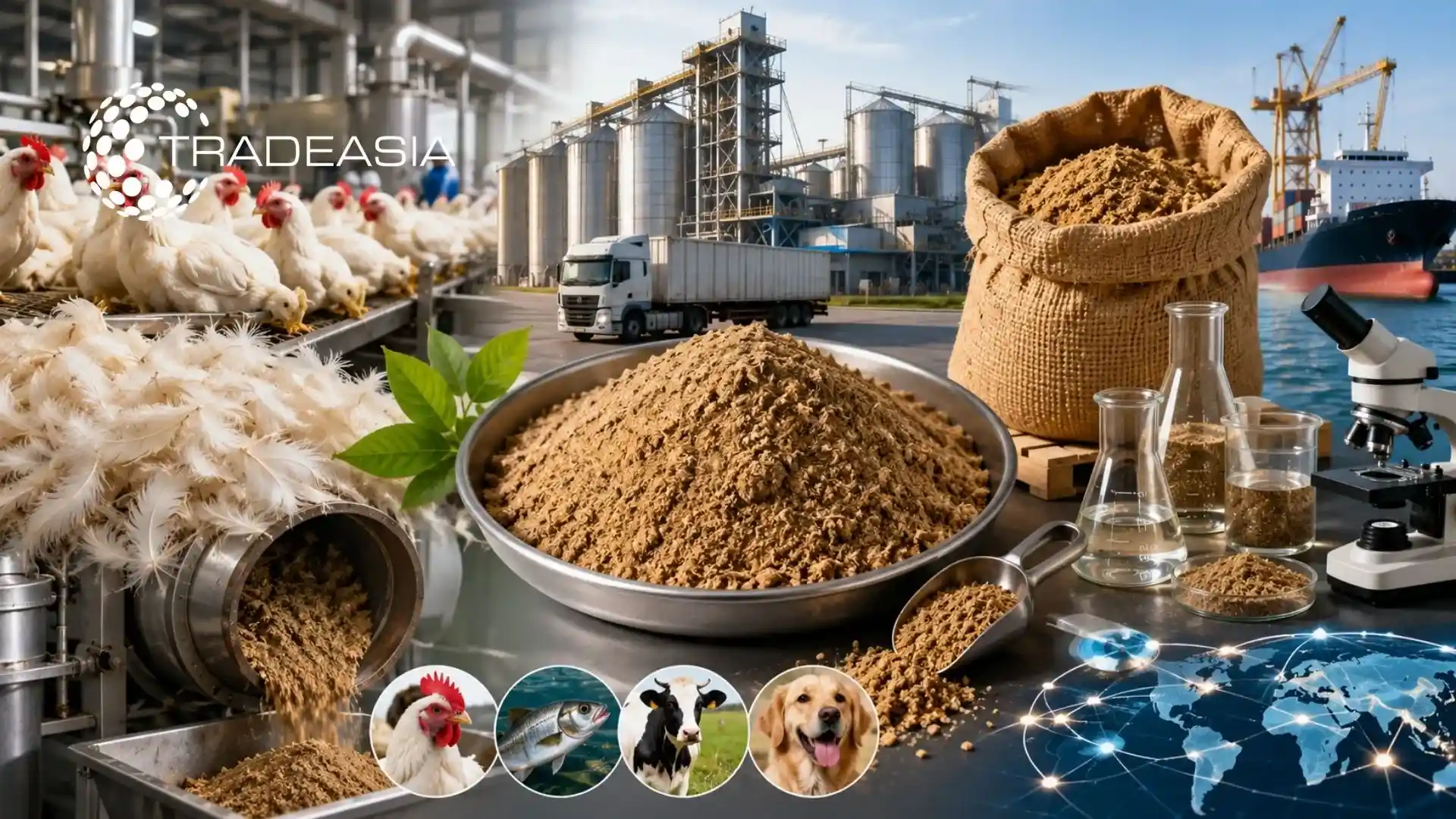
Feather meal is produced by collecting poultry feathers from processing plants and subjecting them to high-temperature, high-pressure hydrolysis followed by drying and grinding. The hydrolysis process breaks down the keratin structure of feathers, improving digestibility and making the protein fraction more accessible to animals. Typical crude protein levels in feather meal range from 75% to 85%, making it one of the most concentrated protein sources available in commercial feed formulation.
However, not all feather meal is identical. Product specifications can vary significantly based on processing parameters, the proportion of other poultry by-products included (such as blood or offal in blended meals), and post-processing handling. Key quality indicators include crude protein content, pepsin digestibility, ash content, moisture level, fat content, and microbiological status. High-quality feather meal intended for monogastric feeds often targets pepsin digestibility above 75%, low residual fat and moisture to reduce rancidity risk, and strict microbial control to meet feed safety standards.
From a functional standpoint, feather meal provides a dense source of amino acids, particularly cystine and other sulfur-containing amino acids, although it is relatively low in certain essential amino acids such as lysine and methionine. As a result, it is commonly used in combination with other protein sources and synthetic amino acids to achieve balanced nutrient profiles. By 2026, buyers are increasingly seeking feather meal products with enhanced digestibility, sometimes achieved through enzymatic treatments or improved hydrolysis technology, as well as standardized grades tailored to specific species and life stages.
The primary application of feather meal feed ingredients is in animal nutrition, particularly in poultry, aquaculture, and pet food formulations. In broiler and layer diets, feather meal can partially replace more expensive protein ingredients, provided that formulations are carefully balanced for amino acid profiles. Aquaculture feeds, especially for certain carnivorous species, may incorporate feather meal as a partial substitute for fishmeal, helping to reduce dependence on marine resources while keeping feed costs under control.
In ruminant nutrition, feather meal can also be used as a bypass protein source, taking advantage of its relatively slow degradability in the rumen and higher digestibility in the lower gastrointestinal tract when properly processed. Pet food manufacturers may use feather meal in certain value-focused formulations, although premium and super-premium segments typically favor other animal proteins. Across all these applications, the inclusion rate of feather meal is usually limited by nutritional balancing, palatability considerations, and regulatory or customer expectations, often ranging from a few percentage points up to around 5–7% in some formulations.
The benefits of feather meal are multifaceted. Economically, it allows feed manufacturers to lower the overall cost of protein in diets, especially in regions where poultry processing by-products are abundant and competitively priced. Nutritionally, it offers high crude protein and specific amino acids that can complement other ingredients. Environmentally, feather meal supports circular-economy objectives by valorizing what would otherwise be waste, reducing landfill use and associated greenhouse gas emissions. As sustainability reporting becomes more rigorous, buyers in 2026 are increasingly factoring these environmental benefits into their procurement decisions, particularly large integrators and multinational feed companies.
Global feather meal buyers encompass a diverse set of stakeholders, from integrated poultry companies and standalone feed mills to aquafeed producers, pet food manufacturers, and specialized traders. Large integrated poultry and livestock companies often secure long-term supply agreements or operate their own rendering facilities, ensuring steady access to by-products. Independent feed mills and regional premix companies may rely more on international traders and distributors, especially when local rendering capacity is limited or inconsistent in quality.
By 2026, buyers are placing greater emphasis on risk management, supply diversification, and digital procurement tools. They are assessing suppliers not only on price but also on quality assurance systems, certification status (such as ISO, HACCP, GMP+), and the ability to provide consistent documentation, including product specifications, certificates of analysis, and safety data sheets. Logistics reliability is equally important, as disruptions in shipping or port operations can have immediate impacts on feed production schedules. Buyers are increasingly using multi-sourcing strategies, combining domestic and imported feather meal to balance cost and security of supply.
In this evolving landscape, platforms like chemtradeasia play a pivotal role. As a global chemicals and feed ingredients trading platform, chemtradeasia connects feather meal producers—often rendering plants and integrated poultry processors in Asia, the Americas, and Europe—with buyers around the world. The platform facilitates transparent communication of product specifications, pricing, and availability, and can help coordinate logistics, documentation, and quality checks. For buyers, working through chemtradeasia offers access to a curated network of suppliers, competitive offers, and market insights on pricing trends, regulatory developments, and demand shifts, helping them make more informed sourcing decisions.
As the global feed industry approaches 2026, feather meal is set to remain an important component of the protein ingredient portfolio, particularly for cost-sensitive and sustainability-focused buyers. Its high protein content, circular-economy credentials, and broad applicability across poultry, aquaculture, ruminant, and certain pet food formulations make it attractive to a wide range of feed manufacturers. However, successful utilization of feather meal requires attention to product quality, digestibility, and formulation balance, as well as careful alignment with regulatory and customer expectations.
For feather meal buyers, the coming years will likely bring increased scrutiny of supply chains, greater emphasis on traceability and certification, and more sophisticated risk management practices. Engaging with reliable partners and platforms such as chemtradeasia can help buyers navigate these complexities, access multiple sourcing options, and stay informed about evolving market conditions. By integrating technical knowledge, market intelligence, and robust procurement processes, stakeholders across the value chain can unlock the full potential of feather meal feed ingredients in a rapidly changing global market.
This article is intended solely for informational and market insight purposes and does not constitute technical, safety, or professional advice; readers should independently verify all information with qualified experts, consult official documentation such as MSDS/SDS, or contact our team for guidance on specific products and applications.
We're committed to your privacy. Tradeasia uses the information you provide to us to contact you about our relevant content, products, and services. For more information, check out our privacy policy.


 English
 Indonesian
 简体字
简体字
 العربية
 Español
 Français
 Português
 日本語
日本語
 한국어
한국어
 Tiếng Việt