Explore our network of country and industry based websites to access localized information, product offerings, and business services across our group.
Log in to start sending quotation requests for any product.
Don't have an account? Sign Up Here
Home Industrial Applications and Buyer Demand in the Citrus Pulp Market 2026
Trade Insights | Applications and Buyers | 25 May 2026
Introduction to the Citrus Pulp Market
Industrial Feed Applications Driving Global Demand
Buyer Segments and Procurement Trends in 2026
Regional Supply Expansion and Price Developments
Sustainability and Future Commercial Opportunities
Conclusion
Sources
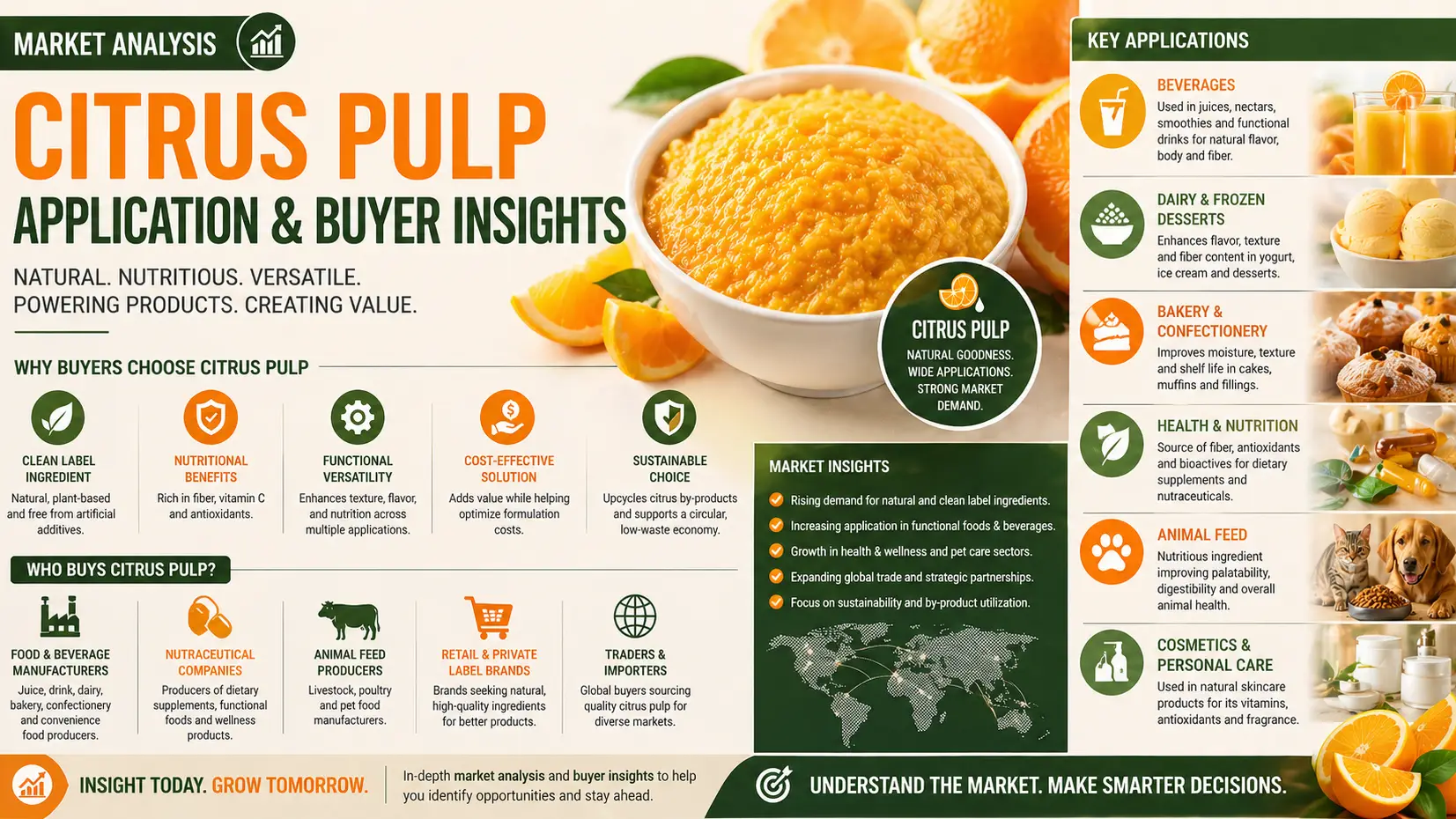
In 2026, the global market for Citrus Pulp continues to expand as livestock producers and agricultural processors seek cost-efficient and sustainable feed ingredients. Derived primarily from orange and citrus juice processing residues, citrus pulp has become a valuable platform commodity within the global feed industry due to its high digestible fiber content, energy efficiency, and growing availability from large-scale citrus processing operations.
The global citrus pulp market is projected to grow at a CAGR of 5.4% through 2030, supported by increasing demand from cattle, dairy, and compound feed manufacturers. International market prices in 2026 are averaging between USD 180–320/MT, depending on pellet quality, moisture levels, and export origin. Global production volumes are estimated to exceed 8.7 million metric tons, with Brazil, the United States, and parts of Europe remaining major production hubs.
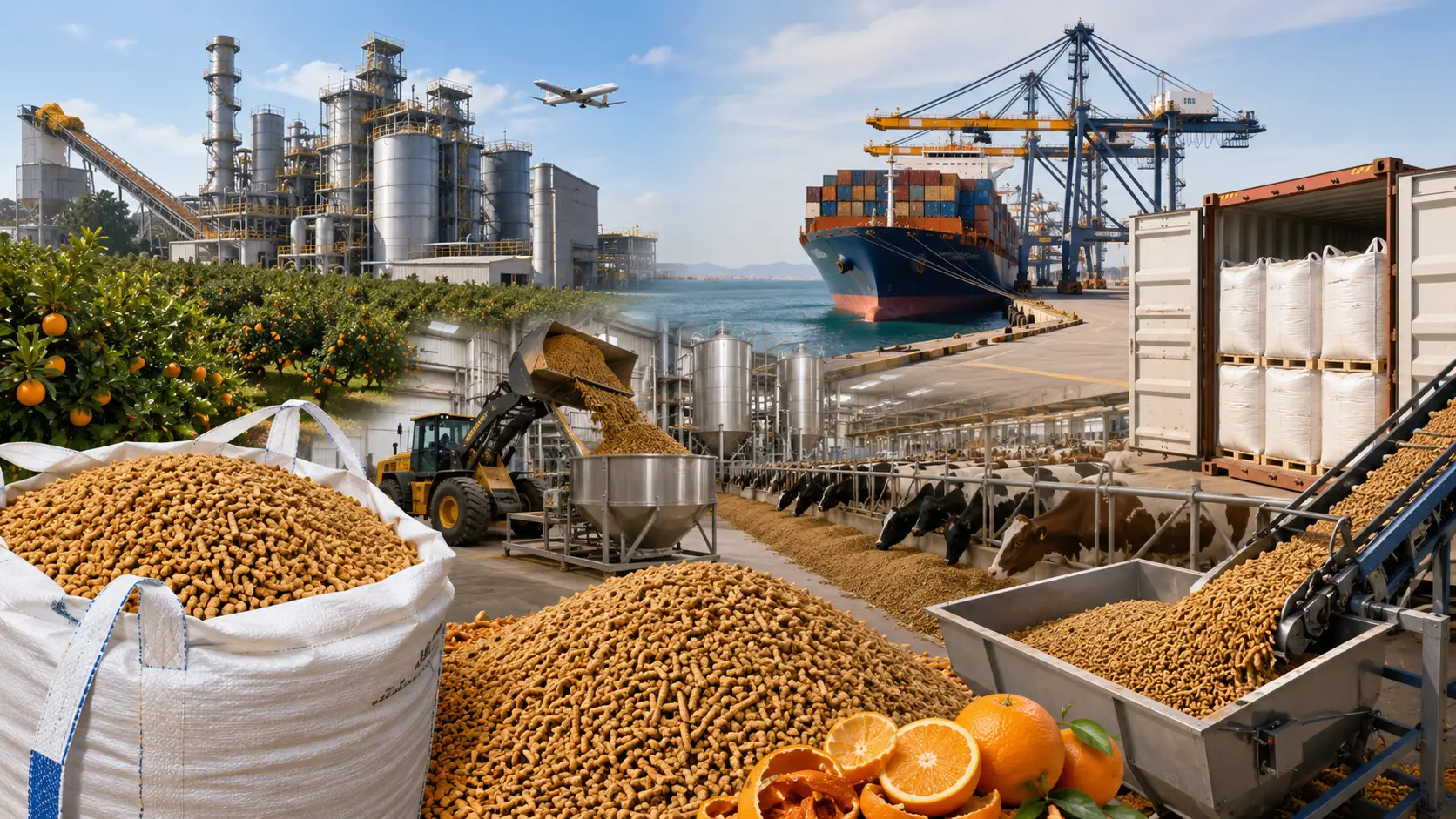
The strongest application growth for citrus pulp remains within industrial livestock feed manufacturing. Feed formulators increasingly use citrus pulp pellets as a partial replacement for corn and beet pulp due to favorable fiber digestibility and competitive pricing. Dairy farms, beef cattle operations, and sheep feed manufacturers are among the largest industrial consumers.
In addition, the aquaculture and pet food industries are beginning to incorporate citrus-derived fiber ingredients into specialized formulations focused on digestive health and sustainable sourcing. By 2026, nearly 68% of total citrus pulp output is directed toward ruminant feed applications, particularly in regions facing rising grain costs and feed supply volatility.
Industrial buyers in the citrus pulp market are becoming increasingly strategic in procurement planning. Large multinational feed manufacturers are prioritizing long-term supplier agreements to stabilize costs and secure consistent shipment volumes. Importers across Asia and the Middle East are also expanding purchases due to growing livestock production and feed demand.
Procurement decisions are now influenced not only by price but also by pellet consistency, transportation efficiency, and sustainability certifications. During the first half of 2026, export-grade citrus pulp pellet prices fluctuated between USD 210–295/MT, largely impacted by freight rates and citrus harvest conditions in South America.
Brazil continues to dominate global citrus pulp exports, accounting for approximately 42% of international supply volumes in 2026. The country’s extensive orange juice processing sector provides stable raw material availability, allowing exporters to maintain competitive pricing in international markets.
Meanwhile, Europe remains a strong consumption region due to advanced dairy farming operations and increasing pressure to adopt circular agricultural practices. Southeast Asia is also emerging as a high-growth import market as feed producers seek alternative fiber ingredients amid fluctuating grain markets and climate-related agricultural disruptions.
Sustainability has become a central growth driver in the citrus pulp industry. Feed manufacturers increasingly view citrus pulp as a circular-economy ingredient because it converts agricultural by-products into commercially valuable livestock nutrition products. This aligns with global sustainability targets aimed at reducing food processing waste and improving agricultural resource efficiency.
Technology investments in drying systems, pellet stabilization, and logistics optimization are also improving product quality and expanding export capabilities. Analysts expect sustainable feed ingredient demand to continue strengthening long-term market prospects for citrus pulp producers and exporters worldwide.
The 2026 citrus pulp market reflects the growing importance of sustainable and cost-effective feed ingredients within modern agricultural supply chains. Rising livestock production, expanding buyer diversification, and stronger emphasis on circular economy practices continue to support global market growth for citrus pulp across industrial feed sectors.
As international demand evolves, Tradeasia International supports global buyers with integrated sourcing solutions, reliable supply partnerships, and efficient distribution networks designed to meet the changing requirements of industrial feed and agricultural industries.
We're committed to your privacy. Tradeasia uses the information you provide to us to contact you about our relevant content, products, and services. For more information, check out our privacy policy.


 English
 Indonesian
 简体字
简体字
 العربية
 Español
 Français
 Português
 日本語
日本語
 한국어
한국어
 Tiếng Việt