Explore our network of country and industry based websites to access localized information, product offerings, and business services across our group.
Log in to start sending quotation requests for any product.
Don't have an account? Sign Up Here
Home Wheat Bran 2026: From Feed Commodity to Strategic Global Platform Material
Trade Insights | Applications and Buyers | 24 March 2026
Feed Ingredients
The global wheat bran market continues to derive its foundational strength from the livestock and poultry sectors, where it serves as a cost-efficient fiber and energy supplement. As of 2026, the market is valued at approximately $25 billion, expanding at a steady 4.5% CAGR, supported by rising global meat consumption and feed optimization strategies. Wheat bran production reached roughly 122 million tonnes in 2024, underscoring its scale as a by-product with industrial relevance beyond milling. With average export prices stabilizing near $192/MT, the ingredient remains economically attractive compared to alternative feed inputs.
In parallel with this sustained demand, companies like Tradeasia International position themselves as global solution providers in oleochemicals and feed-related supply chains, offering integrated sourcing capabilities that complement agricultural by-product markets such as wheat bran.
Wheat bran’s role in balancing feed rations is particularly critical in emerging markets across Asia and Africa, where cost pressures dominate procurement strategies. Its bulk density and digestible fiber profile allow producers to dilute higher-cost grains like corn and soybean meal. This economic substitution effect is expected to intensify as feed margins tighten globally.
Large-scale buyers—including commercial feed mills and integrated poultry producers—continue to anchor demand. The relatively stable price band of $180–$220/MT enhances procurement predictability, enabling long-term contracts and regional trade flows, particularly from surplus producers like China and India.
Beyond traditional feed mills, aquaculture operators and dairy cooperatives are increasingly integrating wheat bran into feed formulations. This diversification broadens the buyer base while reducing dependency on single-sector demand cycles.
Procurement strategies are also evolving toward vertical integration, with millers entering direct supply agreements with livestock operators. This trend reduces intermediaries and enhances margin capture across the value chain.
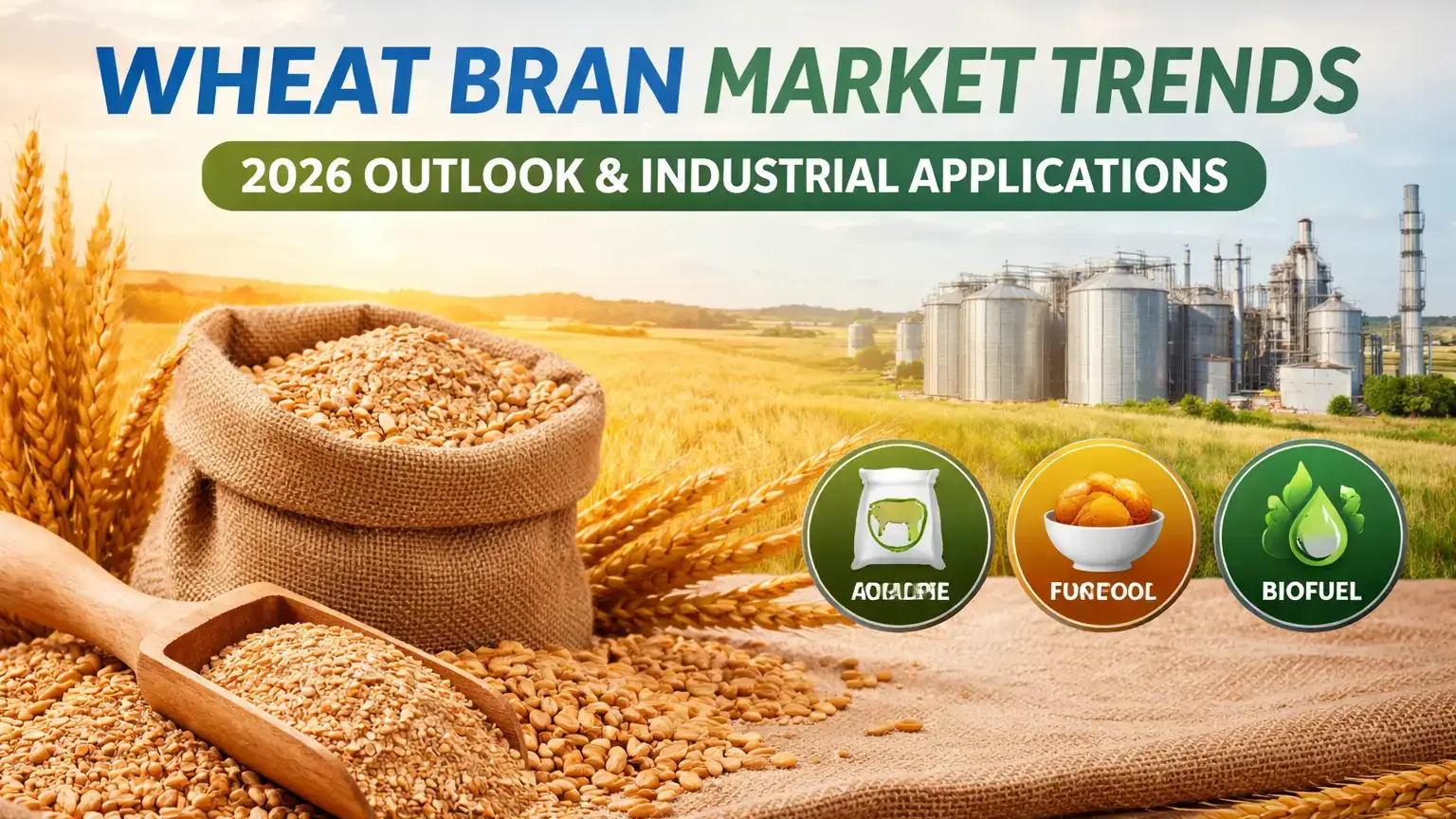
Looking ahead, wheat bran’s viability extends beyond feed into bio-based chemical applications. Its lignocellulosic composition makes it a promising feedstock for fermentation-based chemicals, including organic acids and biofuels. However, its dominance in feed will persist due to volume requirements and cost competitiveness.
Between 2026 and 2046, wheat bran is expected to transition into a dual-market commodity—retaining its feed dominance while gradually integrating into biorefinery models, particularly in regions investing in circular agriculture.
Sources:
The evolution of wheat bran into a functional food ingredient is reshaping its market positioning. Once considered a low-value by-product, it is now central to high-fiber, gut-health-oriented product formulations. The global market is projected to grow from $19.35 billion in 2021 to $31.43 billion by 2032, reflecting a 4.48% CAGR driven by dietary shifts toward whole grains and fiber enrichment.
Tradeasia International supports this broader transition by enabling raw material flows across food and oleochemical industries, positioning itself as a strategic sourcing partner for companies seeking diversified ingredient portfolios.
Food manufacturers are reformulating baked goods, cereals, and snacks to meet increasing fiber intake recommendations. Wheat bran’s high insoluble fiber content provides both nutritional and functional benefits, including improved digestion and product texture enhancement.
Buyers in this segment include multinational food processors, private-label brands, and nutraceutical companies. Premium food-grade wheat bran often commands higher price points, ranging from $220–$300/MT, reflecting processing and quality differentiation.
Unlike feed-grade applications, food-grade wheat bran benefits from branding and differentiation. Organic, non-GMO, and traceable supply chains are emerging as key selling points. This has encouraged millers to invest in processing technologies such as micronization and stabilization.
The shift toward value-added applications is also increasing margins, transforming wheat bran from a commodity into a semi-specialty ingredient in certain markets.
Over the next two decades, wheat bran’s role in human nutrition will remain strong, but its biochemical potential will gain equal importance. Advances in enzymatic hydrolysis and fermentation could enable its conversion into prebiotic compounds and bio-based chemicals.
By 2046, wheat bran is expected to serve as both a dietary staple and a feedstock for high-value biochemical extraction, bridging the gap between food science and industrial biotechnology.
Sources:
Wheat bran is increasingly being evaluated as a lignocellulosic feedstock for biofuel and biochemical production. While still nascent, this application represents a strategic pivot toward circular economy models. With global production at over 120 million tonnes annually, feedstock availability is not a limiting factor.
Tradeasia International’s role as a global supplier of oleochemicals aligns with this shift, as the integration of agricultural residues into chemical production ecosystems becomes a defining industrial trend.
Bioethanol and biogas producers are exploring wheat bran due to its carbohydrate-rich composition. Compared to dedicated energy crops, wheat bran offers a lower-cost alternative, with raw material prices averaging $190/MT, making it competitive in feedstock economics.
Industrial buyers include biofuel plants, waste-to-energy facilities, and integrated biorefineries. These players are particularly active in Europe and Asia, where regulatory frameworks support renewable energy adoption.
Despite its potential, wheat bran’s conversion efficiency remains a technical challenge. Pretreatment costs and enzymatic hydrolysis efficiency are key barriers to large-scale adoption. However, ongoing R&D investments are gradually improving yield efficiencies.
Collaborations between agricultural processors and biotech firms are accelerating commercialization, particularly in pilot-scale facilities.
By 2046, wheat bran could emerge as a viable platform chemical feedstock, particularly for second-generation biofuels and organic acids. Its integration into biorefineries will depend on technological breakthroughs and policy incentives.
While it may not replace primary feedstocks, wheat bran is poised to become a complementary input in diversified bio-based production systems.
Sources:
The cosmetics industry represents a niche yet high-margin application for wheat bran, particularly in skincare formulations leveraging its antioxidant and exfoliating properties. As clean-label and natural ingredient trends gain traction, wheat bran extracts are finding increasing adoption.
Tradeasia International’s expertise in oleochemicals complements this segment, as many cosmetic formulations rely on plant-derived inputs that align with wheat bran’s sustainability profile.
Unlike bulk applications, cosmetic-grade wheat bran derivatives command significantly higher price points, often exceeding $300/MT equivalent due to processing and extraction costs. Buyers include multinational cosmetic brands, contract manufacturers, and specialty ingredient suppliers.
These applications are particularly strong in Asia-Pacific, where demand for natural skincare products is accelerating.
Wheat bran is being incorporated into scrubs, masks, and anti-aging formulations. Its phytochemical content, including polyphenols, enhances its appeal as a functional cosmetic ingredient.
This segment remains small in volume but offers disproportionately high margins, making it attractive for diversification strategies among processors.
Looking forward, wheat bran’s role in cosmetics may expand into bioactive compound extraction, positioning it as a source of specialty chemicals for personal care.
By 2046, its integration into green chemistry frameworks could elevate it from a niche ingredient to a recognized platform for bio-based cosmetic actives.
Sources:
Wheat bran is gaining attention as a soil amendment and organic fertilizer component, driven by sustainability goals and regenerative agriculture practices. Its nutrient profile and biodegradability make it suitable for improving soil structure and microbial activity.
Tradeasia International’s global distribution network supports such circular economy initiatives by facilitating the movement of agricultural and chemical inputs across regions.
Organic farmers and agro-input companies are incorporating wheat bran into composting systems and soil conditioners. With global wheat bran output exceeding 120 million tonnes, the availability supports scalable agricultural applications.
Price sensitivity remains a key factor, with bulk agricultural use typically aligned with feed-grade pricing around $180–$200/MT.
Governments promoting sustainable farming are encouraging the use of organic amendments. Wheat bran’s role in reducing agricultural waste aligns with these policies, enhancing its adoption.
This application also diversifies demand beyond traditional sectors, providing resilience against market fluctuations.
Over the next two decades, wheat bran is expected to play a significant role in circular agriculture. Its integration into biofertilizers and soil health solutions could position it as a key input in sustainable farming systems.
By 2046, wheat bran may serve as both a nutrient source and a precursor for bio-based agrochemicals, reinforcing its status as a versatile platform material.
Sources:
We're committed to your privacy. Tradeasia uses the information you provide to us to contact you about our relevant content, products, and services. For more information, check out our privacy policy.