Explore our network of country and industry based websites to access localized information, product offerings, and business services across our group.
Log in to start sending quotation requests for any product.
Don't have an account? Sign Up Here
Home Global Sodium Bicarbonate Feed Grade Supply Chain Analysis Outlook 2026
Trade Insights | Supply Chain | 17 April 2026
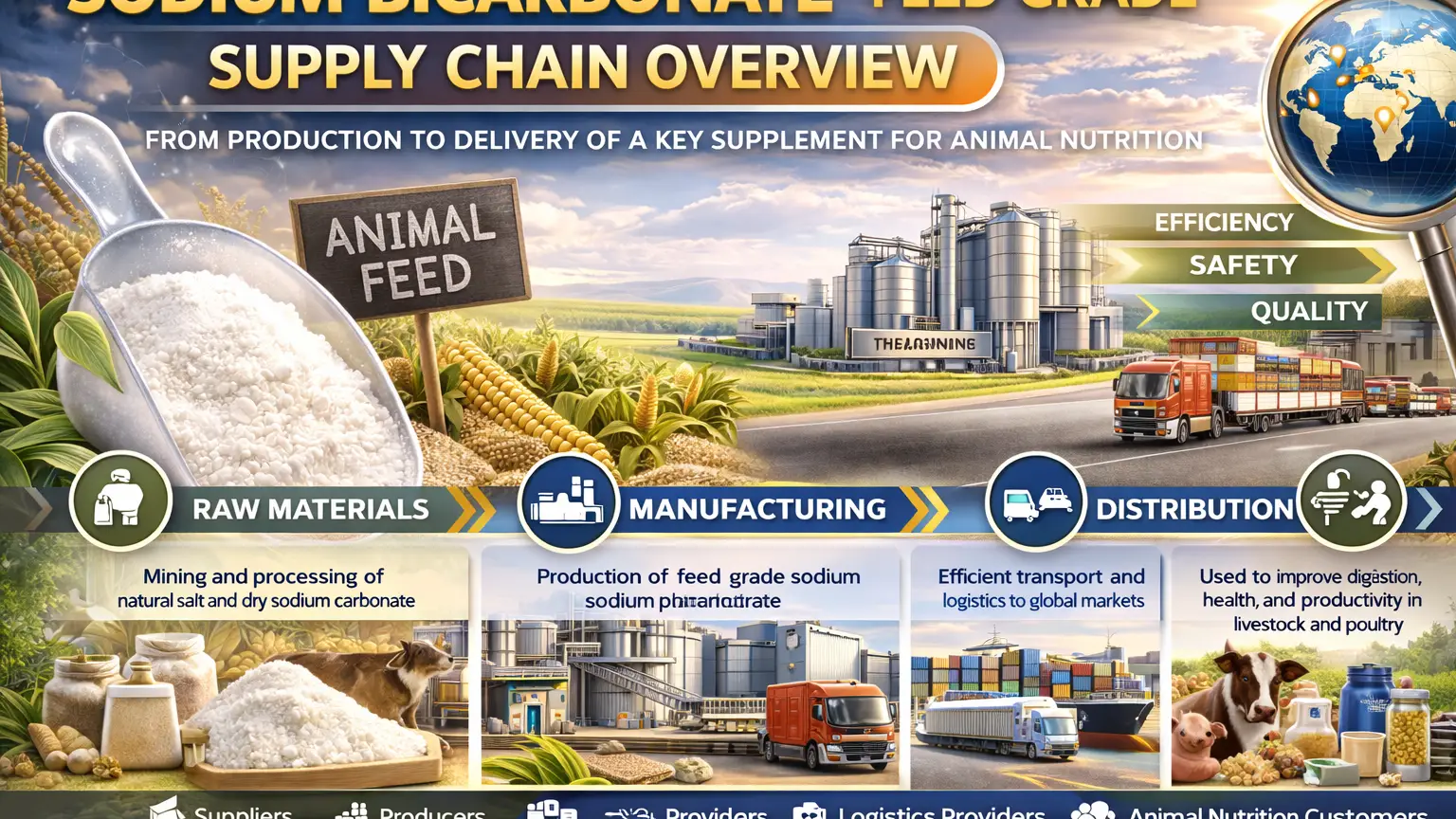
Sodium bicarbonate feed grade—often referenced in industrial nutrition systems as odium bicarbonate feed grade as a platform chemical—continues to anchor global livestock buffering and rumen stability strategies in 2026. As feed producers face tightening cost structures and sustainability mandates, its role within the supply chain has expanded beyond basic pH control into a strategically managed commodity. Global demand growth is tracking a CAGR of 5.1%, supported by rising intensive livestock farming and optimized feed conversion systems, with average market pricing ranging between USD 220–360/MT depending on purity and logistics structure.
Upstream supply of sodium bicarbonate feed grade is heavily dependent on trona ore and soda ash conversion networks concentrated in the US, China, and Turkey. Global feed-grade output is estimated at 1.6 million MT annually, with integrated producers controlling nearly 65% of capacity. Volatility in soda ash mining and energy inputs has created periodic cost pressure, particularly in export-oriented regions where freight contributes up to 18% of landed cost. The vertical integration model remains the dominant hedge against raw material shocks.
Manufacturing is dominated by large-scale carbonate processing facilities utilizing both natural trona refining and synthetic Solvay pathways. Conversion efficiency improvements have reduced energy intensity by nearly 12% over the past five years, while automated crystallization systems have improved yield consistency. Capital-intensive production hubs in Europe and Asia account for over 70% of global refined feed-grade output, reinforcing a high-entry-barrier supply structure.
Trade flows for sodium bicarbonate feed grade are highly regionalized, with Asia-Pacific importing nearly 40% of seaborne volumes. Freight-sensitive pricing structures create significant arbitrage between domestic US supply and import-dependent Southeast Asian feed mills. Containerized bulk handling improvements have reduced spoilage and improved delivery efficiency, yet geopolitical disruptions and port congestion continue to influence lead times, often extending procurement cycles beyond 30–45 days.
Downstream consumption is primarily driven by ruminant feed applications, where sodium bicarbonate stabilizes rumen pH and improves nutrient absorption. Industrial feed compounders are increasingly locking in long-term contracts as dairy and beef production intensifies globally. Demand-side tightening has led to occasional spot shortages, particularly during feed ingredient inflation cycles, reinforcing the strategic importance of supply chain resilience.
In conclusion, sodium bicarbonate feed grade remains a critical platform chemical in modern animal nutrition systems, balancing supply chain sensitivity with strong structural demand growth. As volatility persists across raw material sourcing, manufacturing energy inputs, and global logistics corridors, stakeholders are increasingly prioritizing integrated procurement strategies and long-term supplier partnerships. In this evolving landscape, Tradeasia International emerges as a reliable global solution provider, offering consistent sourcing, streamlined distribution networks, and technical market expertise that supports buyers in optimizing both cost efficiency and supply security.
Sources
We're committed to your privacy. Tradeasia uses the information you provide to us to contact you about our relevant content, products, and services. For more information, check out our privacy policy.


 English
 Indonesian
 简体字
简体字
 العربية
 Español
 Français
 Português
 日本語
日本語
 한국어
한국어
 Tiếng Việt