Explore our network of country and industry based websites to access localized information, product offerings, and business services across our group.
Log in to start sending quotation requests for any product.
Don't have an account? Sign Up Here
Home Manganese Carbonate Supply Chain Outlook 2026: Trade, Production & Risks
Trade Insights | Supply Chain | 27 April 2026
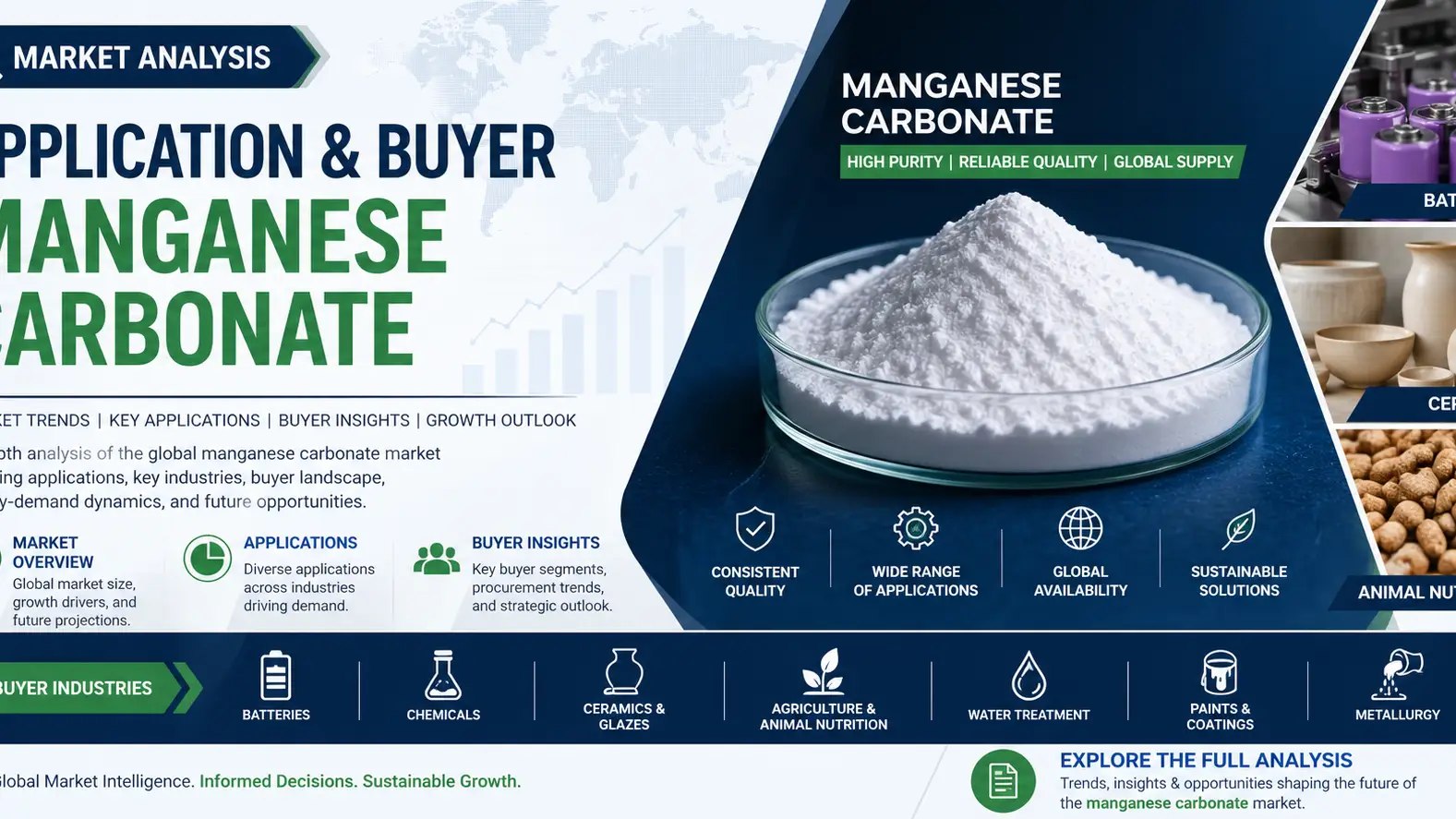
Manganese carbonate (MnCO3) continues to serve as a strategic platform chemical in metallurgy, battery precursor processing, and micronutrient agriculture in 2026. The global supply chain is shaped by constrained ore beneficiation capacity and tightening environmental controls across Asia-Pacific and Africa. Market expansion is steady, with demand tracking a CAGR of 4.9% (2023–2026). Average contract pricing has stabilized between USD 420–680/MT, depending on purity and particle specification, while global effective production volumes are estimated at 1.3 million MT annually.
The manganese carbonate supply chain begins with manganese ore extraction, concentrated in South Africa, Gabon, Australia, and China. Ore is upgraded through leaching and precipitation to produce refined MnCO3, heavily dependent on reagent availability and energy intensity. Trade flows are dominated by Asia-Pacific processors, where integrated chemical hubs reduce conversion costs. Disruptions in mining output or sulfur-based reagents immediately tighten downstream availability, amplifying price volatility across import-dependent regions.
China remains the largest manganese carbonate producer, accounting for over 45% of global output, followed by selective capacity in India and Europe. Smaller-scale facilities in Africa are expanding but remain export-oriented due to limited downstream industries. Production efficiency is increasingly tied to automation and wastewater treatment compliance, with newer plants reducing unit conversion costs by up to 12% compared to legacy operations, improving global competitiveness.
Global manganese carbonate trade is heavily influenced by bulk chemical shipping routes from Asia to Europe and North America. Freight volatility has added 8–15% cost variability to landed prices in 2026. Spot pricing remains in the USD 420–680/MT band, with higher purity grades used in battery precursors commanding premiums. Importers are increasingly adopting long-term contracts to hedge against port congestion and currency-driven cost fluctuations.
Demand growth is anchored in fertilizer micronutrients, steel alloy processing, and emerging battery cathode intermediates. Environmental regulations in China and the EU are tightening wastewater discharge norms, increasing compliance costs and reducing marginal supply. Meanwhile, geopolitical concentration of ore reserves introduces supply insecurity, pushing buyers toward diversified sourcing strategies. These pressures are reinforcing the importance of vertically integrated suppliers capable of stabilizing long-term availability.
Manganese carbonate remains a foundational platform chemical supporting industrial metallurgy, agriculture, and next-generation energy materials. As supply chains grow more complex in 2026, resilience, compliance, and cost efficiency define competitive advantage. Buyers increasingly seek partners capable of ensuring stable procurement and technical-grade consistency. In this context, Tradeasia International offers integrated sourcing and global distribution solutions, helping industries secure reliable manganese carbonate supply while optimizing logistics across key international markets.
Sources
We're committed to your privacy. Tradeasia uses the information you provide to us to contact you about our relevant content, products, and services. For more information, check out our privacy policy.


 English
 Indonesian
 简体字
简体字
 العربية
 Español
 Français
 Português
 日本語
日本語
 한국어
한국어
 Tiếng Việt