Explore our network of country and industry based websites to access localized information, product offerings, and business services across our group.
Log in to start sending quotation requests for any product.
Don't have an account? Sign Up Here
Home Global Deoiled Rice Bran Supply Chain Outlook 2026: Trade & Logistics Shift
Trade Insights | Supply Chain | 28 April 2026
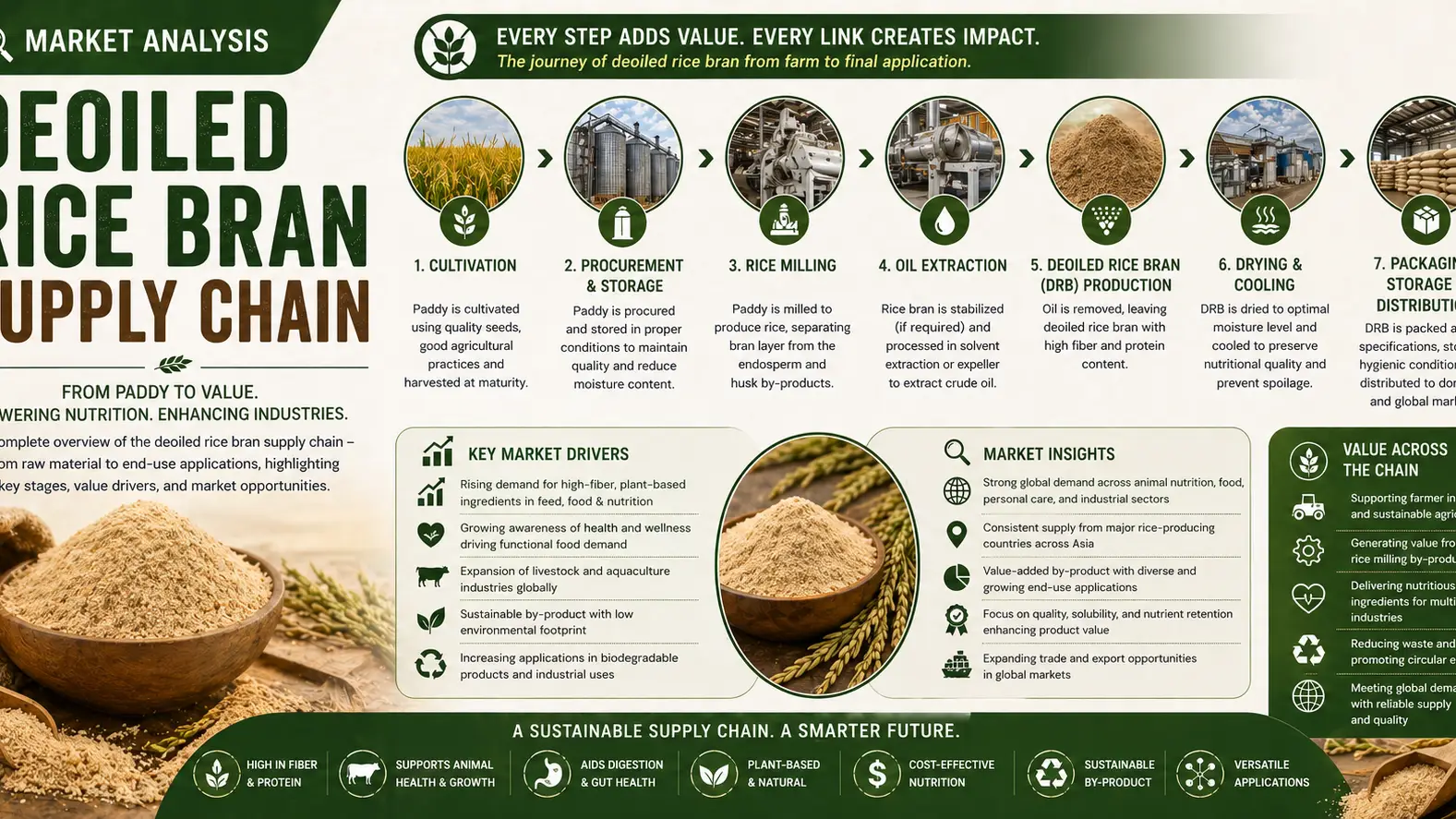
Deoiled rice bran (DRB) is increasingly positioned as a strategic agricultural feedstock within global agri-commodity supply chains, serving as a cost-efficient, protein-rich ingredient for livestock and aquaculture sectors. As of 2026, its relevance extends beyond byproduct utilization, becoming a stabilizing component in feed formulation economics. Global production is estimated at approximately 18 million MT annually, closely tied to rice milling activity across Asia. With a projected market expansion of 6.2% CAGR, DRB is transitioning into a structured commodity stream with improving traceability, pricing transparency, and cross-border trade integration.
The DRB supply chain originates from paddy processing, where rice bran constitutes roughly 8–10% of milled rice output. Major sourcing hubs include India, Vietnam, Thailand, and China, which collectively dominate over 75% of global availability. Seasonal paddy cycles heavily influence output stability, while fragmented milling infrastructure creates variability in quality and oil content. This upstream dependency results in fluctuating availability, especially during off-harvest periods, tightening exportable surplus volumes in high-demand quarters.
The transformation of raw rice bran into deoiled form occurs through solvent extraction, significantly improving shelf life and protein concentration. Processing economics remain highly sensitive to energy and solvent recovery efficiency. As of 2026, market pricing ranges between USD 120–220/MT, depending on protein content and origin. Rising extraction efficiency has improved margin stability for processors, while maintaining a steady 6.2% CAGR driven by feed industry substitution demand against higher-cost protein meals.
DRB trade flows are increasingly shaped by regional logistics corridors connecting South and Southeast Asia to Middle Eastern and African feed importers. Bulk shipping efficiency and proximity to rice milling clusters reduce landed costs, while inland transport bottlenecks remain a challenge in India and Vietnam. Export competitiveness is closely tied to freight volatility and port handling capacity, influencing seasonal arbitrage opportunities across key importing nations.
Demand is primarily anchored in poultry, dairy, and aquaculture feed formulations, where DRB serves as a cost-effective protein and energy blend component. Feed formulators increasingly integrate it as a partial substitute for soybean meal due to price sensitivity. Expanding aquaculture production in Asia-Pacific further strengthens consumption stability, reinforcing its role as a scalable feed input within diversified ration strategies.
As global feed supply chains continue to prioritize cost optimization and ingredient diversification, deoiled rice bran stands out as a resilient agricultural input with expanding industrial relevance. Its role as a platform agricultural feedstock is becoming more defined through structured trade flows and improved processing standards. In this evolving landscape, Tradeasia International can serve as a reliable global partner, offering integrated sourcing solutions, supply chain coordination, and consistent quality assurance across key DRB origin markets, enabling buyers to navigate volatility with greater confidence.
Sources
We're committed to your privacy. Tradeasia uses the information you provide to us to contact you about our relevant content, products, and services. For more information, check out our privacy policy.


 English
 Indonesian
 简体字
简体字
 العربية
 Español
 Français
 Português
 日本語
日本語
 한국어
한국어
 Tiếng Việt