Explore our network of country and industry based websites to access localized information, product offerings, and business services across our group.
Log in to start sending quotation requests for any product.
Don't have an account? Sign Up Here
Home Bakery Meal Applications in Animal Feed and B2B Sourcing
Trade Insights | Supply Chain | 21 May 2026
Bakery Meal Market Context: Why Feed Buyers Use Former Bakery Products
Bakery Meal Applications in Livestock and Poultry Feed
Nutritional Value: Energy, Palatability, and Feed Formulation Benefits
Supply Chain and Processing: From Bakery By-products to Feed Ingredient
Buyer Intent: Who Buys Bakery Meal and What They Evaluate
Sourcing Strategy for B2B Bakery Meal Buyers
Commercial Positioning: Why Bakery Meal Fits Feed Marketplace Demand
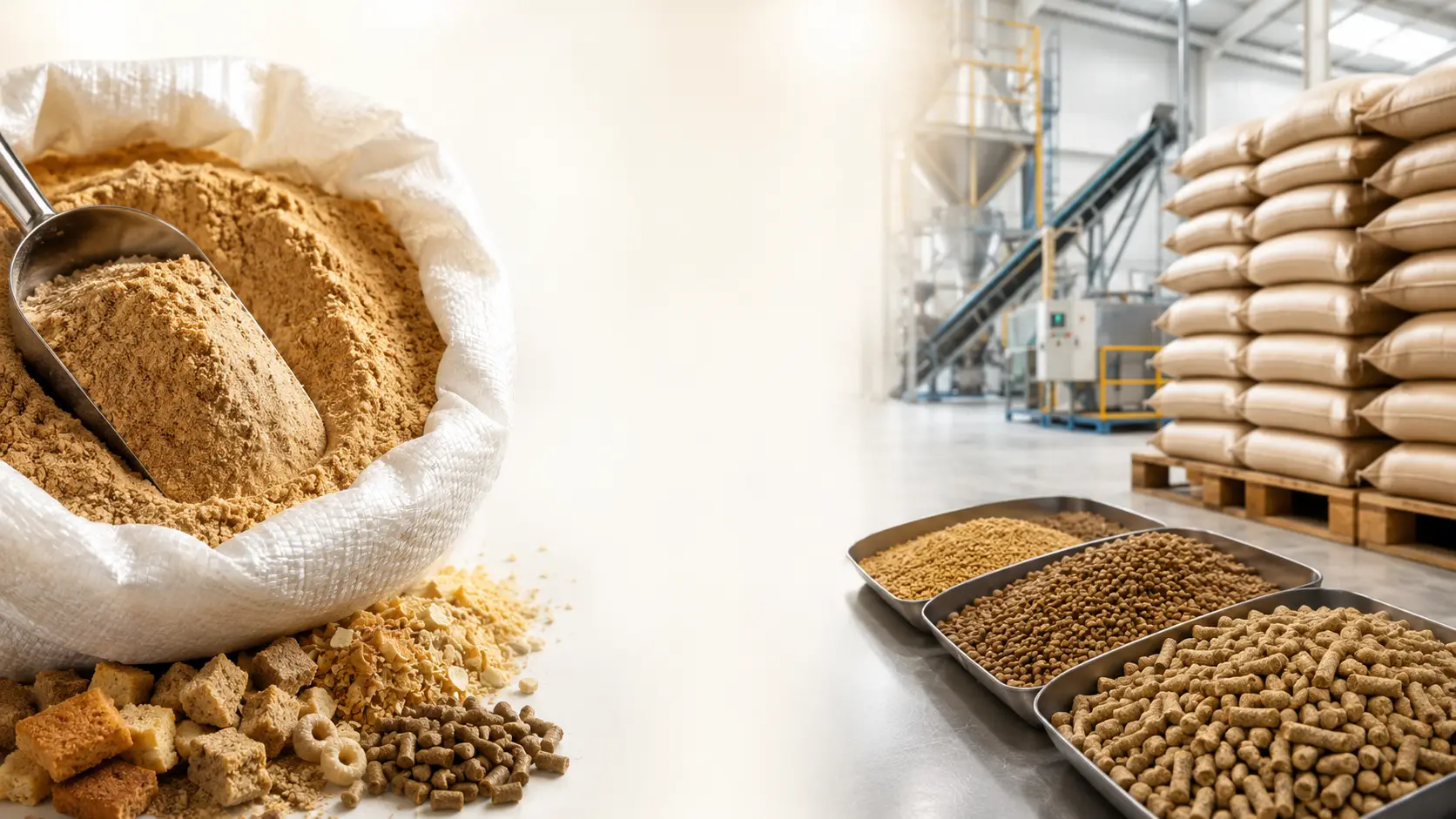
Bakery Meal sits in a commercially important feed category because it converts former bakery products into a usable energy source for compound feed and livestock diets. Feed Ingredients Asia describes Bakery Meal as a dried bakery by-product made from materials such as bread, chips, crackers, cookies, cereals, and other baked goods no longer intended for human consumption, with use in poultry, pigs, and livestock feed.
According to the European Former Foodstuff Processors Association, former foodstuffs include food manufactured for human consumption but no longer intended for the human market due to practical, logistical, manufacturing, or packaging reasons, while still presenting no health risk when used as feed. This definition fits the commercial logic behind Bakery Meal because bakery manufacturers often generate off-spec bread, biscuits, cereals, pasta, and snack products that retain feed value even when they lose retail value.
The market relevance is strongest where feed buyers need cost-effective energy ingredients that can partly support or substitute grain-based energy sources. Bakery Meal is not positioned as a protein concentrate; it is primarily valued for carbohydrates, fat, palatability, and dry-matter energy contribution. For feed mills, that makes Bakery Meal useful when corn, wheat, or other cereal inputs become expensive or when buyers want a diversified ingredient basket.
The best SEO and commercial angle is therefore application-driven sourcing. Buyers searching for Bakery Meal usually want to understand where it fits in feed formulation, which species can use it, what specifications matter, and how to source consistent supply. That makes the product suitable for a B2B marketplace article that connects feed nutrition, circular-resource use, supplier comparison, and RFQ intent.
Bakery Meal applications are concentrated in feed systems that can use digestible energy from starch, sugars, and fats. The product page identifies Bakery Meal as commonly used in poultry and pig feeding, while also noting its role as an alternative grain ingredient for many kinds of livestock.
For poultry feed, Bakery Meal can support energy density and palatability when included within a balanced ration. Poultry producers are highly sensitive to feed cost because energy ingredients form a major part of broiler and layer diets, so an energy-rich bakery by-product can be commercially useful when properly specified and quality-controlled. The ingredient is especially relevant to feed mills that formulate multiple rations and need practical alternatives to conventional cereal grains.
For pig feed, Bakery Meal is particularly relevant because processed former foodstuffs can provide energy from starch, sugars, oils, and fats. EFFPA notes that compound feed manufacturers can incorporate processed former foodstuffs to meet energy requirements in certain diets, particularly piglet diets, and cites research describing processed former foodstuffs as comparable in starch content and generally higher in fat than common cereal grains.
For dairy and beef cattle, Bakery Meal may be used as an energy feed ingredient when nutritionists account for moisture, salt, fat, sugar, and inclusion limits. Ruminant buyers usually evaluate it differently from pig or poultry buyers because rumen function, fiber balance, and ration consistency matter. In practical sourcing terms, the product is most attractive when the buyer can match supply quality with species-specific formulation needs.
Bakery Meal matters commercially because its value is tied to energy, not just low-cost by-product availability. Feed Ingredients Asia lists Bakery Meal as rich in fat at about 7% to 10% and carbohydrates at about 55% to 62% dry matter starch plus sugars, while also noting potential salt content and the benefits of high energy, nutrient value, and palatability.
According to EFFPA’s animal nutrition information, former foodstuffs such as bread, biscuits, breakfast cereals, chocolate bars, and crisps are high in energy in the form of sugar, starch, oil, or fat. EFFPA also notes that former foodstuffs may be nutritionally equivalent to barley and wheat in typical pig feed formulation on an 88% dry matter basis, while offering higher crude fat and high metabolizable energy.
This nutritional profile explains why Bakery Meal is often evaluated as a bakery meal energy source rather than a standalone feed solution. It can support energy density, improve palatability, and help feed manufacturers manage formula cost, but it still needs balancing with protein meals, fiber sources, minerals, vitamins, amino acids, and species-specific additives. Buyers should therefore assess Bakery Meal as part of a complete feed strategy, not as a one-to-one replacement for every cereal ingredient.
The key quality variables are moisture, fat level, salt level, particle size, packaging removal quality, sugar content, and storage stability. Because the product can contain diverse bakery streams, procurement teams need consistent specifications and supplier discipline. A buyer sourcing Bakery Meal for poultry, pigs, or livestock feed should prioritize repeatability because formula inconsistency can affect feed intake, pellet quality, and nutritional performance.
Bakery Meal supply depends on the collection and controlled processing of bakery by-products from food manufacturing, retail, or surplus streams. Feed Ingredients Asia describes a manufacturing process that includes depackaging through a separator, shredding, drying to about 90% dry matter for better storage, and other possible processes such as ensiling, extrusion, pelletization, or silage to improve preservation and storage.
EPA’s Wasted Food Scale states that using wasted food as animal feed can displace production of traditional feed such as soy, corn, or barley, and that turning wasted food into animal feed often requires processing such as cooking, rendering, or drying. This supports Bakery Meal’s commercial logic because the feed value is created not only by collecting former bakery materials but also by converting them into a stable, usable feed ingredient.
Feed safety is the central operational requirement. EFFPA states that former foodstuff processors need to ensure safety and traceability, and that former foodstuffs are commonly incorporated into compound feed by feed manufacturers. Its feed safety guidance also emphasizes requirements such as HACCP, traceability, feed labeling, and compliance with undesirable-substance controls under EU feed rules.
For a B2B buyer, the supply chain question is practical: can the supplier deliver Bakery Meal with consistent composition, clean depackaging, appropriate moisture control, and reliable documentation? The answer determines whether the product can move from opportunistic spot buying into regular feed formulation. This is where a marketplace product page helps buyers compare origin, appearance, packaging, category, application, and technical documents before starting an RFQ.
Bakery Meal buyers are usually feed mills, compound feed manufacturers, livestock integrators, poultry feed producers, pig feed producers, dairy farms, beef cattle operators, feed ingredient distributors, and traders serving regional feed markets. The product’s buyer intent is commercial because users are typically searching for supply, specification, packaging, pricing, and application suitability rather than a basic definition.
According to EFFPA, former foodstuff processors buy former foodstuffs from food business operators when safety and traceability can be legally guaranteed, then deliver the processed end-product, traditionally called biscuit meal, to compound feed manufacturers and sometimes directly to livestock farmers. This directly maps to Bakery Meal buyer intent because the commercial chain depends on traceable former food inputs, processing control, and feed-manufacturer acceptance.
Procurement teams evaluate Bakery Meal by dry matter, fat, starch, sugar, salt, moisture, packaging type, origin, particle consistency, storage condition, and suitability for target species. They also compare suppliers because bakery by-product streams can vary by source, and variation affects formula accuracy. A feed mill that formulates for poultry may prioritize energy and flowability, while a pig feed buyer may place more weight on digestible energy and palatability.
The Bakery Meal sourcing page supports sourcing decisions by giving buyers a clear product identity, origin, HS code, packaging information, category, technical document access, and product application context. For conversion, the page helps turn informational search traffic into RFQ intent because buyers can move from learning about Bakery Meal applications to checking product availability and requesting commercial terms.
Bakery Meal sourcing should be handled as a specification-driven procurement decision because the product is made from variable former bakery inputs. Buyers need to confirm whether the material is suitable for their target species, whether the moisture level supports storage, and whether the supplier can provide consistent batches across repeated shipments.
EPA’s sustainable food management guidance frames wasted food as a resource that can be managed through donation, animal feed, composting, anaerobic digestion, or disposal, while its scale places animal feed above lower-value disposal pathways. For Bakery Meal buyers, this supports a commercial sustainability narrative: qualified former bakery materials can stay in the feed chain rather than moving to disposal routes.
From a logistics perspective, Bakery Meal is easier to trade when it is dried, bagged, and documented. The product page lists the appearance as light brown powder, origin as United States, HS code 230990, and packaging as 50 kg PP bag, which are useful details for importers, distributors, and feed buyers planning storage and landed-cost evaluation.
Sourcing strategy should also account for competing energy ingredients. When corn, wheat, barley, oils, or other feed grains face cost pressure, Bakery Meal can become more attractive as an alternative energy source. When traditional grains are competitively priced, buyers may still use Bakery Meal for palatability, circular-feed positioning, and formulation flexibility, but supplier consistency becomes the deciding factor.
Bakery Meal fits B2B marketplace demand because it connects four commercial themes at once: feed cost optimization, circular resource use, energy formulation, and supplier accessibility. FAO’s food loss and waste platform highlights global efforts to reduce food loss and waste under SDG target 12.3, while EFFPA positions former foodstuffs as a link between food manufacturing and animal feed production.
For Tradeasia, Chemtradeasia, and Tradechem Marketplace positioning, Bakery Meal should be framed as an energy-source feed ingredient for industrial buyers rather than as generic bakery waste. The difference matters because professional feed buyers need a controlled input with defined appearance, origin, packaging, category, application, and technical support. The marketplace role is to reduce sourcing friction between product discovery and supplier engagement.
The most relevant buyer groups are compound feed manufacturers, poultry integrators, pig feed producers, cattle feed formulators, livestock farms, feed ingredient traders, and regional distributors. These buyers are commercially motivated by feed-cost control, supply availability, formulation flexibility, and reliable documentation. Because Bakery Meal is derived from former bakery products, buyers also need reassurance around processing, depackaging, safety, moisture, and traceability.
A strong conclusion for procurement teams is that Bakery Meal is not just a by-product feed. It is a commercially useful energy ingredient when properly processed, specified, and sourced through a supplier that can support repeatable feed applications. Buyers ready to compare supply options can revisit the Bakery Meal product page to review product details, technical access, and sourcing context before moving into quotation discussions.
We're committed to your privacy. Tradeasia uses the information you provide to us to contact you about our relevant content, products, and services. For more information, check out our privacy policy.


 English
 Indonesian
 简体字
简体字
 العربية
 Español
 Français
 Português
 日本語
日本語
 한국어
한국어
 Tiếng Việt