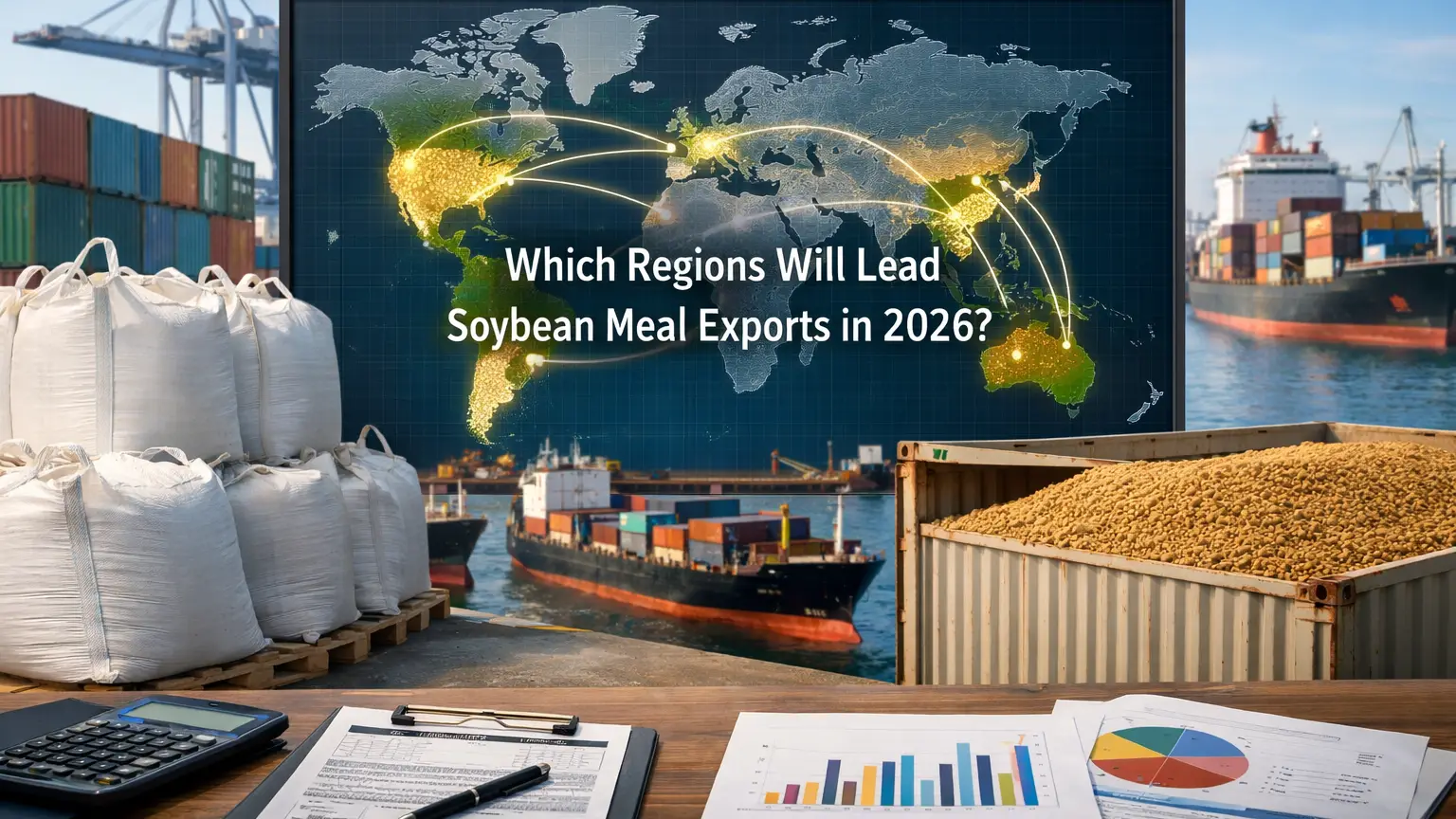
Soybean meal exports are expected to reach record levels heading into 2026, driven by rising global demand for animal protein and feed efficiency. With projected export volumes approaching 82 million tons in the 2025/26 season, feed buyers are increasingly focused on which regions can deliver consistent supply at competitive cost. Export leadership in 2026 will be defined by crushing capacity, logistics performance, policy stability, and compliance with import standards rather than volume alone.
Global Soybean Meal Trade Outlook for 2026
Rising Demand From Livestock and Aquaculture
Global consumption of soybean meal continues to expand as poultry, swine, dairy, and aquaculture production grows across Asia, the Middle East, and parts of Latin America. Soybean meal remains the preferred protein source due to its favorable amino acid profile and pricing advantage compared with alternative meals.
Import demand has increased notably in countries such as Vietnam, Mexico, Iran, and parts of Southeast Asia, signaling sustained pressure on export availability through 2026. Lower meal prices relative to other protein sources further support this growth.
Crushing Capacity as the Foundation of Export Supply
Export leadership closely follows crushing scale. Regions with large and efficient soybean processing infrastructure can convert raw soybeans into trade-ready meal at lower unit cost. Brazil, the United States, and Argentina dominate global crushing, with continued investments strengthening their export positions heading into 2026.
South America Remains the Primary Export Powerhouse
Brazil’s Structural Advantages in Crushing and Logistics
Brazil is expected to remain the world’s largest soybean meal exporter in 2026, holding more than 30 percent of global export share. Crushing capacity continues to expand, with additional daily throughput scheduled through 2027. This scale advantage allows Brazil to supply large volumes at competitive prices.
Logistics improvements further strengthen Brazil’s position. Major export corridors connecting inland crushing plants to ports such as Santos benefit from ongoing infrastructure upgrades, including bulk handling efficiency improvements. These developments reduce inland freight costs and support reliable shipment flows to Asia and Europe.
For price-sensitive feed buyers, Brazil offers a combination of scale, cost efficiency, and growing logistical sophistication.
Argentina’s Role and Policy Sensitivity
Argentina remains a key soybean meal exporter, historically accounting for a similar share of global exports as Brazil. Crushing capacity is relatively stable, supporting strong export availability when weather conditions are favorable.
Recent reductions in export taxes on soybean meal have improved margins and export competitiveness. However, Argentina’s trade policy environment remains a variable to monitor. Sudden changes in tax rates or export regulations can affect shipment timing and pricing, making policy awareness critical for importers.
North America Provides Stability and Quality Assurance
United States Crushing Growth and Domestic Demand Balance
The United States continues to expand soybean crushing, driven largely by renewable diesel demand for soybean oil. This growth generates additional soybean meal supply, supporting exports estimated in the mid-teens million ton range for 2025/26.
While domestic biofuel demand limits aggressive export growth, the United States remains a reliable supplier with consistent quality and predictable shipment schedules. This stability appeals to buyers prioritizing supply security and compliance.
Export Destinations and Infrastructure Strength
US soybean meal exports are increasingly diversified, with strong flows to Southeast Asia, Europe, and Latin America. Investments in port infrastructure, particularly along the Gulf Coast, support efficient loading and reduce logistical disruptions.
For buyers operating under strict feed safety and sustainability requirements, US-origin soybean meal often aligns well with regulatory expectations.
Emerging Export Regions Worth Monitoring
Southeast Asia’s Growing Crushing Base
Southeast Asia is gradually emerging as a regional soybean meal supplier. New crushing investments in Vietnam are expected to increase local processing capacity significantly, reducing reliance on imports while creating limited export potential within the region.
Indonesia is also exploring additional crushing capacity near major ports, leveraging domestic feed demand and existing palm oil logistics infrastructure. While these volumes remain modest compared with South America or North America, they offer regional diversification opportunities.
Eastern Europe and the Black Sea Region
Countries in Eastern Europe and the Black Sea region contribute a small share of global soybean meal exports. While cost competitiveness exists in theory, geopolitical disruptions and infrastructure limitations constrain scalability.
Transit routes through ports such as Constanta support limited export flows, but reliability challenges prevent these origins from competing with established exporters in 2026.
Logistics, Infrastructure, and Cost Competitiveness
Port Efficiency and Freight Economics
Efficient port operations play a decisive role in export competitiveness. South American ports handling large volumes benefit from economies of scale, lowering freight costs per ton. Infrastructure investments continue to improve turnaround times and reduce congestion risks.
In contrast, buyers value North American ports for consistent scheduling and lower disruption risk, even if per-ton costs are sometimes higher.
Reliability Versus Scale in Shipment Planning
South America offers unmatched volume availability, but weather events and port congestion can introduce short-term risk. North America provides more predictable shipment performance. Many buyers combine both origins to balance cost and reliability.
Trade Policy and Regulatory Factors
Export taxes, sustainability requirements, and import regulations increasingly influence sourcing decisions. Brazil’s relatively open trade environment supports stable exports, while Argentina’s policy shifts require close monitoring.
Sustainability and traceability requirements are becoming standard for many importing markets. Buyers must ensure suppliers can provide documentation that meets evolving environmental and feed safety standards.
What Soybean Meal Importers Should Prioritize in 2026
Importers should adopt diversified sourcing strategies that combine South American volume with North American reliability. Monitoring emerging suppliers in Southeast Asia can provide additional flexibility, particularly for regional buyers.
Contract timing also matters. Aligning purchases with Brazil’s post-harvest export window and US crushing peaks can improve pricing outcomes and availability.
Conclusion
In 2026, soybean meal export leadership will be shaped by structural strengths rather than headline production numbers. South America will continue to lead through crushing scale and logistics efficiency, North America will provide stability and compliance, and Southeast Asia will play a growing regional role.
For feed manufacturers and traders navigating global soybean meal sourcing, Chemtradeasia supports trade-aware procurement with diversified origin access, regulatory insight, and market intelligence, helping buyers secure reliable supply across leading export regions for 2026 and beyond.