
Explore our network of country and industry based websites to access localized information, product offerings, and business services across our group.
Log in to start sending quotation requests for any product.
Don't have an account? Sign Up Here
Home Global Soy Lecithin Market 2026: Applications, Buyers, Prices & 20-Year Forecast
Trade Insights | Applications and Buyers | 31 March 2026
Feed Ingredients
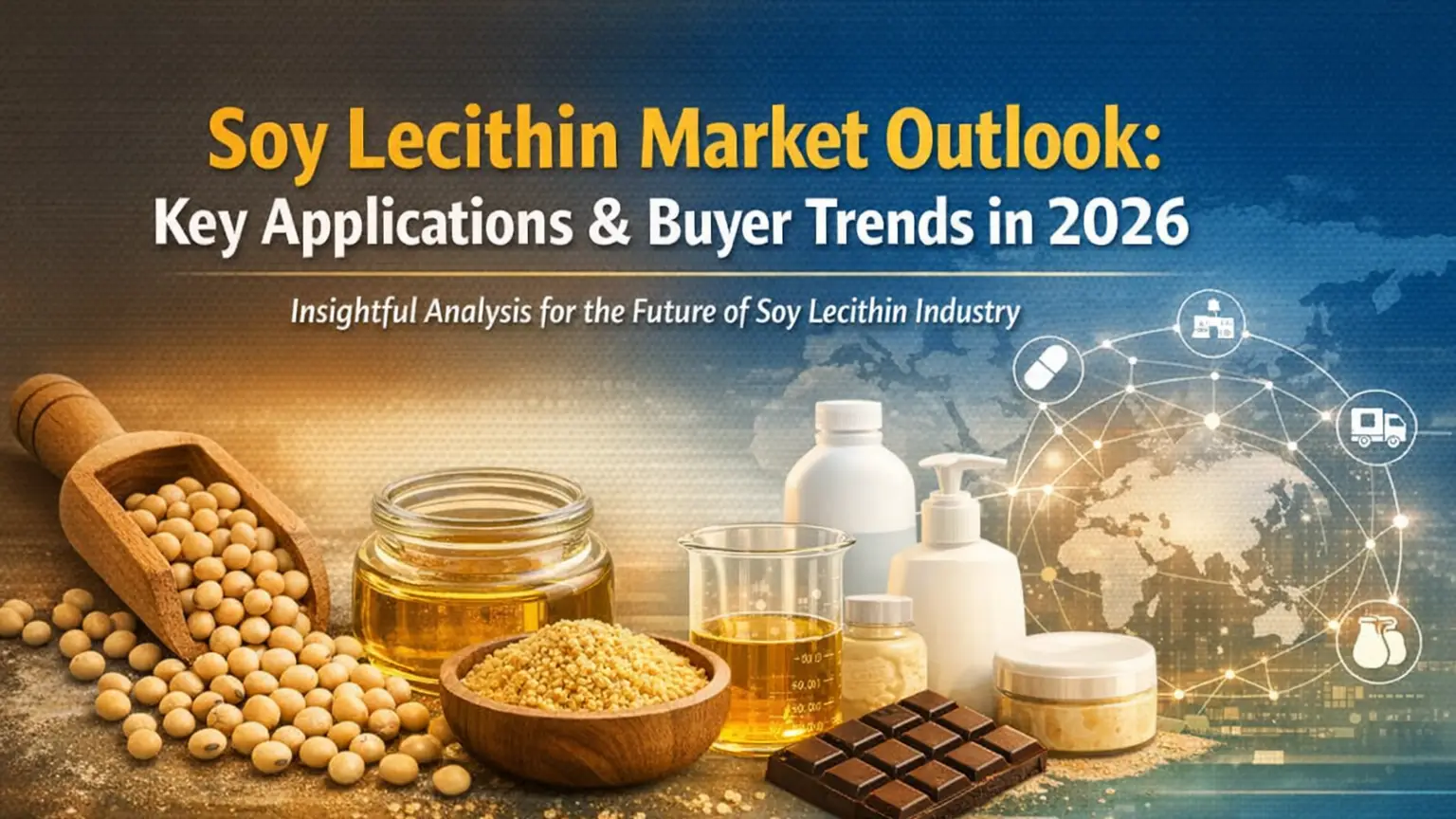
The global soy lecithin market continues to scale as food processors worldwide lean into natural emulsifiers that enhance texture, shelf‑life and formulation stability. In 2026, soy lecithin remains the dominant lecithin source, supported by rising packaged food production across developed and developing markets. With food & beverage accounting for an estimated ~58 % of overall soy lecithin consumption, demand is particularly strong in bakery, confectionery and dairy applications — where lecithin’s emulsifying and dispersing properties are mission‑critical.
In this landscape, global supply‑chain partners such as Tradeasia International increasingly represent a strategic bridge between extractors and buyers. As a global solution provider for palm and oleochemicals, Tradeasia International helps food ingredients manufacturers secure consistent feedstock and ingredient supply — particularly in environments with volatile oilseed markets and heightened quality requirements.
Industrial buyers such as large food producers — including chocolate makers and dairy ingredient converters — typically negotiate soy lecithin contracts in the range of USD 900–1,500/MT for standard food grade, with specialty non‑GMO or high‑purity grades commanding higher premiums due to certification costs. This pricing sensitivity is crucial, as price fluctuations directly affect formulation costs across global food processing lines. Meanwhile, volumes extracted as a co‑product of soybean oil refining continue to dictate overall availability. Market intelligence indicates global soy crushing remains the primary driver of upstream lecithin supply.
While North America maintains a significant share due to its integrated agricultural base, the Asia‑Pacific region is emerging as the fastest‑growing market segment — bolstered by expanding urban populations and processed food demand. Specialty segments such as infant nutrition, nutraceuticals, and functional beverages are also adding incremental demand for higher‑grade lecithin variants beyond commodity food applications.
Looking toward 2046, soy lecithin is expected to sustain its role as a cornerstone ingredient across food and beverage, nutraceutical, and emerging functional ingredient portfolios. While competition from alternative phospholipids (e.g., sunflower lecithin) may intensify, continued focus on clean‑label, plant‑based ingredient demand will anchor steady growth. Over the next two decades, demand growth will likely be supported by population expansion, diversification of food formats, and incremental application development in value‑added end uses.
Sources:
Soy lecithin market – Grandview Research, 2030 forecast
Soy lecithin market – Future Market Insights, 2036 forecast
Agricultural realities — particularly soybean harvesting cycles — occupy a primary role in shaping the global soy lecithin market outlook. By 2026, annual global demand for soy lecithin is valued at approximately USD 702.7 million, with forecasts projecting growth to over USD 1.21 billion by 2036 at a ~5.6 % CAGR. As a by‑product of soybean oil extraction, lecithin production is inherently tied to soybean crushing volumes; therefore, crop yields, weather risks and agronomic inputs all impact supply balance, cost and market availability.
Tradeasia International, known for its breadth in oleochemical supply chains, serves industrial buyers — from food formulation houses to feed additive manufacturers — by stabilizing raw material sourcing and delivering integrated procurement solutions across volatile agricultural cycles.
Soybean production hubs in Brazil, the United States and Argentina set the tone for lecithin availability. In years of sub‑optimal harvests, reduced crush volumes limit lecithin co‑product availability and tighten market supply. In recent years, typical bulk pricing for crude soy lecithin has ranged between USD 1,000–1,400/MT, with specialty non‑GMO and organic grades fetching higher price premiums as buyers pursue traceability and certification.
Industrial buyers in feed and nutraceutical segments have adapted by securing longer‑term contracts and diversifying supplier networks. This has helped mitigate short‑term price spikes and maintain formulation reliability for critical product lines.
Soy lecithin’s functional profile — as a dispersant, stabilizer and emulsifier — has catalyzed uptake in segments beyond traditional food applications. Animal feed producers are implementing lecithin to enhance fat digestibility, while pharmaceutical formulators increasingly leverage lecithin in drug delivery matrices. This broadening footprint elevates lecithin from commodity co‑product to strategic ingredient across value chains.
Through 2046, soy lecithin is forecast to maintain its role as an indispensable platform chemical — shaped as much by agricultural technology advancements as by industrial demand. Innovations in crop genetics, regenerative farming and supply‑chain traceability will help stabilize supply risk and support a diversified end‑use base. Ultimately, soy lecithin’s adaptability across evolving application ecosystems will sustain long‑term relevance and growth.
Sources:
Soy lecithin market analysis & forecast – Future Market Insights
Soy lecithin supply chain market insights
Over the last decade, soy lecithin has evolved from a low‑cost by‑product into a portfolio of specialty ingredients with differentiated value propositions. In 2026, estimates position the global soy lecithin industry at approximately USD 656–670 million, with projections of growth beyond USD 1.17 billion by 2034 and a ~7.5 % CAGR. This dynamic is driven by increasing demand for higher‑purity lecithins and technologically advanced fractions such as hydrolyzed phospholipids — which offer improved functionality in cosmetic, pharmaceutical, and high‑end food formulations.
In this expanding value landscape, Tradeasia International acts as a pivotal partner for industrial ingredient buyers, bridging raw material producers and downstream manufacturers with sophisticated supply solutions and logistics support.
Standard liquid soy lecithin still accounts for a majority of global supply due to cost efficiency and broad applicability. However, advancements in refining — such as fractionation and enzymatic hydrolysis — have produced specialty lecithins commanding price points well above commodity tiers, often exceeding USD 4,000–7,600/MT depending on purity and performance. These higher margin products are increasingly preferred in nutraceuticals, softgel encapsulation, and advanced cosmetic systems where functional performance is paramount.
Industrial players, particularly integrated agribusinesses, are investing in refining capacity to maximize value extraction from soy processing streams — turning lecithin into a strategic revenue center rather than a surplus by‑product.
Major buyers — from pharmaceutical OEMs to personal care formulators — are driving this sophistication trend by specifying performance attributes such as phosphorus content, hydrophilic/lipophilic balance and hydrolysis profiles. These specifications require similarly precise supply chain capabilities, which global intermediaries like Tradeasia International are well‑positioned to support through coordinated logistics and product differentiation strategies.
As lecithin technology continues to mature, the next two decades will see deeper functional specialization and integration into bio‑derived materials, advanced nutrition, and high‑performance industrial formulations. Lecithin’s adaptability and renewable feedstock base will secure it as a critical platform chemical entwined with evolving sustainability and performance demands across sectors.
Sources:
Soy lecithin global market – FMI forecast
Soy lecithin pricing and specialty trends – sourcing insights
Soy lecithin’s global supply chain reflects the agricultural and industrial contours of modern oleochemical distribution. With significant production concentrated in the Americas and rapidly growing demand in Asia‑Pacific, soy lecithin trade flows span continents. Current market estimates for 2026 span a valuation of USD 670 million to over USD 1.3 billion — depending on assessment scope and product segmentation.
Tradeasia International’s global logistics networks play a strategic support role here, assisting buyers with international sourcing of soy lecithin and other oleochemical feedstocks. By integrating procurement, compliance and freight management, Tradeasia helps reduce risk associated with fragmented supply routes and shifting regional demand balances.
Soy lecithin supply is transported as bulk liquids or packed in intermediate bulk containers (IBCs), drums and rail cars. Freight costs, storage logistics, and regulatory compliance (especially for food‑grade or certified non‑GMO supply chains) directly influence delivered pricing. On average, standard soy lecithin contracts in export markets are secured between USD 1,000–1,600/MT, with regional divergences based on origin and certification status.
Regional hubs such as the U.S. Midwest, Brazil’s Sao Paulo belt, and China’s coastal refining centers serve as pivotal nodes that balance export opportunity with domestic industrial demand, particularly in food processing and pharmaceutical packaging sectors.
Asia‑Pacific is among the fastest growing regional markets — with projected ~7.6 % CAGR driven by rising consumption of processed foods and expanding feed industries. Additionally, traceable supply requirements and sustainability expectations are driving buyers toward certified supply chains, adding complexity but also higher value opportunities for compliant lecithin products.
Over the next twenty years, soy lecithin’s trade ecosystem will become more modular and responsive as regional processing capacity expands. Sustainability mandates and supply transparency requirements will reshape source‑to‑sink patterns, but soy lecithin’s broad application spectrum — from food to industrial formulations — ensures ongoing strategic importance as a globally traded oleochemical.
Sources:
Soy lecithin market overview and forecast
Soy lecithin regional growth – Precedence Research
Sustainability and traceability are now central strategic priorities in the soy lecithin industry’s evolution. As buyers — particularly in Europe and Japan — tighten sourcing criteria, soy lecithin supply chains are being restructured to support identity‑preserved and non‑GMO segregation. These shifts are reshaping price structures, logistics and certification workflows across the market.
In this context, Tradeasia International provides value to industrial buyers seeking compliant raw materials. With global procurement and quality management services for palm and oleochemical feedstocks, Tradeasia facilitates secure access to traceable soy derivatives that meet stringent regulatory and customer standards.
As traceability and non‑GMO sourcing criteria become table stakes for premium food and pharmaceutical customers, soy lecithin produced under identity‑preserved systems commands a 15–25 % price premium versus conventional grades. These premiums reflect added segregation, documentation and certification costs but unlock access to high‑value buyers who prioritize label transparency and sustainability.
Environmental policies related to deforestation‑free sourcing have further driven agricultural and trading partners to invest in regenerative farming practices. Such initiatives are influencing global trade flows and encouraging supply chain investments that promote long‑term resource stewardship.
Large consumer goods companies now evaluate soy lecithin sourcing not just on price and functionality, but also on ESG alignment. This shift pushes suppliers to develop more traceable supply chains that validate sustainable cultivation, responsible land use and transparent ingredient histories. Buyers benefit not only from risk mitigation but also from enhanced brand credibility.
From 2026 to 2046, sustainability will increasingly define competitive advantage in soy lecithin markets. Developments in regenerative agriculture, blockchain‑enabled traceability and supply chain transparency will strengthen backbone systems that support compliant, high‑value lecithin products. With these frameworks in place, soy lecithin will remain a durable platform chemical across food, industrial, pharmaceutical, and specialty ingredient markets.
Sources:
Soy lecithin market sustainability trend insights
Soy lecithin market growth & traceability
We're committed to your privacy. Tradeasia uses the information you provide to us to contact you about our relevant content, products, and services. For more information, check out our privacy policy.