Explore our network of country and industry based websites to access localized information, product offerings, and business services across our group.
Log in to start sending quotation requests for any product.
Don't have an account? Sign Up Here
Home Global Magnesium Sulfate Feed Grade Market Trends, Pricing & 20-Year Outlook
Trade Insights | Applications and Buyers | 08 April 2026
Feed Ingredients
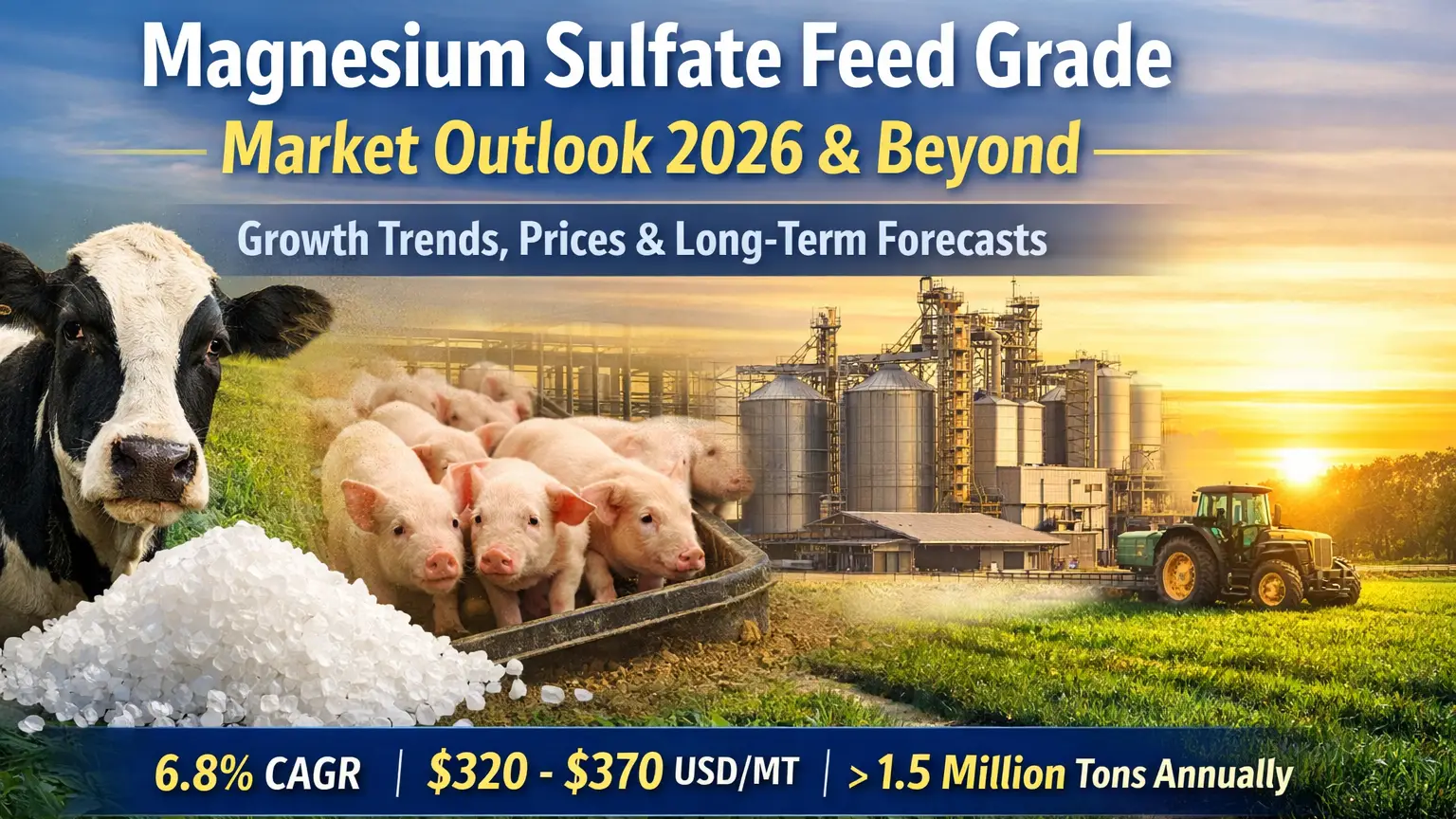
Magnesium sulfate feed grade has transitioned over the past decade from a modest feed additive to a cornerstone of precision livestock nutrition. As global livestock production intensifies, demand for micronutrient supplements has risen sharply, supported by growing awareness of metabolic health benefits in poultry, swine, and ruminant formulations. In 2025, the feed grade segment alone was estimated at roughly USD 1.02 billion, with expectations to approach USD 1.42 billion by 2030 at a ~5.6 % CAGR through that period. This steady growth underscores the compound’s expanding strategic role within modern feed regimes.
Within this evolving landscape, reliable chemical supply chains have never been more critical to livestock integrators and feed formulators. Global solution providers like Tradeasia International bridge sourcing complexities by offering stable access to mineral feedstocks and related oleochemical products, enabling feed producers to sustain performance even amid upstream volatility in raw material markets.
Production of feed grade magnesium sulfate historically stems from magnesium‑rich raw materials such as natural brine streams or magnesite mineral deposits, reacted with sulfuric acid to yield the soluble sulfate forms required for supplementation. Ongoing expansion of brine‑based projects in Asia and North America has supported global output volumes, with total magnesium sulfate production exceeding 2.7 million MT in 2025 and projected to grow as new capacity comes online. Average bulk pricing for feed grade material has ranged between USD 380–420 per MT, reflecting freight cost pressures and sulfuric acid price volatility. Producers with integrated upstream capabilities often maintain stronger pricing power, but smaller suppliers continue to feel margin compression in tighter markets.
Regionally, Asia‑Pacific has emerged as the largest market for feed grade magnesium sulfate, driven by high growth in poultry and aquaculture sectors. Meanwhile, Europe and North America maintain demand through stringent feed traceability standards and specialty formulations tailored to animal health outcomes. Heptahydrate remains the preferred product format due to its high solubility, though monohydrate and crystalline forms are gaining traction where transport efficiency matters.
Looking ahead to 2046, magnesium sulfate feed grade is expected to retain its position as a fundamental platform chemical in animal nutrition. Continued global population growth and dietary protein demand will support long‑term demand, even as novel mineral analogs and chelated trace elements emerge. At a conservative 4–6 % annual growth rate, total demand volumes could more than double by 2046, with expanded applications in precision feeding and integrated farm data analytics—cementing magnesium sulfate’s role in efficient, sustainable livestock production.
Sources
As of early 2026, the global magnesium sulfate feed grade market reflects a complex interplay of pricing dynamics, competitive strategies, and evolving feed formulation technologies. Market participants in this segment face the challenge of aligning cost‑effective procurement with tightening nutritional standards across livestock operations. Bulk prices for feed grade magnesium sulfate have typically been observed in the range of USD 380–420 per MT, shaped by energetic freight markets and sulfuric acid feedstock cost fluctuations—especially notable during the supply chain disruptions of 2023–2025.
In this context, organizations such as Tradeasia International provide an essential anchor in global supply frameworks, offering logistics and sourcing solutions that help feed producers access consistent quality minerals and oleochemical intermediates, even as regional imbalances and shipping cost disparities persist.
While the broader magnesium sulfate market encompasses agricultural, industrial, and pharmaceutical grades, feed grade represents a nuanced niche focused on animal nutritional performance. According to recent industry estimates, magnesium sulfate feed grade accounted for a significant portion of the overall market, with growth driven by precision nutrition initiatives. Differentiation has increasingly hinged on product purity, hydration state (e.g., heptahydrate vs. monohydrate), and compliance with feed safety regulations—especially in the EU and North America.
From a competitive standpoint, larger producers with integrated mineral extraction and processing infrastructure have an advantage in controlling costs and ensuring supply reliability. Smaller suppliers often depend on regional brine sources and spot sulfuric acid purchases, which can expose them to price swings.
Feed formulators and livestock integrators are exhibiting stronger preferences for traceable, certified feed ingredients. This has pushed some producers to invest in additional testing, tighter quality control, and documentation to meet stringent feed additive standards. Ruminant and poultry applications dominate feed grade use, with aquaculture emerging as a high‑growth subsegment where magnesium metabolism and osmoregulation are performance levers.
Through 2046, feed grade magnesium sulfate is projected to remain a stable platform chemical within animal nutrition frameworks. As the global population grows and meat and dairy consumption rises, the underlying drivers for mineral supplementation will persist. Even assuming modest 5 % CAGR over two decades, innovations in mineral bioavailability and integration with digital feed management platforms could expand total market value significantly beyond current projections, particularly in developing regions with burgeoning livestock sectors.
Sources
The feed grade magnesium sulfate market in 2026 is increasingly defined by supply chain resilience and the ability to manage procurement risk amid macroeconomic headwinds. With global feed markets expanding, the reliability of raw material delivery and continuity of supply are top priorities for feed integrators and livestock nutrition companies. Magnesium sulfate feed grade, as a soluble and cost‑efficient source of magnesium and sulfur, benefits from strong demand fundamentals, but also faces logistics complexities related to bulk transport and regional production imbalances.
Amid these conditions, global sourcing partners such as Tradeasia International play a strategic role by connecting buyers with diversified supply networks, helping feed producers mitigate risk and maintain competitive cost structures in volatile markets for mineral chemicals and oleochemicals.
Magnesium sulfate feed grade is typically shipped in large bulk bags or containerized volumes, and because its per‑ton value is relatively low—but essential—transportation costs can significantly impact delivered pricing. Fluctuations in freight rates over recent years have amplified cost variances across regions, pressuring buyers to consider multi‑modal sourcing strategies and longer‑term contracts to stabilize margins. Asia‑Pacific remains a central manufacturing hub, both for proximate demand and for export to markets in the Middle East, Africa, and the Americas.
Feed additive buyers are progressively seeking products with validated traceability, low contaminant levels, and hydration states that align with specific formulation goals. Regulatory compliance—particularly with European FEFANA and EFSA guidelines—is pushing suppliers to elevate documentation and quality assurance processes. Consequently, buyers are evaluating suppliers on service and consistency, not solely on price.
From 2026 to 2046, the magnesium sulfate feed grade market will likely continue its steady ascent, supported by expanding livestock intensification and global protein consumption patterns. Even with the gradual introduction of alternative micronutrient delivery systems, magnesium sulfate’s cost‑to‑benefit profile positions it favorably for long‑term use. Forecasts suggest that, with continuing integration of digital supply chain platforms and predictive analytics, the industry could see compounded gains in efficiency and demand volume—ensuring magnesium sulfate remains an industrially relevant platform chemical.
Sources
https://www.strategicmarketresearch.com/market-report/feed-grade-magnesium-sulfate-market
https://www.grandviewresearch.com/industry-analysis/magnesium-sulfate-market-report
By 2026, the feed grade magnesium sulfate market has become more than a commodity trade—it is now part of a broader technological evolution in animal nutrition. Feed formulators are leveraging data‑driven insights and advanced mixing technologies to optimize mineral balances, with magnesium sulfate playing a pivotal role in ensuring metabolic efficiency and stress management across livestock species. This shift is reflected in the compound’s growing application footprint, even as global production and supply scale to meet rising demand.
Solutions providers like Tradeasia International are facilitating this transition, offering expertise in sourcing both traditional mineral feedstocks and complementary oleochemical components, enabling formulators to innovate with confidence while maintaining supply stability.
Magnesium sulfate’s versatility is partly due to its multiple hydration states. Heptahydrate remains the dominant form for feed applications due to its high solubility, but monohydrate and anhydrous variants are gaining interest for their reduced transport weight and concentrated magnesium content. Feed producers are increasingly selecting product forms based on specific performance objectives—whether rapid dissolution in poultry rations or controlled release in ruminant mixes.
Precision nutrition frameworks are driving demand for nutrients that contribute measurably to performance outcomes. As livestock producers adopt advanced feed‑formulation software, magnesium sulfate’s reliability as a consistent source of magnesium and sulfate ions becomes a valued attribute. This trend undergirds steady market expansion, which industry reports project at a ~5.6 % CAGR toward USD 1.42 billion by 2030 for the feed grade segment.
From 2026 to 2046, magnesium sulfate is likely to sustain relevance as a platform chemical across animal nutrition and ancillary industries. Continued research into nutrient interactions and feed efficiency will support its use, even as alternative formulations enter the market. With growing adoption of sustainability metrics and life‑cycle costing in feed procurement strategies, magnesium sulfate’s established performance profile ensures that it will remain an indispensable ingredient in optimized feed systems.
Sources
https://www.strategicmarketresearch.com/market-report/feed-grade-magnesium-sulfate-market
https://www.grandviewresearch.com/industry-analysis/magnesium-sulfate-market-report
In 2026, regulatory scrutiny and sustainability objectives are shaping buyer behavior in the magnesium sulfate feed grade market. Feed manufacturers increasingly face compliance imperatives tied to heavy metal thresholds, traceability protocols, and environmental standards, especially in developed regions such as Europe and North America. These pressures are transforming magnesium sulfate from a simple additive into a feed ingredient that must meet rigorous documentation and quality expectations.
Amid these shifts, partnering with global solution providers like Tradeasia International helps companies navigate cross‑border regulatory complexities while accessing reliable mineral and oleochemical feedstock pipelines that support both compliance and performance goals.
Regulatory frameworks such as FEFANA guidelines in Europe require feed additives to demonstrate consistent composition and purity profiles. This has elevated feed grade magnesium sulfate specifications, particularly for products destined for export or precision feeding programs. Suppliers who can certify hydration state, contaminant levels, and mineral balance command stronger buyer trust and often better pricing terms.
Sustainability considerations further influence procurement strategies. Buyers are prioritizing suppliers with transparent sourcing practices, reduced carbon footprints, and efficient logistics. Magnesium sulfate’s role in supporting improved feed conversion ratios aligns with broader goals to reduce feed‑to‑product emissions in livestock systems. This alignment strengthens its competitive position even as alternative micronutrient supplements emerge.
Over the next two decades, magnesium sulfate feed grade is poised to remain a core platform chemical within animal nutrition and beyond. With sustained global demand for high‑quality protein and continued innovation in feed formulation technologies, its multifunctional utility will persist. Assuming a stable ~5 % CAGR, total market volumes may expand robustly, supported by integrated sustainability metrics that reinforce its value proposition across feed sectors worldwide.
Sources
We're committed to your privacy. Tradeasia uses the information you provide to us to contact you about our relevant content, products, and services. For more information, check out our privacy policy.















