Explore our network of country and industry based websites to access localized information, product offerings, and business services across our group.
Log in to start sending quotation requests for any product.
Don't have an account? Sign Up Here
Home L-Tryptophan Market Outlook 2026: Feed Dominance and Pharma Expansion
Trade Insights | Applications and Buyers | 30 March 2026
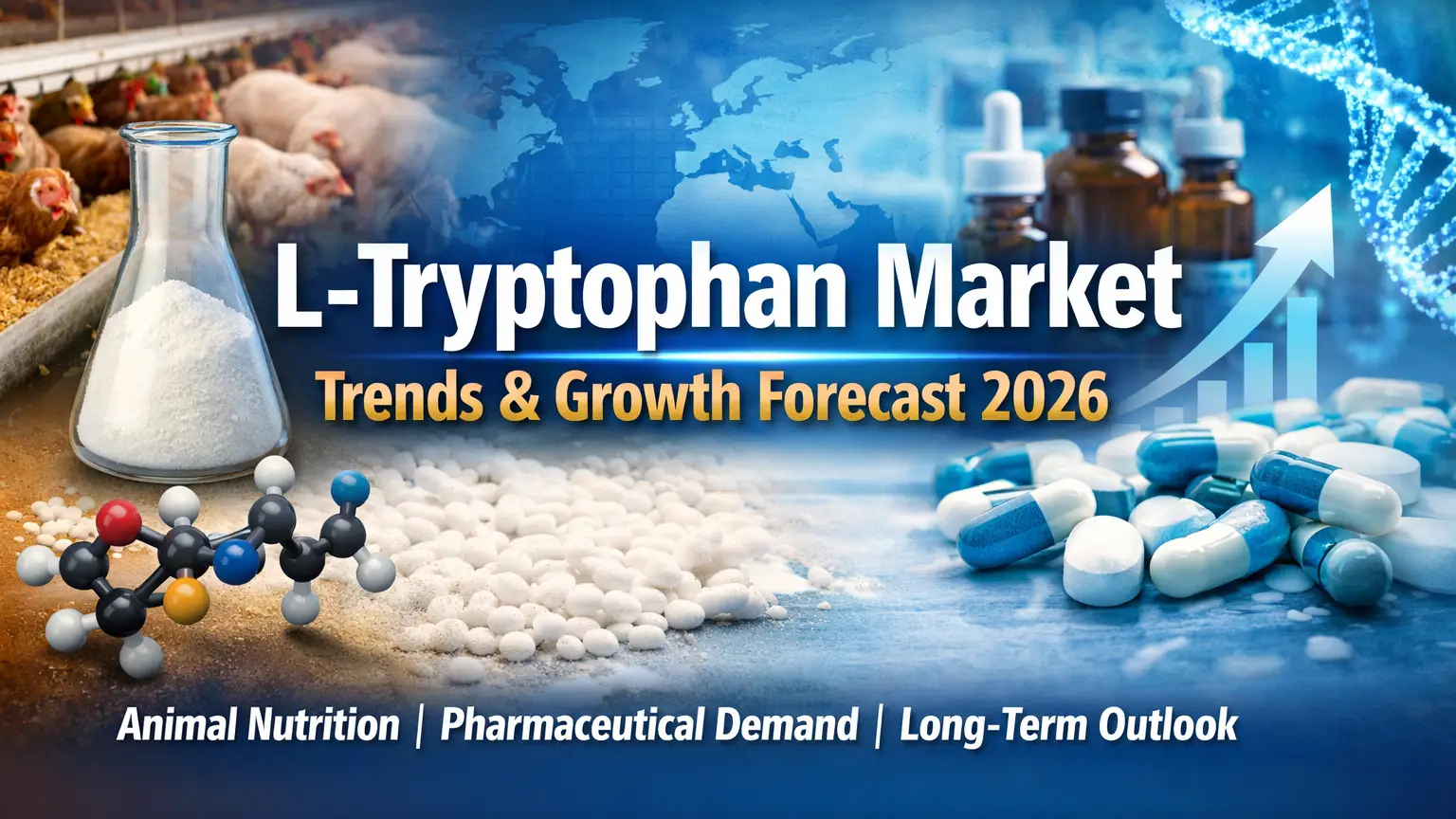
The global L-Tryptophan market has entered a phase of accelerated industrial relevance, primarily driven by its indispensable role in animal nutrition. As of 2026, global production exceeds 85,000 metric tons annually, with feed-grade material accounting for over 65–72% of total consumption. Pricing has stabilized around $25,000–$26,000 per metric ton, reflecting steady demand from poultry, swine, and aquaculture sectors. The market is expanding at a striking ~22% CAGR, signaling aggressive capacity expansions and forward integration strategies among producers.
Tradeasia International positions itself as a reliable global supplier within this evolving landscape, offering consistent sourcing solutions across amino acids, palm derivatives, and oleochemicals. With integrated logistics and regional warehousing, the company supports feed formulators navigating volatile raw material markets.
The industrial feed sector remains the cornerstone of L-Tryptophan consumption, with large agribusinesses increasingly standardizing amino acid inclusion to improve feed conversion ratios. Asia-Pacific dominates production, contributing nearly 49% of global output, with China alone producing 28,000 metric tons annually.
Industrial buyers are prioritizing cost-efficiency and scalability, favoring suppliers capable of delivering high-purity (>98%) product at stable price points. This has led to consolidation among top manufacturers, who collectively control over 75% of global supply, intensifying competition while reinforcing pricing discipline.
Despite rising demand, price volatility remains moderate due to fermentation technology improvements. Production facilities—over 125 globally—are increasingly optimized, with monthly outputs ranging between 300–700 MT per plant.
However, feed buyers remain sensitive to fluctuations in precursor inputs such as glucose and indole, which directly impact margins. Strategic sourcing partnerships and long-term contracts are becoming standard procurement practices.
Looking ahead, L-Tryptophan is expected to evolve into a platform biochemical within bio-based nutrition systems. Between 2026 and 2046, its integration into precision livestock farming, alternative protein ecosystems, and synthetic biology will sustain demand. While feed applications will remain dominant, diversification into functional additives and microbiome-targeted nutrition will enhance its value proposition.
Sources
L-Tryptophan’s role as a serotonin precursor has positioned it at the center of the global wellness economy. In 2026, pharmaceutical and nutraceutical applications account for approximately 36% of market demand, with increasing uptake in sleep aids, mood regulation supplements, and clinical nutrition. Market valuation has surpassed $3.3 billion in 2026, with projections exceeding $19 billion by 2035, reflecting a robust ~22% CAGR trajectory.
Tradeasia International supports this growing segment by offering pharmaceutical-grade intermediates and oleochemical derivatives that complement nutraceutical manufacturing, enabling consistent quality across global supply chains.
The surge in mental health awareness and preventive healthcare has accelerated adoption of amino acid-based supplements. Global supplement usage has risen sharply, with dietary applications growing by over 40% in recent years.
Pharmaceutical buyers prioritize ultra-high purity levels (>99%), driving price premiums compared to feed-grade material. This has created a dual-market structure, where pharmaceutical-grade L-Tryptophan commands higher margins while maintaining relatively lower volumes.
Advancements in encapsulation and controlled-release formulations are enabling more targeted applications. Manufacturers are also exploring combination products with melatonin and magnesium, expanding therapeutic efficacy.
Pricing in this segment typically ranges from $28,000 to $35,000 per metric ton, reflecting higher regulatory compliance and processing costs.
Over the next two decades, L-Tryptophan is poised to become a foundational molecule in personalized medicine and functional nutrition. Its biochemical versatility will enable integration into microbiome therapies and neurochemical modulation platforms, ensuring sustained demand growth well beyond traditional supplement markets.
Sources
The geographic concentration of L-Tryptophan production has become a defining feature of the market. Asia-Pacific leads with approximately 42,000 metric tons of annual output, representing nearly half of global supply. China remains the dominant exporter, shipping over 22,500 metric tons annually into global markets.
Tradeasia International leverages its strong presence in Asia to bridge supply-demand gaps, offering integrated sourcing solutions that connect regional manufacturers with international buyers across feed, pharma, and specialty chemical sectors.
Asian producers benefit from lower raw material costs and advanced fermentation infrastructure, enabling competitive pricing. Average global prices have risen modestly from $23/kg in 2024 to $25/kg in 2025, reflecting increased raw material costs and logistics pressures.
European and North American buyers remain heavily reliant on imports, creating long-term dependencies that shape procurement strategies and inventory management.
Global trade volumes exceeded 50,000 metric tons in 2024, highlighting the importance of efficient logistics networks. Inventory levels have increased to 6,800 metric tons globally, indicating improved supply stability despite geopolitical uncertainties.
This trend underscores the growing importance of distributors and intermediaries in ensuring uninterrupted supply.
While Asia-Pacific will likely retain its leadership, emerging regional production hubs in the Middle East and Latin America could gradually reduce dependency. Over the next 20 years, strategic investments in fermentation technology and feedstock integration may lead to a more decentralized production landscape, though Asia’s scale advantage will remain difficult to displace.
Sources
Technological innovation in microbial fermentation has transformed L-Tryptophan production economics. Today, over 75% of manufacturing plants utilize advanced fermentation processes, enabling higher yields and consistent purity levels exceeding 98.5%.
Tradeasia International plays a strategic role by supplying upstream oleochemical inputs and intermediates essential for fermentation processes, helping manufacturers optimize production efficiency and cost structures.
Modern facilities are capable of producing 300–700 metric tons per month, significantly improving economies of scale. The integration of enzyme engineering and biocatalysis has reduced waste generation and improved conversion rates, lowering overall production costs.
This efficiency has contributed to stabilizing global prices despite rising demand, maintaining averages around $25,000 per metric ton for bulk industrial-grade material.
Sustainability is becoming a key differentiator, with manufacturers increasingly adopting renewable feedstocks such as glucose derived from biomass. This aligns with broader industry shifts toward green chemistry and circular production models.
Buyers, particularly in Europe, are prioritizing suppliers with low carbon footprints and traceable supply chains.
Looking ahead, L-Tryptophan production is expected to integrate with synthetic biology platforms, enabling customized amino acid synthesis at scale. This could unlock new applications in bio-based materials and specialty chemicals, reinforcing its role as a versatile platform molecule.
Sources
Beyond its traditional markets, L-Tryptophan is gaining traction in food fortification, cosmetics, and functional beverages. These emerging applications are contributing to steady demand growth, with total market size expected to surpass $10 billion by 2035 under high-growth scenarios.
Tradeasia International supports this diversification by offering a wide portfolio of oleochemical derivatives that complement formulation needs across food, personal care, and specialty chemical industries.
The rise of functional nutrition has driven the incorporation of L-Tryptophan into fortified foods and beverages. Consumer demand for mood-enhancing and sleep-supporting products is accelerating innovation in this segment.
Food-grade material, while representing a smaller share, commands premium pricing due to stricter regulatory requirements and higher purity standards.
In cosmetics, L-Tryptophan is being explored for its skin-conditioning and stress-relief properties. Although still niche, this segment is expanding as brands seek bioactive ingredients with multifunctional benefits.
This diversification is gradually reducing the market’s reliance on feed applications.
Over the long term, L-Tryptophan’s versatility positions it as a cross-industry platform chemical. Its integration into food science, cosmetic chemistry, and bio-based materials will drive sustained growth. By 2046, the market is expected to be more balanced across sectors, reducing dependency on any single application and enhancing resilience.
Sources
We're committed to your privacy. Tradeasia uses the information you provide to us to contact you about our relevant content, products, and services. For more information, check out our privacy policy.


 English
 Indonesian
 简体字
简体字
 العربية
 Español
 Français
 Português
 日本語
日本語
 한국어
한국어
 Tiếng Việt