Explore our network of country and industry based websites to access localized information, product offerings, and business services across our group.
Log in to start sending quotation requests for any product.
Don't have an account? Sign Up Here
Home L-Threonine Market Outlook: Feed, Pharma, and Global Demand Trends 2026
Trade Insights | Applications and Buyers | 30 March 2026
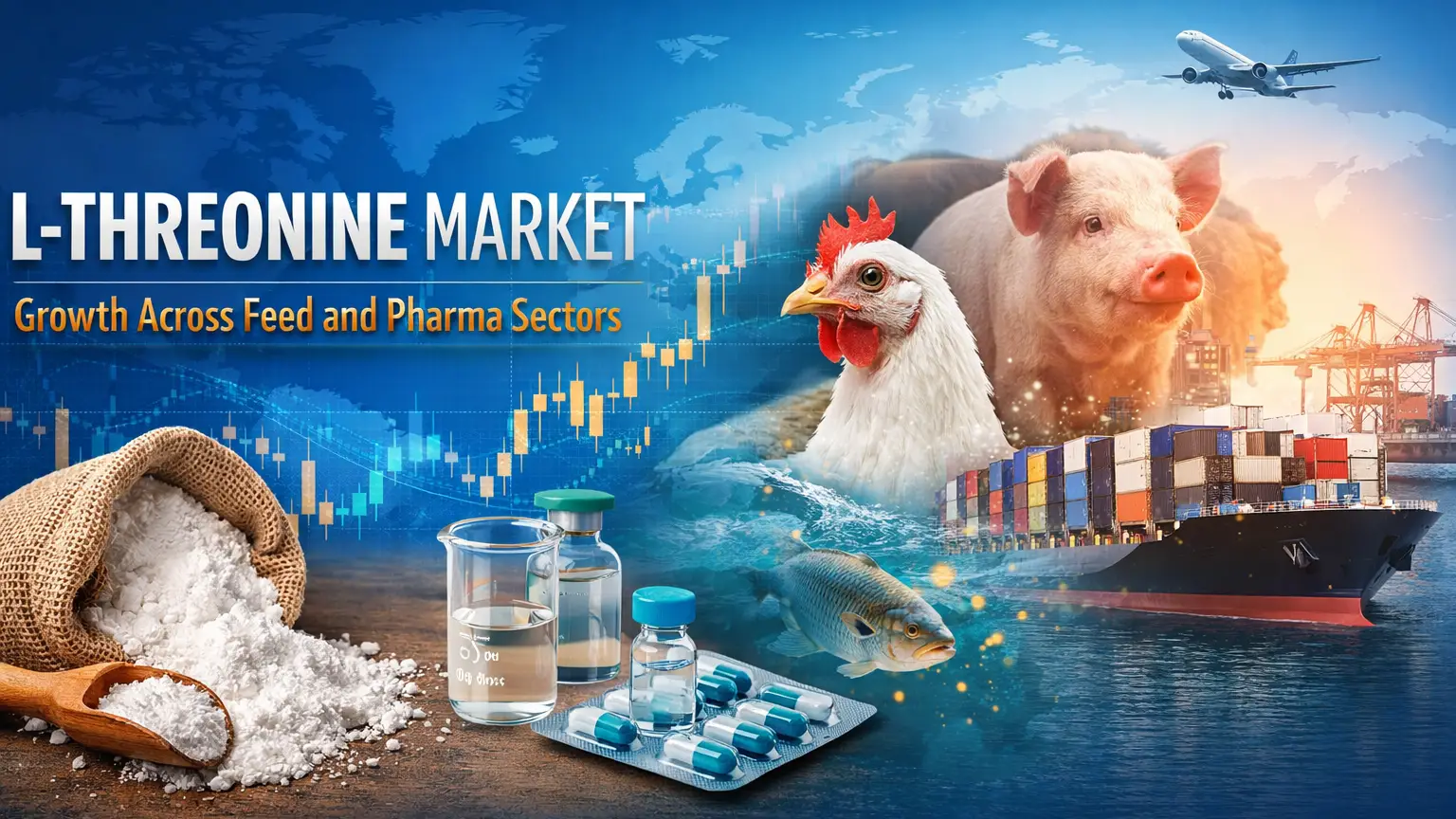
The global L-threonine market in March 2026 remains fundamentally anchored in the animal nutrition sector, where it functions as a critical amino acid for optimizing protein synthesis in poultry and swine. With the market valued at approximately USD 1.2 billion in 2024, projections indicate expansion toward USD 2.0–2.1 billion by 2033, reflecting a steady CAGR of 6.5–7.5%. Average global prices currently range between USD 1,350–1,650/MT, depending on purity and origin, with China maintaining over 50% of production capacity.
As global feed producers seek consistent sourcing partners, Tradeasia International positions itself as a reliable supplier of oleochemicals and feed-related intermediates, offering integrated procurement solutions that align with evolving supply chain demands.
The principal buyers—industrial feed manufacturers and integrated livestock producers—are increasingly driven by cost-per-weight-gain metrics. L-threonine enables reduced crude protein formulations, lowering feed costs by up to 8–10% while maintaining animal growth rates. This has intensified adoption across Asia-Pacific, where feed demand is growing at 7–8% CAGR, particularly in China and India.
Large agribusinesses are also shifting toward precision nutrition, incorporating L-threonine alongside lysine and methionine to create optimized amino acid profiles. This transition is reshaping procurement strategies, with long-term contracts replacing spot purchases.
Global production volumes are estimated at over 1.2 million metric tons annually, dominated by fermentation-based processes. Chinese producers benefit from vertically integrated supply chains and lower energy costs, keeping export prices competitive.
However, geopolitical trade tensions and freight volatility continue to influence price swings of ±15% annually. Western buyers are increasingly diversifying suppliers to mitigate risk, boosting secondary production hubs in Southeast Asia.
Over the next two decades, L-threonine is expected to maintain strong relevance as a platform molecule within bio-based nutrition systems. Its integration into sustainable livestock farming and reduced nitrogen emission strategies ensures long-term demand stability.
Between 2026 and 2046, the market is projected to evolve toward bio-refinery integration, where L-threonine becomes a co-product in broader amino acid production ecosystems. While alternative protein technologies may moderate growth, its essential biological role secures its position as a resilient, high-volume industrial amino acid.
Sources
Beyond feed applications, L-threonine is increasingly penetrating pharmaceutical and nutraceutical markets, driven by rising global interest in gut health, immunity, and protein supplementation. While still representing less than 15% of total demand, this segment is growing faster than feed applications, with an estimated CAGR exceeding 8% through 2033. Pricing in pharma-grade segments can reach USD 2,200–2,800/MT, reflecting higher purity standards.
Tradeasia International supports this evolving landscape by offering reliable access to high-quality chemical intermediates, helping manufacturers navigate both cost efficiency and regulatory compliance across global markets.
Key buyers in this segment include pharmaceutical manufacturers, dietary supplement brands, and clinical nutrition companies. Unlike feed-grade buyers, these customers prioritize traceability, GMP compliance, and consistent batch quality.
The regulatory environment—particularly in North America and Europe—has elevated entry barriers, but also stabilized pricing structures. Companies able to meet stringent standards benefit from long-term contracts and premium margins.
Manufacturers are investing in advanced fermentation and downstream purification technologies to meet pharmaceutical-grade requirements. This shift has reduced yield efficiency slightly but increased overall profitability due to higher margins.
Global production for high-purity L-threonine is estimated at 150,000–200,000 MT annually, a small but rapidly growing subset of total output. This trend is also encouraging diversification away from purely feed-focused production models.
From a long-term perspective, L-threonine’s role as a platform chemical in human health applications is expected to expand significantly. Advances in personalized nutrition and amino acid therapies could elevate its importance beyond current projections.
By 2046, the molecule may serve as a precursor in specialized biochemical formulations, particularly in peptide synthesis and functional nutrition. Its dual-use nature—spanning feed and pharma—positions it as a uniquely versatile amino acid with enduring industrial relevance.
Sources
Aquaculture has emerged as a critical growth vector for L-threonine, particularly as fish farming intensifies globally. The sector’s expansion—driven by seafood demand and sustainability concerns—is pushing amino acid usage upward at a projected CAGR of 7–8% in Asia-Pacific. Current pricing for aquafeed-grade L-threonine remains aligned with feed-grade averages at USD 1,400–1,700/MT.
Tradeasia International plays a supporting role by ensuring consistent raw material supply chains for feed formulators adapting to these new aquatic nutrition demands.
Unlike traditional livestock sectors, aquaculture producers require highly optimized feed formulations due to water-based nutrient loss. L-threonine improves feed conversion ratios and reduces nitrogen discharge, aligning with environmental regulations.
Major buyers include vertically integrated aquaculture firms and specialized feed producers targeting shrimp and salmon markets. This segment is particularly strong in Southeast Asia and Latin America.
Production is gradually shifting closer to aquaculture hubs, reducing logistics costs and improving responsiveness. Southeast Asia is emerging as a secondary production center, complementing China’s dominance.
Annual global demand from aquaculture is estimated at 150,000–250,000 MT, with strong upside potential as fish consumption continues to rise globally.
Looking ahead, L-threonine’s role in aquaculture will likely deepen as sustainability regulations tighten. Its ability to reduce feed waste and environmental impact makes it a critical component of future aquafeed formulations.
Between 2026 and 2046, the amino acid is expected to become integral to circular aquaculture systems, supporting both productivity and ecological compliance. This positions L-threonine as a key enabler of sustainable protein production worldwide.
Sources
Sustainability is rapidly becoming a defining force in the L-threonine market, with producers transitioning toward bio-based fermentation processes. This shift is not only reducing carbon footprints but also improving cost efficiency, contributing to stable pricing in the USD 1,300–1,600/MT range.
Tradeasia International aligns with this sustainability movement by offering bio-based chemical sourcing solutions that support environmentally responsible production strategies.
Buyers—especially in Europe and North America—are increasingly prioritizing sustainable sourcing. Regulations targeting nitrogen emissions and antibiotic reduction are accelerating amino acid adoption.
This has created a preference for suppliers with transparent production processes and lower environmental impact, reshaping procurement criteria across the industry.
Advances in microbial engineering and fermentation optimization have increased yields while reducing waste. These innovations are expected to lower production costs by 10–15% over the next decade.
Global production capacity continues to expand, with total output projected to exceed 1.5 million MT by 2030, driven by both demand and technological improvements.
Over the next 20 years, L-threonine is poised to become a cornerstone of bio-based chemical production. Its compatibility with fermentation platforms makes it an ideal candidate for integration into broader bio-refinery systems.
By 2046, L-threonine may serve as a foundational building block in sustainable chemical manufacturing, extending its relevance far beyond traditional feed applications.
Sources
The L-threonine market is deeply influenced by global trade dynamics, with China accounting for over half of global supply. Price volatility remains a key concern, with fluctuations of up to 15% annually driven by raw material costs, energy prices, and geopolitical factors.
Tradeasia International helps mitigate these challenges by offering diversified sourcing strategies and stable supply partnerships across multiple regions.
Regions such as North America and Africa remain heavily import-dependent, exposing buyers to supply disruptions. This has led to increased use of long-term contracts and inventory buffering strategies.
Large buyers are also exploring regional production investments to reduce reliance on imports, signaling a gradual shift toward localized supply chains.
Average global prices currently hover around USD 1,400–1,700/MT, but premium grades can exceed USD 2,500/MT. Margins are under pressure due to rising energy costs and competition among major producers.
Despite this, demand remains resilient, supported by the essential role of L-threonine in both feed and emerging applications.
In the long term, L-threonine’s position as a globally traded amino acid will remain secure, though supply chains will become more regionalized. Technological advancements and sustainability requirements will further shape production and trade patterns.
By 2046, L-threonine is expected to retain its status as a high-volume, strategically important amino acid, with expanded roles in both nutrition and bio-based chemical industries.
Sources
We're committed to your privacy. Tradeasia uses the information you provide to us to contact you about our relevant content, products, and services. For more information, check out our privacy policy.


 English
 Indonesian
 简体字
简体字
 العربية
 Español
 Français
 Português
 日本語
日本語
 한국어
한국어
 Tiếng Việt