Explore our network of country and industry based websites to access localized information, product offerings, and business services across our group.
Log in to start sending quotation requests for any product.
Don't have an account? Sign Up Here
Home Cottonseed Meal Market 2026: Applications & Buyer Landscape Analysis
Trade Insights | Applications and Buyers | 25 May 2026

Introduction: Cottonseed Meal in 2026 Industrial Feed Economy
Applications in Animal Feed & Ruminant Nutrition
Key Buyers Across Global Feed Supply Chains
Price Dynamics, Trade Flows & Production Scale
Regional Supply Chain & Processing Economics
Conclusion: Strategic Role in Global Feed Security
Sources
Cottonseed meal continues to strengthen its position as a critical protein-rich byproduct in the global oilseed ecosystem. As of 2026, the market reflects steady industrial demand driven by livestock expansion, feed optimization strategies, and cost-sensitive protein substitution trends. Global production is estimated at approximately 17 million MT, supported by expanding cotton processing capacity in Asia, the United States, and Brazil. With a moderate CAGR of around 4.8%, cottonseed meal is increasingly recognized as a strategic feed input balancing affordability and nutritional value in industrial agriculture systems.
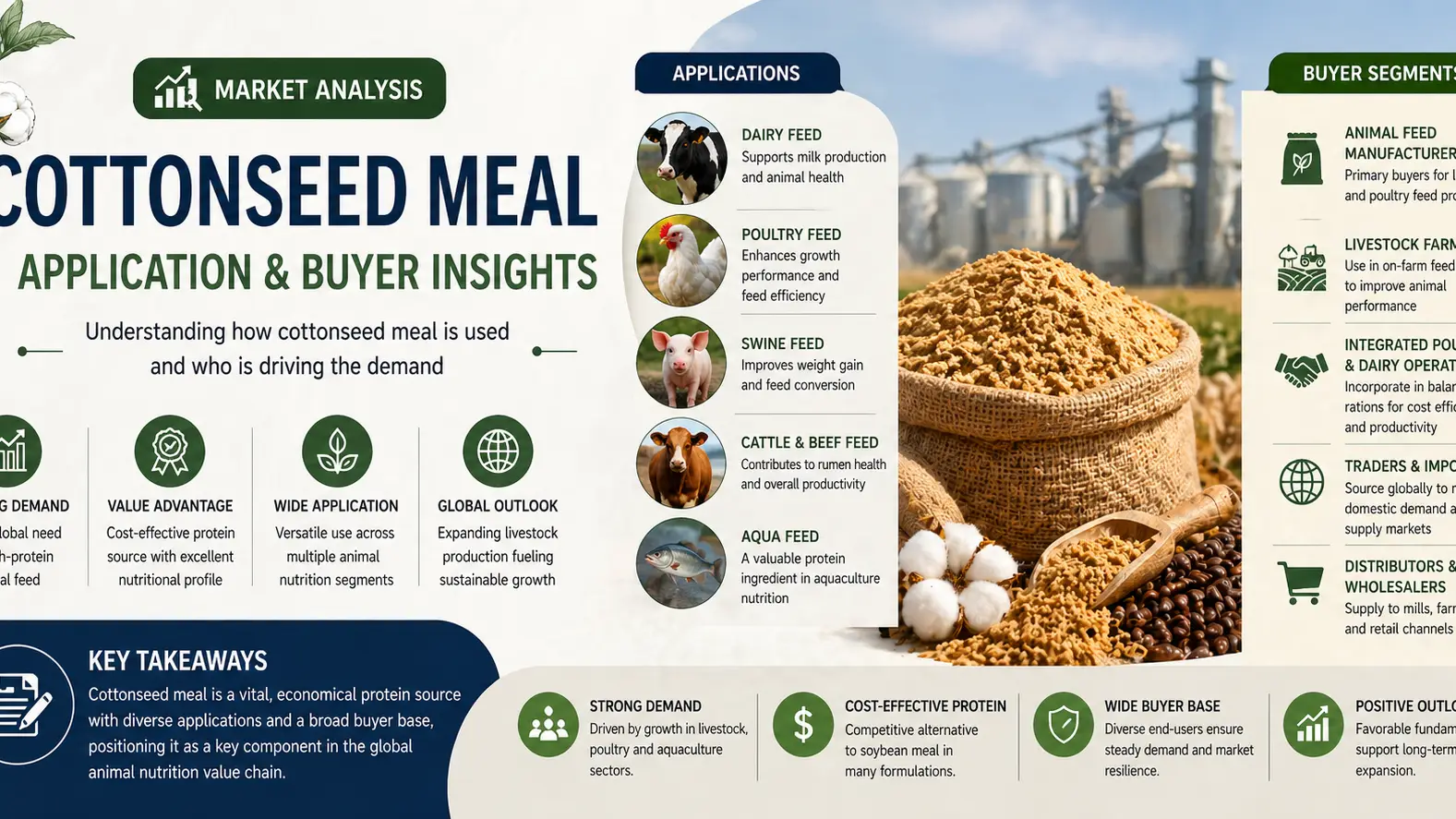
Cottonseed meal is primarily utilized in cattle, dairy, and sheep feed formulations due to its high protein content ranging between 36–41%. In 2026, feed formulators continue to integrate it as a partial substitute for soybean meal in ruminant diets, especially where cost optimization is critical. Its role in pelletized feed production has expanded, particularly in mixed feed operations targeting dairy yield enhancement. However, usage in poultry remains limited due to gossypol sensitivity, restricting its application to carefully processed formulations.
The buyer landscape is dominated by commercial feed mills, integrated livestock producers, and dairy cooperatives. Large-scale aquaculture feed manufacturers also represent a niche but growing segment. Feed mills account for over 55% of global demand, driven by industrial-scale blending requirements. Integrated livestock companies increasingly secure long-term contracts to stabilize feed input costs, especially in volatile grain markets. These buyers prioritize consistent protein levels, traceability, and competitive pricing in the range of USD 220–360/MT depending on region and processing grade.
The cottonseed meal market is highly influenced by cotton crop yields and crushing margins. In 2026, price volatility remains moderate, with global averages fluctuating between USD 220–360/MT. Trade flows are concentrated from major producers such as India, China, and the United States, which collectively contribute a significant share of the 17 million MT global output. Exchange rates, freight costs, and soybean meal substitution trends continue to shape cross-border pricing strategies.
Asia-Pacific leads consumption, driven by rapid livestock industrialization, while North America remains a key exporter with advanced crushing infrastructure. Efficient oil extraction and byproduct utilization are central to margin optimization. Supply chain integration between cotton ginners and feed processors is becoming more streamlined, reducing logistics inefficiencies and improving meal availability for downstream buyers.
Cottonseed meal is increasingly positioned as a stabilizing component in global feed formulations, balancing cost and protein supply in a tightening agricultural economy. As demand grows across livestock-intensive regions, procurement strategies are becoming more sophisticated, emphasizing long-term sourcing reliability and quality assurance. In this evolving landscape, Tradeasia International serves as a global solutions provider, connecting industrial buyers with consistent, high-quality cottonseed meal supply chains and supporting efficient cross-border trade execution for sustainable feed production.
We're committed to your privacy. Tradeasia uses the information you provide to us to contact you about our relevant content, products, and services. For more information, check out our privacy policy.


 English
 Indonesian
 简体字
简体字
 العربية
 Español
 Français
 Português
 日本語
日本語
 한국어
한국어
 Tiếng Việt