Explore our network of country and industry based websites to access localized information, product offerings, and business services across our group.
Log in to start sending quotation requests for any product.
Don't have an account? Sign Up Here
Home Calcium Propionate Market Trends, Applications & Buyer Insights 2026
Trade Insights | Applications and Buyers | 07 April 2026
Feed Ingredients
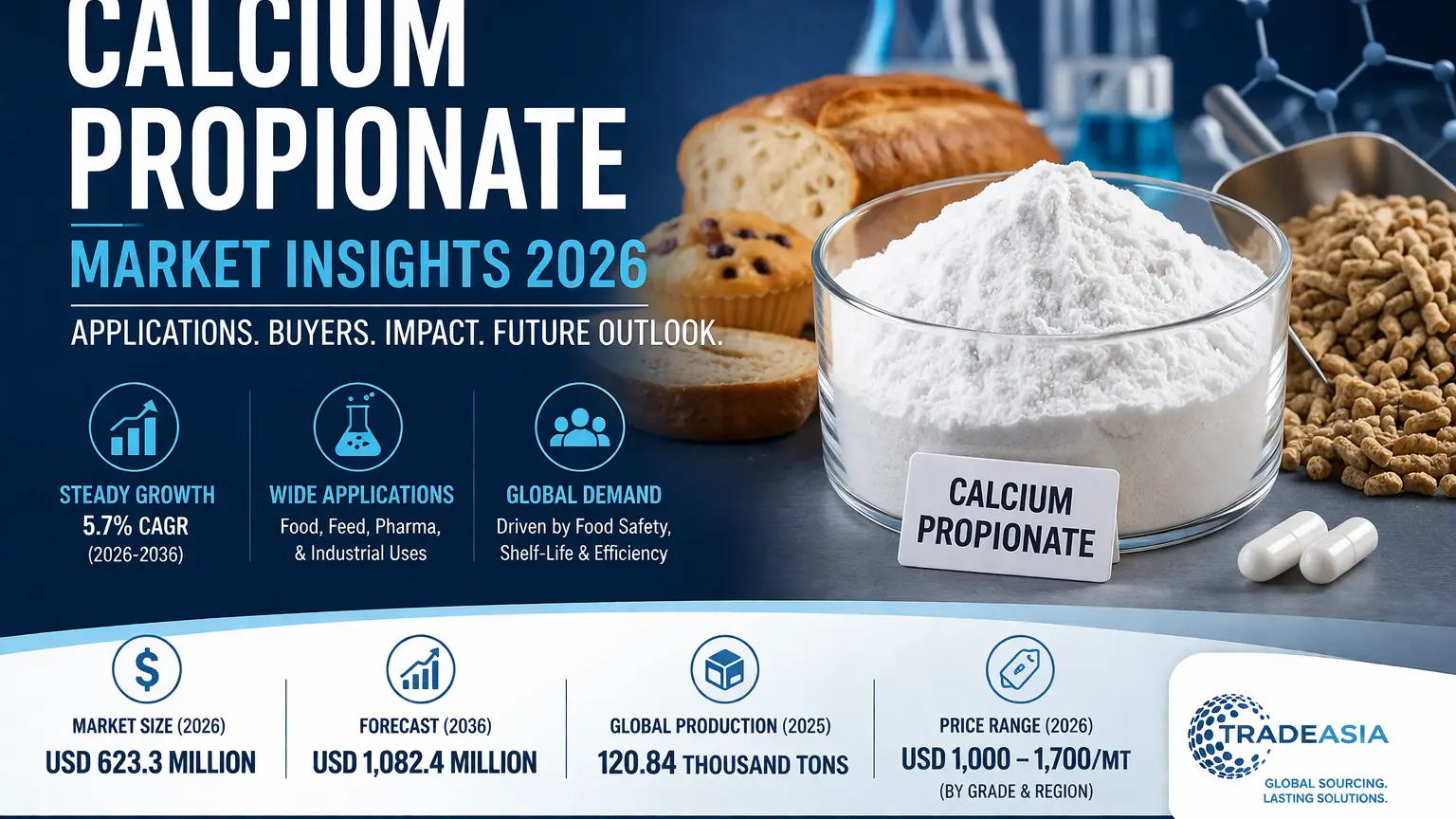
The global calcium propionate market continues to expand on the back of industrial bakery demand, where shelf-life optimization remains a strategic priority. In 2026, the market is valued at approximately USD 623.3 million, with projections indicating growth toward USD 1,082.4 million by 2036, reflecting a CAGR of 5.7%. Production volumes are also rising steadily, reaching 120.84 thousand tons in 2025, with forecasts of 179.27 thousand tons by 2034. Bulk prices for food-grade calcium propionate in 2026 are typically observed between USD 1,200–1,600/MT, depending on purity and regional logistics.
As global bakery chains scale production and distribution, calcium propionate has become indispensable for mold inhibition in packaged bread, cakes, and pastries. Its compatibility with large-scale automated baking systems ensures consistent quality and reduces waste across supply chains.
Positioned within this dynamic ecosystem, Tradeasia International offers reliable sourcing solutions for oleochemicals and related derivatives that complement preservative supply chains. By leveraging integrated procurement networks, the company supports manufacturers seeking consistency in raw material availability and pricing stability.
Industrial bakery buyers account for over 68% of application demand, underscoring the dominance of food preservation use cases. The rise of convenience foods, particularly in Asia-Pacific and the Middle East, continues to accelerate calcium propionate consumption. Large-scale food processors benefit from extended shelf life, allowing products to withstand long distribution cycles without spoilage.
Moreover, private-label brands and supermarket chains are increasingly investing in centralized baking operations, further boosting procurement volumes. This trend is reshaping supplier relationships, with buyers prioritizing long-term contracts and consistent quality standards.
The pricing of calcium propionate is closely linked to propionic acid feedstock costs and energy-intensive production processes. Fluctuations in upstream petrochemical markets directly impact price ranges, although long-term contracts often buffer volatility for major buyers.
From a strategic standpoint, suppliers are focusing on cost optimization through process efficiency and regional production hubs. This has enabled relatively stable price bands despite rising global demand.
Over the next two decades, calcium propionate is expected to maintain its role as a platform preservative chemical. While clean-label trends may introduce alternative solutions, its cost-effectiveness and regulatory acceptance will sustain demand. By 2046, the market is likely to evolve toward hybrid preservative systems, where calcium propionate remains a foundational component in industrial formulations.
Sources:
The animal nutrition industry is emerging as a high-growth vertical within the calcium propionate market, driven by the need to prevent fungal contamination in feed. With a global market CAGR ranging between 4.48% and 5.7%, feed applications are forecast to outpace traditional food segments in growth rate. Current production stands above 120 thousand tons annually, with increasing allocation toward livestock and poultry feed formulations.
Tradeasia International plays a strategic role in supporting feed additive supply chains by offering consistent access to chemical intermediates and oleochemical derivatives. This positions the company as a valuable partner for feed manufacturers navigating fluctuating raw material markets.
Feed manufacturers are among the fastest-growing buyers of calcium propionate due to its effectiveness in preventing mold growth during storage and transportation. In regions with high humidity, such as Southeast Asia and Latin America, spoilage risks significantly increase, making preservatives essential.
The poultry and swine sectors, in particular, rely heavily on calcium propionate to maintain feed quality. With global meat consumption rising, producers are scaling operations, directly increasing additive demand.
Feed-grade calcium propionate typically trades at USD 1,000–1,400/MT, slightly lower than food-grade variants due to purity differences. Large feed producers often negotiate bulk pricing, securing long-term supply agreements to mitigate volatility.
Additionally, vertical integration among agribusinesses is influencing procurement strategies, with some companies investing in in-house additive production capabilities.
Looking ahead, calcium propionate’s role in feed preservation is expected to strengthen as global protein demand rises. By 2046, innovations in feed efficiency and biosecurity will likely enhance its application, ensuring continued relevance despite emerging natural preservative alternatives.
Sources:
The surge in processed food consumption globally is a primary driver of calcium propionate demand. The market, valued at over USD 408 million in 2026, is projected to grow steadily at a CAGR of ~5.23%, supported by increasing urbanization and changing dietary habits.
Tradeasia International contributes to this evolving value chain by providing integrated sourcing solutions for food-grade additives and oleochemicals, helping manufacturers maintain operational continuity and cost competitiveness.
Urban lifestyles have shifted consumer preferences toward ready-to-eat and packaged food products. Calcium propionate enables these products to maintain freshness over extended periods, aligning with modern distribution models.
Retail expansion, particularly in emerging economies, has amplified the need for preservatives that ensure product integrity across long supply chains.
Food safety regulations across Europe and North America continue to support calcium propionate usage due to its proven efficacy and safety profile. Compliance with these standards is critical for manufacturers exporting to regulated markets.
At the same time, demand for higher purity grades is increasing, influencing pricing trends that now range between USD 1,300–1,700/MT for premium food-grade material.
Calcium propionate is expected to remain a cornerstone preservative in processed foods through 2046. While clean-label alternatives will gain traction, its cost-performance ratio ensures long-term viability in large-scale manufacturing.
Sources:
Regional dynamics are shaping calcium propionate production and trade flows, with North America holding over 35% market share, while Asia-Pacific emerges as the fastest-growing region. Global production is projected to surpass 179 thousand tons by 2034, highlighting steady capacity expansion.
Tradeasia International supports cross-border chemical distribution by connecting suppliers and buyers through efficient logistics and procurement networks, particularly in high-growth Asian markets.
Asia-Pacific’s rapid industrialization and growing food processing sector are key demand drivers. Countries like China and India are increasing domestic production capacity while also importing specialty grades to meet quality requirements.
This regional growth is reshaping global trade patterns, with exporters focusing on competitive pricing strategies.
Export prices vary widely, typically ranging from USD 1,100–1,600/MT, influenced by freight costs and regional supply-demand imbalances. Strategic warehousing and distribution hubs are becoming essential for suppliers aiming to reduce lead times.
By 2046, regional diversification of production is expected to reduce supply chain risks. Calcium propionate will continue to benefit from global food security initiatives, ensuring steady demand across both developed and emerging markets.
Sources:
Beyond food and feed, calcium propionate is gaining traction as a platform chemical in pharmaceuticals and specialty applications. The market is projected to grow at approximately 8.04% CAGR in some segments, driven by innovation and diversification.
Tradeasia International enhances this ecosystem by providing access to a wide portfolio of chemical intermediates, supporting innovation across multiple industries.
In pharmaceuticals, calcium propionate is used as a stabilizer and preservative, particularly in formulations requiring microbial control. Although this segment represents a smaller share, it offers higher margins and growth potential.
Specialty applications, including personal care, are also emerging, further diversifying demand.
Manufacturers are investing in improved formulations and blends that enhance preservative efficiency while meeting regulatory standards. This is driving demand for customized grades and higher-value products.
Pricing for specialty grades can exceed USD 1,800/MT, reflecting their niche applications and higher purity requirements.
Calcium propionate is expected to evolve into a multifunctional platform chemical by 2046, supporting food सुरक्षा, pharmaceuticals, and specialty chemicals. Its adaptability and cost efficiency will ensure continued relevance despite technological shifts.
Sources:
We're committed to your privacy. Tradeasia uses the information you provide to us to contact you about our relevant content, products, and services. For more information, check out our privacy policy.















