Explore our network of country and industry based websites to access localized information, product offerings, and business services across our group.
Log in to start sending quotation requests for any product.
Don't have an account? Sign Up Here
Home Broken Rice Market 2026: Applications, Buyers & Industrial Growth Trends
Trade Insights | Applications and Buyers | 16 April 2026
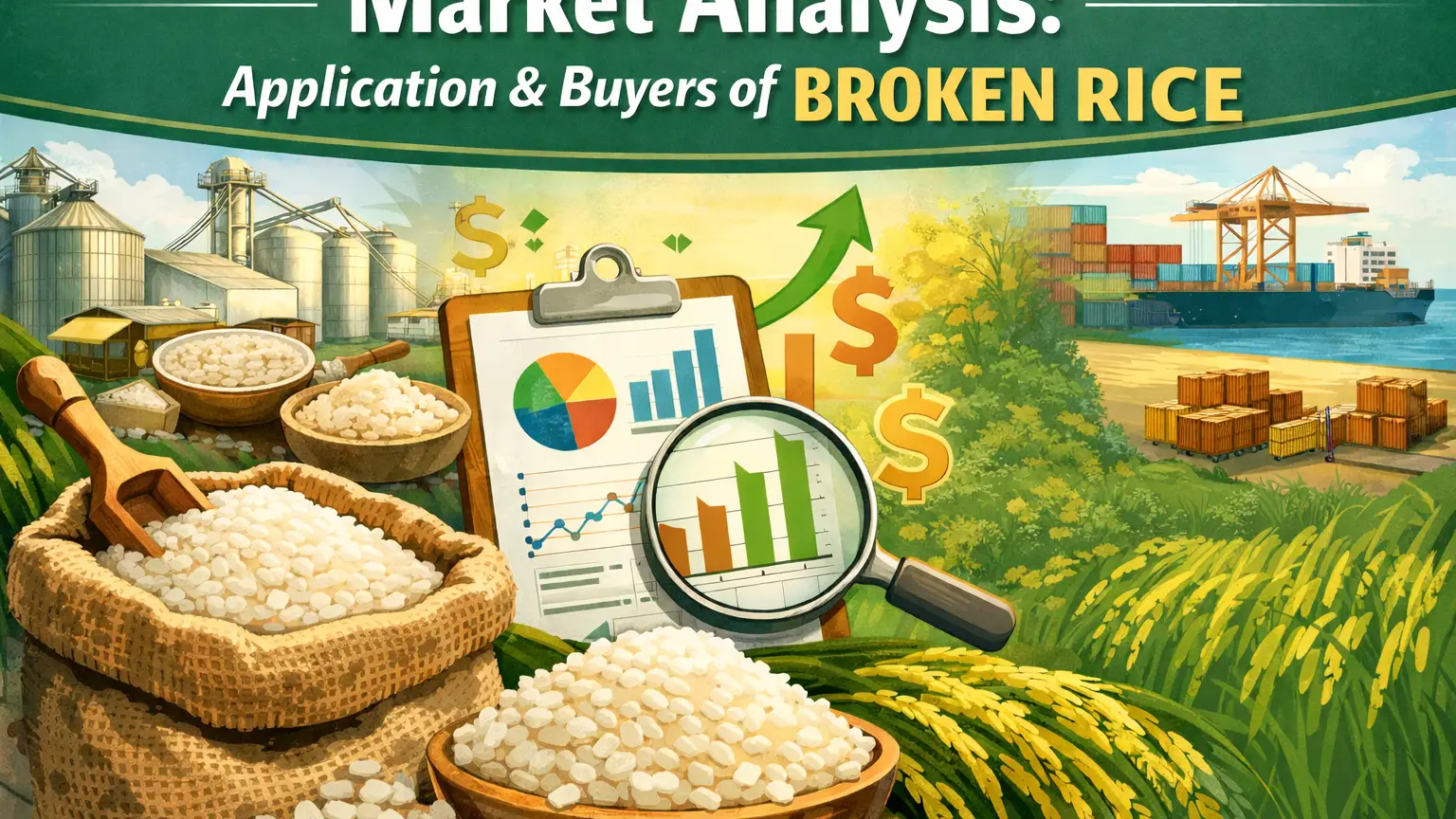
Broken rice, once treated as a low-value milling byproduct, has steadily evolved into a strategic agricultural feedstock positioned at the intersection of food, feed, fuel, and biochemical value chains. As of 2026, it is increasingly recognized as a platform chemical precursor due to its high starch content and versatile conversion potential into ethanol, glucose syrups, and fermentation-based intermediates. Global rice milling activity—exceeding 510 million metric tons annually—generates an estimated 15–20% broken fraction, ensuring a structurally abundant supply base that underpins industrial scalability.
The animal feed sector remains the most consistent buyer of broken rice, particularly in poultry and aquaculture formulations across Asia and West Africa. Its appeal lies in caloric density and cost efficiency compared to maize. In 2026, feed-grade broken rice trades in the range of USD 320–420/MT, depending on grading and origin, often undercutting corn by 10–18%. This price advantage has driven sustained adoption, especially in Vietnam, India, and Thailand, where feed millers integrate broken rice as a partial substitute to manage volatile grain imports. The global feed application segment is expanding at an estimated 4.1% CAGR, supported by rising protein consumption.
Ethanol producers represent a more cyclical but high-volume buyer segment. Government blending mandates in India and Southeast Asia initially boosted broken rice demand; however, shifting economics have redirected procurement toward cheaper maize. Ethanol-grade broken rice pricing in 2026 fluctuates around USD 350–400/MT, but demand elasticity is high, with substitution occurring whenever maize falls below USD 300/MT equivalent. This volatility highlights the sensitivity of biofuel buyers to feedstock arbitrage, making procurement strategies heavily dependent on policy incentives and crop cycles.
Food manufacturers and starch processors constitute a stable downstream market, using broken rice in noodles, snacks, brewing, and rice flour applications. With global processed food demand expanding at 3.5–5% CAGR, broken rice is increasingly valued for its uniform starch composition. Industrial buyers typically source at USD 340–380/MT, benefiting from lower input costs versus whole grain rice while maintaining functional performance in extrusion and fermentation processes. This segment is also the most resilient to substitution risks due to established formulation dependencies.
A rapidly evolving buyer class includes biochemical firms and bioplastic producers leveraging broken rice as a fermentation substrate. With starch content exceeding 70%, it is a competitive feedstock for lactic acid, bioethanol, and biodegradable polymer precursors. Pilot-scale biorefineries in Asia report conversion efficiencies improving by 12–15% year-on-year, strengthening long-term viability. While still niche, this segment signals a structural shift toward circular bioeconomy integration, positioning broken rice as a transitional platform chemical in decentralized production ecosystems.
From a market structure perspective, broken rice remains highly price-sensitive but increasingly diversified across industrial buyers. Its role is shifting from a simple feed substitute to a multi-sectoral input embedded in energy, food, and biochemical systems. However, supply chain fragmentation and feedstock switching risk continue to define procurement strategies in 2026.
Within this evolving landscape, integrated suppliers play a crucial role in stabilizing procurement and logistics flows. Companies such as Tradeasia International increasingly support global buyers by aligning agricultural sourcing with industrial demand cycles, offering consistency in a market shaped by volatility, arbitrage-driven switching, and regional supply imbalances.
Broken rice is no longer merely a milling residue—it is becoming a strategic agri-industrial platform chemical, bridging traditional agriculture with emerging bio-based economies while redefining global buyer behavior across multiple industries.
We're committed to your privacy. Tradeasia uses the information you provide to us to contact you about our relevant content, products, and services. For more information, check out our privacy policy.


 English
 Indonesian
 简体字
简体字
 العربية
 Español
 Français
 Português
 日本語
日本語
 한국어
한국어
 Tiếng Việt




















