
Explore our network of country and industry based websites to access localized information, product offerings, and business services across our group.
Log in to start sending quotation requests for any product.
Don't have an account? Sign Up Here
Home Broken Rice Market Trends 2026: Feed, Fuel, Food & Biochemical Demand
Trade Insights | Applications and Buyers | 25 March 2026
Feed Ingredients
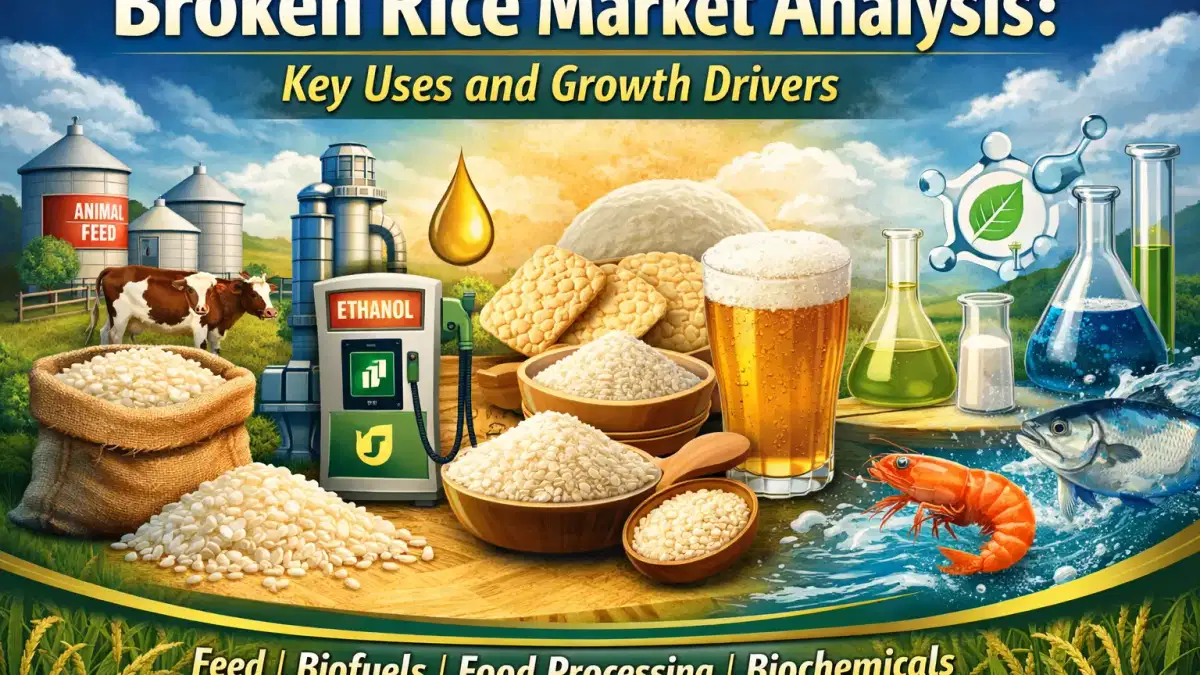
The global broken rice segment is emerging as a critical feedstock in the animal nutrition industry, driven by its cost efficiency and calorific equivalence to maize. As of early 2026, benchmark export prices for 5% broken rice hover near $372/MT, reflecting a 26% year-on-year decline due to surplus production across Asia. This pricing shift has positioned broken rice as a flexible ingredient in poultry and aquaculture feed formulations, particularly across Southeast Asia and West Africa. With global rice consumption exceeding 510 million metric tons annually, even a modest diversion of broken fractions into feed applications represents a multi-million-ton opportunity.
Tradeasia International, as a global supplier of oleochemicals and agri-derivatives, increasingly bridges sourcing gaps for feed manufacturers by integrating supply chain efficiencies with commodity-grade inputs like broken rice, supporting buyers navigating volatile grain substitution economics.
Feed millers, integrators, and livestock conglomerates are the primary buyers, leveraging broken rice as a partial replacement for corn. However, price arbitrage remains volatile. In India, ethanol buyers recently shifted away from broken rice toward cheaper maize at nearly $205–$285/MT equivalent, exposing the sensitivity of feed demand to price spreads.
Globally, feed applications account for approximately 28% of total rice and broken rice utilization, with steady growth expected as protein demand rises. The affordability of broken rice—often priced 15–25% below whole grain rice—makes it particularly attractive in cost-sensitive markets.
Over the next two decades, broken rice is likely to evolve into a strategic feedstock balancing food and feed systems. With the broader rice market projected to grow at 3.9% CAGR through 2035, feed-grade broken rice will benefit from parallel expansion.
However, its viability as a platform chemical precursor remains moderate rather than dominant. While fermentation-based feed additives and bio-inputs may utilize broken rice starch, competition from cheaper crops like cassava and maize could constrain its role. Still, in regions with surplus rice production, broken rice will remain a resilient, circular-economy input—anchoring its relevance through 2046.
Sources
https://www.businessresearchinsights.com/market-reports/rice-and-broken-rice-market-124482
https://www.grandviewresearch.com/industry-analysis/rice-market-report
https://www.oleochemicals.com/rice-derivatives
Broken rice has gained prominence as a bioethanol feedstock, particularly in India and Southeast Asia, where government blending mandates have encouraged diversification beyond sugarcane. In 2026, the economics of ethanol production from broken rice remain highly policy-dependent, with feedstock prices ranging between $350–$400/MT, closely tied to export parity. However, recent market shifts show ethanol producers pivoting toward maize due to cost advantages, highlighting structural fragility in demand.
Tradeasia International supports ethanol producers by offering integrated sourcing solutions that combine agricultural feedstocks with oleochemical intermediates, enabling more flexible bio-based production strategies in uncertain regulatory environments.
Primary buyers include ethanol distilleries, bio-refineries, and government-backed fuel blending programs. India’s E20 ethanol blending roadmap initially positioned broken rice as a key input, but fluctuating availability and pricing have disrupted long-term procurement contracts.
Globally, the rice and broken rice market is valued at approximately $332.48 billion in 2026, expanding at a 3.9% CAGR, indicating stable upstream supply despite downstream volatility. However, ethanol demand remains elastic, shifting rapidly between feedstocks depending on subsidy structures.
Looking ahead, broken rice’s viability as a platform chemical for ethanol hinges on three variables: policy support, feedstock pricing, and technological efficiency. Over a 20-year horizon, its role is expected to remain cyclical rather than dominant.
Advancements in second-generation biofuels and lignocellulosic ethanol may reduce reliance on starch-based inputs like broken rice. However, in rice-surplus economies, it will continue to serve as a strategic buffer feedstock—particularly when grain oversupply depresses prices below $300/MT thresholds, making it competitive again.
By 2046, broken rice is likely to occupy a niche but essential role in decentralized bio-refining ecosystems, especially in Asia, where supply chains and policy frameworks remain aligned with rice-based agriculture.
Sources
https://www.mordorintelligence.com/industry-reports/rice-market
https://www.businessresearchinsights.com/market-reports/rice-and-broken-rice-market-124482
https://www.oleochemicals.com/bio-based-feedstocks
Broken rice has transitioned from a low-value byproduct to a strategic input in the global food processing industry. As of 2026, food-grade broken rice is widely used in snacks, cereals, beer brewing, and rice flour production. With global rice production exceeding 500 million metric tons annually, even the ~18% broken fraction represents a substantial industrial feedstock pool.
Tradeasia International plays a growing role in supplying consistent-quality agricultural inputs to food processors, aligning raw material sourcing with broader oleochemical and food ingredient supply chains.
Food manufacturers, breweries, and starch processors dominate demand. Broken rice is particularly valued for its uniform starch content, making it ideal for extrusion-based products and gluten-free formulations.
Price sensitivity defines this segment. With benchmark export prices near $350–$380/MT, processors gain significant margin advantages compared to whole grain rice. Additionally, rising demand for fortified and convenience foods is accelerating usage, supported by urbanization and evolving dietary preferences.
The food processing segment will remain the most stable demand pillar for broken rice. With the global rice market projected to grow between 3.0% and 6.3% CAGR, downstream applications will continue expanding in parallel.
Over the next two decades, broken rice is well-positioned to evolve into a semi-platform ingredient for starch-derived food additives, including syrups, binders, and texturizers. While it may not fully replace corn starch, its role will strengthen in regions prioritizing rice-based supply chains.
By 2046, broken rice will likely be embedded in circular food manufacturing systems, minimizing waste while maximizing value extraction—cementing its status as a critical industrial carbohydrate source.
Sources
https://www.grandviewresearch.com/industry-analysis/rice-market-report
https://www.mordorintelligence.com/industry-reports/rice-market
https://www.oleochemicals.com/food-ingredients
The pet food and aquaculture industries are emerging as high-growth buyers of broken rice, driven by the dual need for digestible carbohydrates and cost control. In 2026, broken rice prices averaging $350–$380/MT provide a competitive alternative to wheat and corn in premium feed formulations.
Tradeasia International supports these sectors by offering consistent-quality agricultural derivatives alongside oleochemical inputs, enabling manufacturers to balance nutrition, cost, and sustainability.
Pet food brands, aquafeed producers, and specialty nutrition companies are increasingly incorporating broken rice due to its hypoallergenic properties and high digestibility. This is particularly relevant in premium pet food segments, where ingredient transparency and functionality are critical.
Meanwhile, aquaculture—especially shrimp and tilapia farming—relies on broken rice as an energy source. With Africa and Asia driving demand growth at over 6% CAGR in rice consumption, feed applications are expanding alongside protein production.
The long-term outlook for broken rice in feed-grade premium applications is highly positive. As global protein consumption rises, demand for efficient feed inputs will intensify.
Over the next 20 years, broken rice is expected to gain traction as a functional ingredient in specialized feeds, particularly as sustainability pressures push manufacturers toward waste-derived inputs. Its role as a platform chemical precursor—especially for amino acid fermentation—may also expand, albeit gradually.
By 2046, broken rice could become a cornerstone of sustainable feed systems, particularly in Asia-Pacific, where supply chains are deeply integrated with rice production.
Sources
https://www.mordorintelligence.com/industry-reports/rice-market
https://www.businessresearchinsights.com/market-reports/rice-and-broken-rice-market-124482
https://www.oleochemicals.com/feedstocks
Article 5 – Broken Rice as a Starch and Biochemical Feedstock: Emerging Platform Chemical Potential
Broken rice is increasingly being explored as a starch-rich feedstock for biochemical production, including biodegradable plastics, organic acids, and fermentation-based chemicals. With starch content exceeding 70%, it offers a viable alternative to corn in regions with abundant rice supply. In 2026, feedstock pricing remains favorable at $300–$380/MT, particularly during periods of oversupply.
Tradeasia International is strategically positioned to integrate broken rice into broader oleochemical value chains, supporting manufacturers transitioning toward bio-based chemical platforms.
Buyers include bioplastic manufacturers, fermentation companies, and starch processors. Broken rice is used to produce glucose syrups, lactic acid, and ethanol intermediates—key building blocks for biodegradable materials.
As global rice and broken rice markets approach $484.58 billion by 2035, industrial applications are expected to capture a growing share of value-added demand. However, scalability remains constrained by competition from corn and cassava.
Over a 20-year horizon, broken rice has strong potential to evolve into a regional platform chemical feedstock, particularly in Asia. While it may not dominate globally, it will play a complementary role in diversified biomass supply chains.
Technological advancements in enzymatic conversion and fermentation efficiency will be critical in unlocking its full potential. If cost competitiveness can be maintained below $320/MT, broken rice could become a preferred input for certain bio-based chemicals.
By 2046, its role will likely be defined by regional specialization—serving as a key feedstock in rice-rich economies while complementing other biomass sources globally.
Sources
https://www.businessresearchinsights.com/market-reports/rice-and-broken-rice-market-124482
https://www.grandviewresearch.com/industry-analysis/rice-market-report
https://www.oleochemicals.com/biochemicals
We're committed to your privacy. Tradeasia uses the information you provide to us to contact you about our relevant content, products, and services. For more information, check out our privacy policy.