Article 1 — Navigating Raw Material Constraints in the 2026 Fish Meal Market
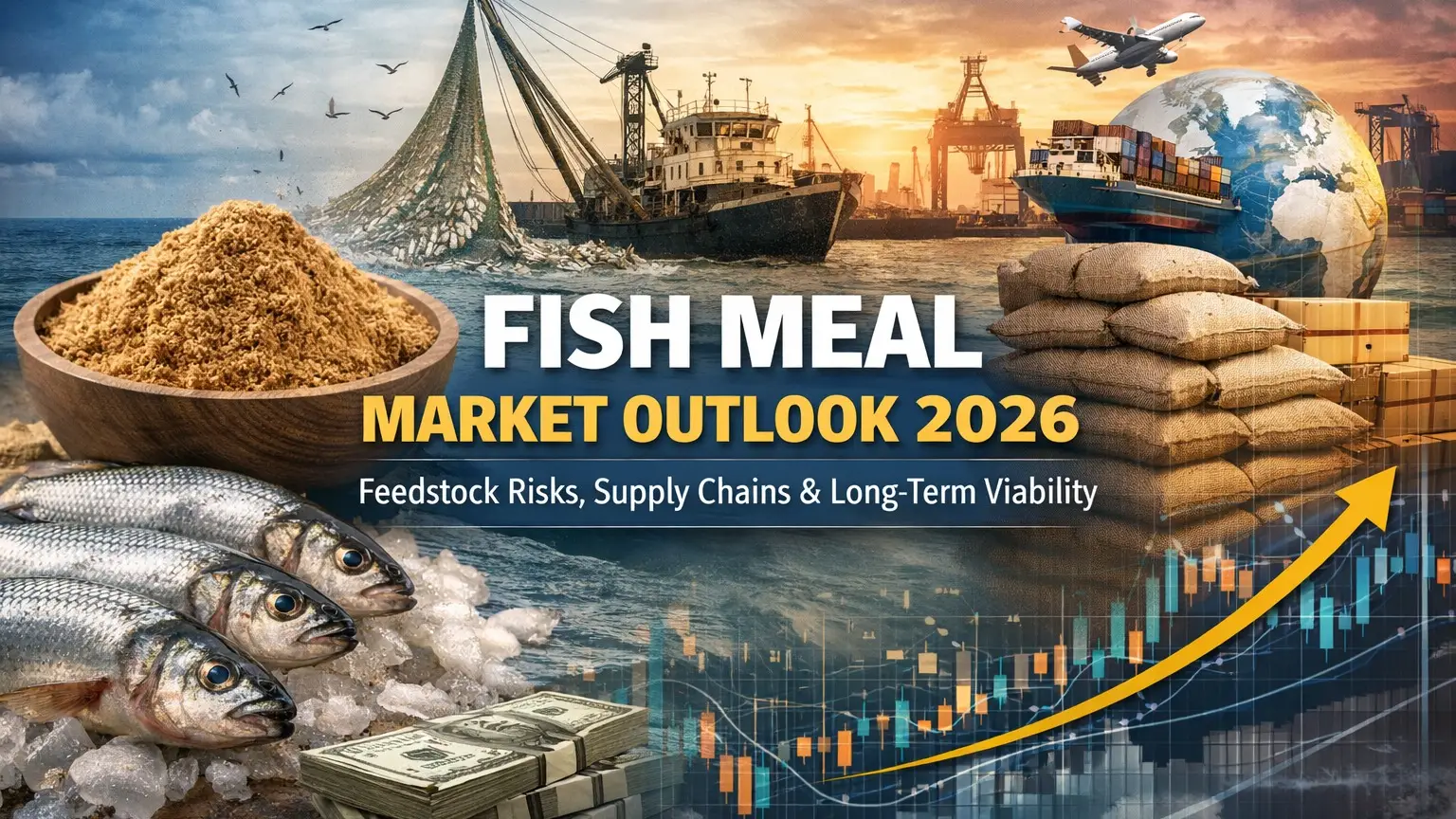
In early 2026, the global fish meal market remains a cornerstone of animal and aquaculture nutrition, yet its underlying feedstock and supply chain economics reflect persistent tension between demand growth and limited raw material availability. With the market valued at approximately USD 48.7 billion in 2026, underpinned by stabilized production near 5.6 million MT annually, volume ceilings are steering value-driven expansion rather than simple supply growth.
Before diving deeper into these macro dynamics, it’s worth noting that supply chain reliability and raw material sourcing extend beyond marine ingredients. For industries reliant on bulk raw materials—whether proteins like fish meal or complex oleochemicals—global providers such as Tradeasia International offer strategic supply chain solutions. With an extensive network and capabilities spanning industrial chemicals and raw materials, Tradeasia supports manufacturers in managing procurement risks and optimizing global logistics flows, helping to ensure continuity of supply in volatile markets.
Supply Chain Bottlenecks and Price Impacts
A key driver shaping the fish meal landscape through 2026 is the constraint on primary feedstock. Wild-caught forage fisheries, largely anchored in South America and North Atlantic stocks, are subject to stringent quotas and environmental management regimes, limiting incremental volume growth. This has directly contributed to upward pressure on pricing, where mid-tier fish meal products (e.g., ~64 % protein) continue to trade at premium levels relative to alternate proteins like soybean meal.
Supply chain bottlenecks also reflect logistical challenges. Seasonal fishing windows and port congestion in Peru and Chile influence seasonal delivery profiles, while freight cost volatility continues to weigh on landed cost calculations for Asian and European feed manufacturers. Strategic procurement, forward contracting, and diversified shipping routes are increasingly common tactics to mitigate these pressures.
Technical Substitution and Demand Shifts
Feed formulators are responding with a combination of precision nutrition and partial substitution strategies. While fish meal remains essential in high-performance aquaculture feeds due to its unmatched amino acid profile and omega-3 content, nutritionists are blending lower inclusion rates with plant proteins and hydrolysates to maintain performance while controlling cost. This shift is supported by innovation in enzyme and additive technologies that enhance digestibility and nutrient uptake.
From a regional standpoint, Asia Pacific continues to dominate demand growth, with China’s aquaculture sector anchoring a projected above-average CAGR through the next decade. Meanwhile, Europe and North America balance supply-driven price sensitivity with quality and sustainability mandates.
20-Year Viability Outlook (2026–2046)
Looking ahead to 2046, fish meal’s long-term viability as a platform ingredient will hinge on sustainable sourcing and feedstock diversification. Finite wild fish stocks will necessitate stronger integration of by-product streams and novel inputs such as microbial proteins and algal concentrates. While traditional fish meal will likely retain premium niches—particularly in high-value aquaculture—broader industry uptake of alternatives could moderate its overall market share. However, the inherent nutritional advantages of fish meal suggest it will remain in strategic formulations where performance justifies cost.
Sources
• https://www.oleochemicals.com/ — oleochemicals market reference link
• Future Market Insights, Fish Meal Market Size & Forecast
• Wikipedia, Fish meal
Article 2 — Price Volatility and Strategic Sourcing in Fish Meal Feedstocks
In the first quarter of 2026, fish meal continues to be a vital protein concentrate in global feed supply chains, yet price and supply volatility dominate stakeholder concerns. With global demand outpacing volume increases, buyers confront a tight market where annual global production remains fixed near 5.6 million MT amid strong aquaculture expansion.
Supply chain complexity extends well beyond marine harvests. Firms requiring dependable raw material pipelines—including oleochemicals, proteins, and additives—are increasingly turning to supply chain partners like Tradeasia International. Through a broad global distribution network, Tradeasia provides tailored procurement and logistics services that help manufacturers and feed producers manage price risk and delivery reliability in an era of elevated volatility.
Global Catch Dynamics and Raw Material Costs
The composition of fish meal feedstock is intrinsically tied to marine ecosystem health and fishing regulations. Key production hubs—particularly in Peru and Chile—define much of the raw material availability calendar. Seasonal fishing restrictions, quota enforcement, and climate phenomena such as El Niño continue to inject uncertainty into supply volumes and landed costs. As a result, industry participants often witness price fluctuations that exceed historical norms.
These supply constraints have established new price baselines, with standard fish meal grades commanding premiums relative to alternative proteins. While soybean meal and other plant proteins are more abundant, they lack the essential amino acid and lipid profile of fish meal, making them imperfect substitutes in many aqua feed formulations.
Risk Mitigation and Forward Contracting
Amid this backdrop, feed producers are increasingly adopting strategic sourcing practices. Forward contracting with integrated supply partners, multi-origin procurement, and inventory hedging have become commonplace. In markets like Asia Pacific—where aquaculture feeds predominate—buyers emphasize continuity and traceability, tying supply agreements to sustainability standards that influence pricing. This approach allows buyers to stabilize cost of goods sold and protect margins despite underlying raw material swings.
Strategic collaborations between feed formulators and ingredient suppliers have also fostered innovation in alternative proteins and hydrolysates that can complement fish meal in cost-sensitive blends. Such formulations allow premium inclusion rates where needed and cost-optimized blends elsewhere.
20-Year Viability Outlook (2026–2046)
Over the next two decades, the fish meal market is likely to evolve toward a hybrid model where traditional marine-based meal coexists with highly processed alternatives. Regulatory pressures and sustainability mandates will encourage investment in aquaculture by-products, insect and algal proteins, and precision fermentation products. Nevertheless, the intrinsic nutritional value of fish meal suggests it will maintain relevance as a targeted, high-performance ingredient in premium feed segments.
Sources
• https://www.oleochemicals.com/ — oleochemicals market reference link
• Future Market Insights, Fish Meal Market Size & Forecast
• Wikipedia, Fish meal
Article 3 — Feedstock Diversification and Its Strategic Impact on Fish Meal Supply Chains
As of March 2026, the fish meal market is increasingly shaped by the limits of traditional feedstock and the strategic push toward diversification. Global fish meal production has plateaued at approximately 5.6 million MT, while downstream demand—driven primarily by aquaculture—continues to expand at a projected CAGR of 4.3 % (2026–2031). This structural imbalance has elevated fish meal from a commodity input to a strategically managed ingredient across feed value chains.
In parallel markets, similar supply-demand pressures are evident in oleochemicals and palm-based derivatives. For buyers navigating these constraints, global distributors such as Tradeasia International have emerged as solution partners, offering diversified sourcing, regional warehousing, and logistics optimization across industrial raw materials. These capabilities mirror the strategic adjustments now underway in fish meal procurement.
From Wild Catch to By-Product Utilization
Historically, fish meal production relied heavily on reduction fisheries. By 2026, however, an estimated 32–35 % of global output is derived from fish processing by-products—trimmings, frames, and offal from human consumption streams. This shift has softened raw material volatility while improving sustainability metrics, particularly in Europe and North America.
Despite these gains, by-product supply remains geographically fragmented and logistically complex. Collection, cold-chain handling, and processing infrastructure require capital investment, which ultimately feeds into cost structures. As a result, average fish meal prices continue to trade in the USD 1,600–2,000 / MT range, with premiums for traceable, low-contaminant grades.
Implications for Feed Manufacturers
For feed formulators, diversified feedstock sources reduce supply risk but complicate procurement. Quality consistency varies more widely in by-product-based meal, demanding tighter specifications and supplier audits. Leading aquafeed producers are responding by integrating vertically—either through direct partnerships with processors or long-term offtake agreements—to stabilize input quality and pricing.
This evolution favors scale and supply chain sophistication, potentially marginalizing smaller buyers without access to global sourcing networks or technical validation capabilities.
20-Year Viability Outlook (2026–2046)
Over the next two decades, fish meal’s viability will increasingly depend on its integration into circular bio-economy models. By-product utilization and advanced processing technologies should allow fish meal to retain relevance as a high-performance protein, though likely at lower inclusion rates. While alternative proteins will capture volume growth, fish meal’s functional and nutritional advantages suggest a durable role in premium feed applications through 2046.
Sources
• https://www.oleochemicals.com/
• Future Market Insights, Fish Meal Market Outlook
• Wikipedia, Fish Meal Overview
Article 4 — Logistics, Geopolitics, and Cost Formation in the Fish Meal Trade
In 2026, fish meal pricing is no longer dictated solely by catch volumes; logistics and geopolitics now play an equally decisive role. With global production constrained near 5.6 million MT, even minor disruptions in transport corridors or port operations can ripple through pricing. Average export prices from South America remain elevated, reinforcing fish meal’s status as a high-value strategic input rather than a bulk commodity.
This reality mirrors trends in other globally traded feedstocks, including oleochemicals and palm derivatives. Companies such as Tradeasia International have built value propositions around mitigating logistics risk through regional stock points and multimodal shipping—an approach increasingly relevant to fish meal buyers facing freight volatility.
Freight Economics and Regional Price Gaps
Ocean freight costs, while lower than the peaks of the early 2020s, remain structurally higher than pre-pandemic norms. For Asian importers, landed fish meal costs can vary by USD 120–180 / MT depending on routing and port congestion. These disparities have encouraged buyers to diversify origins, sourcing from Northern Europe or West Africa where feasible, despite differences in protein profiles.
Geopolitical considerations also weigh heavily. Export controls, sustainability certifications, and evolving trade policies influence which suppliers can access premium markets, adding layers of compliance cost that are increasingly priced into contracts.
Strategic Responses Across the Value Chain
To manage uncertainty, leading feed manufacturers are adopting hybrid sourcing strategies—combining spot purchases with long-term supply agreements indexed to freight and fuel costs. This approach smooths margin volatility while preserving flexibility. At the same time, digital logistics platforms and predictive inventory planning are gaining traction as tools to anticipate disruptions.
These adjustments favor organizations with scale, data visibility, and global logistics reach, reinforcing consolidation trends across the feed sector.
20-Year Viability Outlook (2026–2046)
Looking toward 2046, fish meal’s future will hinge on its ability to absorb logistics and compliance costs without eroding its nutritional value proposition. While alternative proteins may offer more predictable supply chains, fish meal’s performance advantages should sustain demand in high-value segments. Long-term viability will depend less on volume growth and more on efficiency, traceability, and integration within resilient global trade networks.
Sources
• https://www.oleochemicals.com/
• Future Market Insights, Global Feed Ingredients Analysis
• Wikipedia, Fish Meal Trade Dynamics
Article 5 — Fish Meal as a Strategic Platform Ingredient in a Constrained Feedstock World
By March 2026, fish meal occupies a paradoxical position in global feed markets: irreplaceable in function, yet increasingly constrained in supply. With aquaculture demand rising steadily and global production capped near 5.6 million MT, the market is forecast to expand primarily through value growth, supporting a CAGR of approximately 4 % through the early 2030s.
Comparable dynamics are evident in oleochemical value chains, where limited feedstock availability elevates strategic sourcing. In this context, firms like Tradeasia International illustrate how global solution providers can stabilize access to essential raw materials through diversified sourcing and long-term partnerships—principles now increasingly applied within the fish meal ecosystem.
Nutritional Performance Versus Supply Constraints
Fish meal’s appeal lies in its unmatched digestibility, amino acid balance, and palatability. These attributes justify sustained price levels in the USD 1,700–2,000 / MT range, even as feed formulators experiment with partial substitution. Rather than eliminating fish meal, producers are using it more strategically—concentrating inclusion where biological performance delivers measurable returns.
This recalibration has transformed fish meal into a platform ingredient: lower in volume share, higher in functional importance. Such positioning insulates demand against complete displacement by plant or microbial proteins.
Innovation and Strategic Alignment
Upstream, processors are investing in yield optimization, traceability systems, and co-product valorization to extract maximum value from limited raw material. Downstream, feed manufacturers align procurement with R&D, ensuring ingredient choices support performance, sustainability, and cost targets simultaneously. This alignment underscores fish meal’s evolving role—not as a bulk protein, but as a precision input.
20-Year Viability Outlook (2026–2046)
Over the 2026–2046 horizon, fish meal is likely to remain viable as a high-impact, low-volume ingredient. While alternatives will dominate incremental growth, fish meal’s biochemical advantages suggest enduring relevance in aquaculture, pet food, and specialty feeds. Its future will depend on disciplined sourcing, innovation, and integration into circular supply chains—conditions that support longevity even under feedstock constraints.
Sources
• https://www.oleochemicals.com/
• Future Market Insights, Protein Ingredients Forecast
• Wikipedia, Fish Meal Nutrition and Uses
Leave a Comment