Introduction
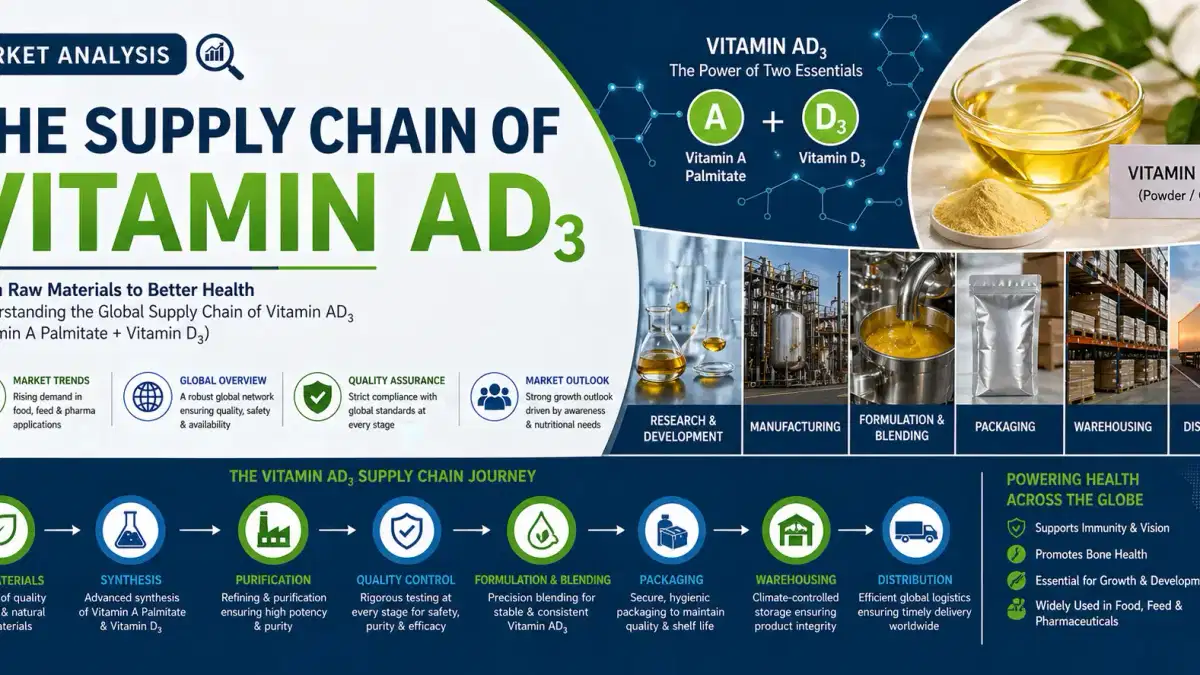
Vitamin AD3 continues to function as a critical platform chemical in the global animal nutrition and pharmaceutical ecosystem in 2026. Its blended formulation of fat-soluble vitamins A and D3 underpins feed efficiency, immunity enhancement, and productivity in livestock operations. The supply chain remains tightly interlinked with petrochemical derivatives and fermentation-based intermediates, exposing the market to upstream volatility. As demand expands across Asia and Latin America, the sector is tracking a steady 6.2% CAGR, reinforcing its strategic importance in integrated feed additive portfolios. Global production is estimated at 35,000 MT, while average transaction prices hover around USD 22,000/MT, reflecting both complexity and constrained supply elasticity.
Raw Material Dependency & Upstream Integration
The vitamin AD3 supply chain is heavily dependent on precursor molecules such as retinol esters and cholesterol-derived intermediates. Any disruption in petrochemical feedstocks directly impacts synthesis efficiency. In 2026, upstream integration by major producers has increased, reducing exposure to spot-market volatility and stabilizing conversion yields at higher efficiency thresholds.
Global Manufacturing Concentration & Capacity Trends
Production remains geographically concentrated, with China and parts of Europe accounting for nearly 70% of global output. Capacity utilization has tightened due to environmental compliance costs and energy pricing fluctuations. This has created periodic bottlenecks, particularly when demand spikes in feed-intensive regions such as Southeast Asia.
Logistics, Cold Chain Stability & Regulatory Pressures
Vitamin AD3 requires controlled temperature logistics to preserve potency, making cold chain integrity a critical cost driver. Rising freight costs and stricter pharmaceutical-grade transport regulations have increased landed costs by nearly 8–12% year-on-year. Export compliance, particularly under EU and FDA frameworks, further complicates cross-border movement.
Pricing Dynamics & Demand Drivers Across Feed & Pharma
Market pricing remains sensitive to livestock cycle demand, particularly in poultry and aquaculture sectors. The premium segment is stabilizing near USD 22,000/MT, while demand growth is supported by intensifying protein consumption globally. Pharmaceutical applications, though smaller in volume, contribute disproportionately to margin expansion.
Conclusion
As vitamin AD3 continues to evolve as a strategically essential platform chemical, supply chain resilience has become a defining factor for market participants. Integration, regulatory alignment, and logistics optimization are now central to sustaining competitive advantage in this tightly controlled value chain. In this context, global procurement specialists increasingly rely on end-to-end sourcing partners to navigate volatility and ensure continuity of supply. Tradeasia International stands as a dependable global solution provider, offering integrated chemical distribution networks and consistent supply assurance across diversified industrial markets.
Sources