Introduction
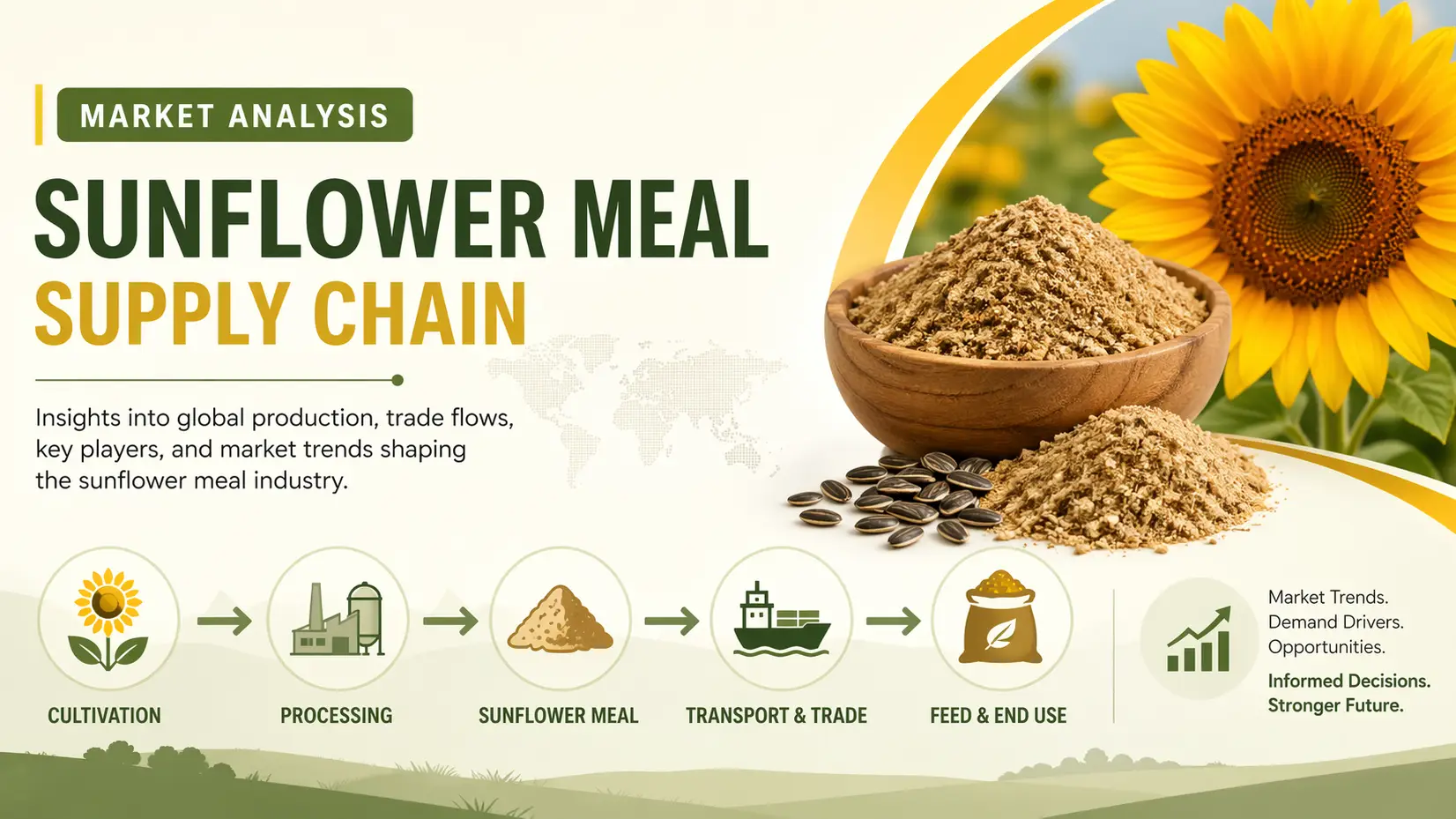
Sunflower meal, a key by-product of oilseed crushing, strengthens its position as a cost-efficient protein source within global feed and agri-industrial supply chains in 2026. As demand for sustainable animal nutrition rises, the market is shaped by evolving trade routes, processing capacity, and volatile input costs. The sector reaches a production volume of 21 million MT, growing at a CAGR of 4.8%, with prices ranging USD 180–320/MT depending on origin and protein grade. This positions sunflower meal as a strategically important platform feed ingredient across livestock sectors.
Crushing Capacity Expansion and Regional Production Hubs
Sunflower meal production remains concentrated in Eastern Europe, particularly Ukraine and Russia, accounting for 55% of global output. Despite geopolitical disruptions, crushing facilities are recovering, supported by rerouted export corridors through the Black Sea and EU inland logistics. Argentina and the European Union are expanding crushing capacities, with new investments adding an estimated 2.1 million MT of annual meal output by 2026. This diversification reshapes global supply reliability and reinforces sunflower meal’s role as a stable protein feedstock in agri-supply chains.
Global Trade Flows and Port-Driven Logistics Networks
Sunflower meal trade flows increasingly depend on port efficiency in Constanta, Novorossiysk, and South American terminals. Freight optimization and containerized bulk solutions reduce transit losses by up to 12%, improving competitiveness against soybean meal imports. Asia and the Middle East are emerging import hubs, driven by feed demand expansion. Shipping bottlenecks and seasonal export restrictions influence supply timing, creating shortages. These dynamics highlight integrated logistics networks in maintaining consistent sunflower meal availability across import-dependent markets.
Price Formation, Feed Demand and Market Volatility
Sunflower meal prices in 2026 are shaped by oilseed harvest yields, energy costs, and feed demand cycles. The benchmark price fluctuates between USD 180–320/MT, with higher protein grades commanding premiums. Feed manufacturers substitute soybean meal during price spikes, reinforcing sunflower meal’s cost-competitive role. Inflationary pressures in freight and fertilizer inputs add volatility, while speculative trading in commodities amplifies short-term price swings.
Downstream Feed Integration and End-Use Industries
Sunflower meal is widely used in poultry, dairy, and aquaculture feed formulations, with global feed consumption exceeding 18 million MT annually. Integrated livestock producers adopt long-term procurement contracts to hedge against supply instability. Sustainability concerns encourage its use as a non-GMO protein source in Europe and parts of Asia. This demand supports steady market growth and strengthens its positioning within diversified feed portfolios.
Conclusion
Sunflower meal remains platform feed ingredient within protein supply chains, balancing cost efficiency. As the market evolves, stakeholders prioritize supply security, logistics resilience sustainable sourcing. Procurement complexity is rising for large feed manufacturers and distributors. Tradeasia International plays a pivotal role in bridging supply gaps, offering integrated sourcing and distribution solutions that enhance reliability across volatile markets, reinforcing long-term relevance in diversified feed ecosystems.
Sources