Explore our network of country and industry based websites to access localized information, product offerings, and business services across our group.
Log in to start sending quotation requests for any product.
Don't have an account? Sign Up Here
Home Stable Production, Rising Costs: The New Reality of Corn Gluten Meal Trade
Trade Insights | Supply Chain | 31 March 2026
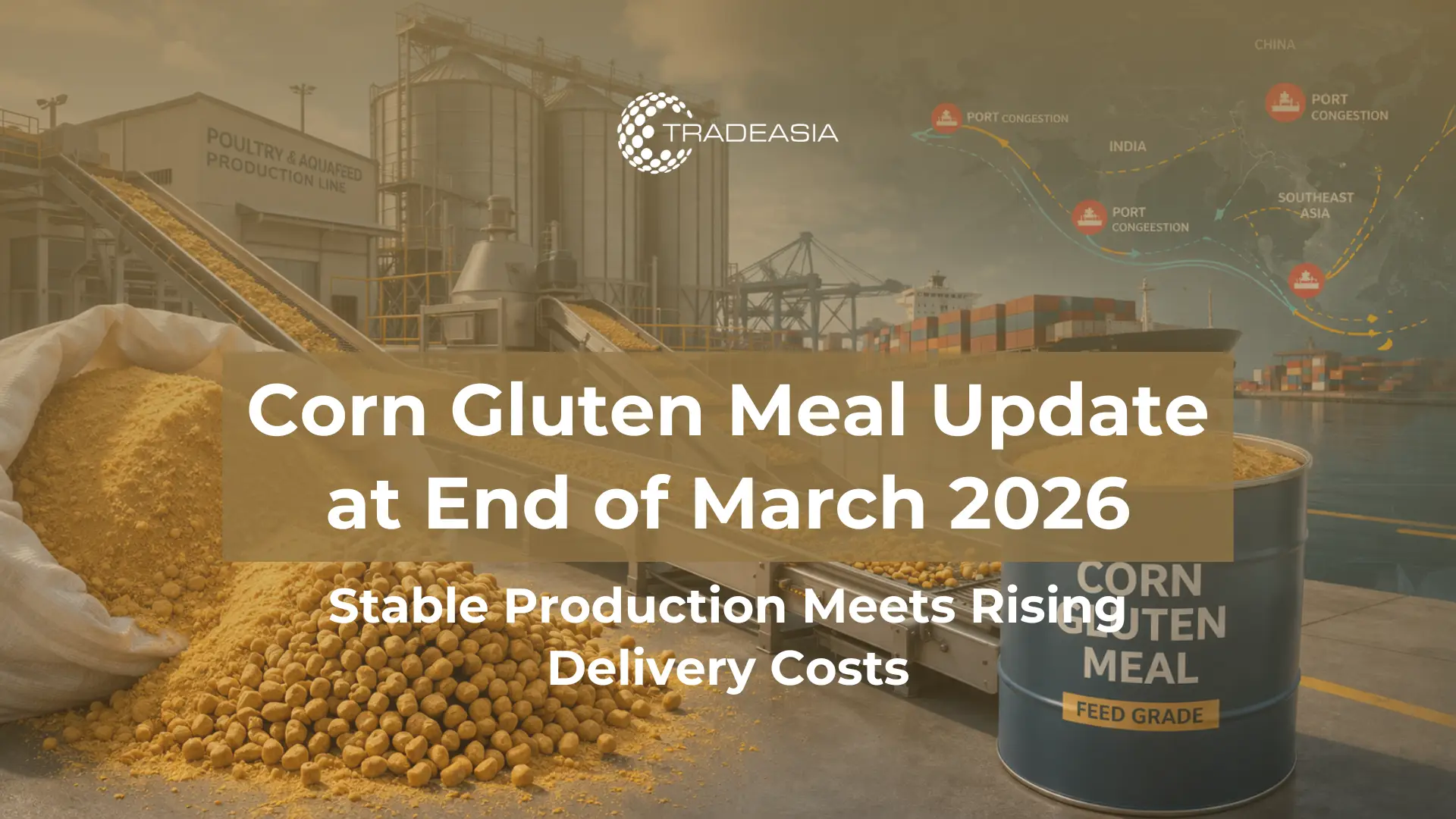
Corn Gluten Meal Market 2026 Is Stable at Origin but Volatile in Transit
Logistics Disruption Is Now the Main Driver of Short-Term Price Movement
Poultry and Aquaculture Continue Supporting Global Demand
China and the United States Still Anchor Export Supply
Import-Dependent Buyers Face Higher Landed Costs and Longer Lead Times
Procurement Strategy Is Shifting Toward Flexibility and Regional Balance
Conclusion
The corn gluten meal market 2026 is increasingly being shaped by logistics rather than by production shortages. Output remains structurally stable in major exporting countries such as China and the United States, supported by large corn wet-milling industries and continued demand from livestock and aquaculture feed sectors. Market research published in 2026 indicates that global corn gluten meal demand is still expanding, with the market projected to grow from about $8.58 billion in 2025 to around $9.07 billion in 2026. (thebusinessresearchcompany.com)
That stability at origin does not automatically translate into smooth market availability at destination. UNCTAD’s maritime outlook warns that longer routes, volatile freight rates, and chronic disruption are putting supply chain reliability under pressure in 2026. In practical terms, the market is becoming more “distribution-driven,” meaning cargo availability is increasingly determined by transportation efficiency rather than by mill output.
According to market analysis published by feed-industry sources, buyers are still seeing regular product availability from exporting regions, but delivery windows are becoming harder to predict because shipping schedules remain unstable. This is why the corn gluten meal price trend can move upward even when upstream production indicators remain unchanged. (Feedingredients Asia)
For feed mills, the real commercial issue is timing. If a cargo is delayed, the cost is not limited to freight alone; it can also affect inventory planning, working capital, and formulation flexibility. That is why more buyers are now treating corn gluten meal logistics disruption as a procurement risk on par with raw material pricing.
In 2026, the most immediate price pressure is coming from freight inflation, vessel rerouting commodities, and longer transit times. Market commentary and logistics reporting show that geopolitical disruption in major maritime chokepoints has pushed some routes into longer and more expensive patterns, while container and vessel availability remains uneven. Freight-sensitive agricultural ingredients are therefore exposed to cost swings that have little to do with actual production output.
This shift matters because corn gluten meal is often traded across long-distance routes into import-dependent regions in Asia, the Middle East, and Africa. When freight goes up or voyages become less reliable, the landed-cost increase can be significant enough to influence the final quoted price even if the product itself is plentiful at origin. Current 2026 reporting on shipping market deterioration reinforces that transport instability remains a major trade variable. (Fitch Ratings)
According to UNCTAD, ships that once passed through major trade routes in days are now taking much longer in some corridors, with higher costs and lower reliability becoming persistent rather than temporary conditions. This means short-term price movements are increasingly reflecting logistics friction instead of classic supply-demand imbalance.
The result is a market that can feel tight even when supply is technically sufficient. Buyers may see adequate product availability on paper, but the actual timing of cargo arrival becomes uncertain, which creates short-term volatility in spot pricing and encourages more defensive purchasing behavior across the feed ingredient trade. (Feedingredients Asia)
Demand remains one of the strongest stabilizing factors in the market. Corn gluten meal continues to be used as a poultry feed protein ingredient and as a protein-rich component in aquaculture feed, where it is valued for digestibility, pigment contribution, and relatively competitive cost compared with some alternative protein ingredients. Feed-industry market reports continue to cite poultry, aquaculture, and pet food as core demand channels in 2026. (Feedingredients Asia)
This broad-based usage means global corn gluten meal demand has not weakened in the way some freight-sensitive commodity traders might expect. Instead, demand is firm enough to keep the market active while logistics problems create short-term dislocation. That combination of healthy consumption and unstable distribution is one reason price movements remain reactive in 2026. (Feedingredients Asia)
According to market analysis published by The Business Research Company and Research and Markets, demand growth continues to be supported by aquaculture expansion, animal protein consumption, and the need for protein-rich feed ingredients. That underlying demand trend is helping prevent a deeper market correction despite shipping challenges. (thebusinessresearchcompany.com)
For buyers, this means the market is not weak in a structural sense. It is commercially firm, but operationally stressed. As long as poultry and aquaculture sectors keep pulling volume, the market is likely to remain active, even if shipping delays feed ingredients and higher distribution costs continue to create instability around short-term offer levels. (Feedingredients Asia)
China and the United States remain the most important production anchors for the global trade structure. Both countries have large corn processing industries, stable wet-milling capacity, and established export channels, which is why they continue to set the tone for international market availability. Multiple 2026 market summaries still identify them as the leading supply bases for global buyers. (Feedingredients Asia)
That concentration is strategically important because it gives the market a degree of stability at origin. Even when freight markets become unstable, the presence of strong exporting bases helps prevent outright supply collapse. Instead, the tension appears later in the chain, at the point where transport cost and route reliability determine whether cargo can reach destination on acceptable commercial terms.
Industrial buyers can evaluate supply options through the Corn Gluten Meal China product page, which is relevant for buyers seeking East Asian export supply. For buyers comparing shorter or alternative regional sourcing patterns, the Corn Gluten Meal Indonesia product page can support origin review in Southeast Asia.
These origin comparisons matter more in a distribution-driven market because procurement decisions now depend not just on protein specs and price, but on route reliability, booking availability, and the probability of timely delivery. That makes sourcing diversification a practical tool rather than just a theoretical risk-management idea. (SeaRates)
The heaviest burden is falling on import-dependent regions that rely on regular inbound shipments to support feed manufacturing. When freight becomes expensive and transit times lengthen, the buyer pays twice: once through higher landed costs and again through lower planning certainty. Reports on 2026 rerouting show transit times from Asia can be materially longer, in some cases up about 40%, depending on destination and corridor. (SeaRates)
This matters especially in markets where feed mills run on tight inventory cycles. If replenishment is delayed, buyers may need to hold more stock, substitute ingredients, or accept spot premiums. The commercial effect is that a stable export market can still feel undersupplied locally because distribution is inefficient. That is one reason shipping delays feed ingredients are having such a strong effect on short-term trade behavior.
According to maritime trade analysis, freight and delay costs are increasingly changing the balance between supplier quotes that may once have looked similar on an FOB basis. Buyers are paying closer attention to the total route cost, possible delay exposure, and the reliability of onward inland transport once cargo reaches port.
To support planning and internal validation, buyers can review documentation through the Feed Ingredients Asia download center. In a volatile freight market, having technical documents, quality references, and product data ready early in the process helps reduce delays in approval and improves operational flexibility when shipment timing is already under pressure.
The commercial response to this environment is a more cautious and flexible procurement strategy. Buyers are increasingly staggering purchases, diversifying origins, and working with suppliers that can communicate clearly about dispatch timing and current logistics conditions. This is a classic animal feed supply chain management response to a market where distribution inefficiency has become the main volatility driver.
In practical terms, that means buyers are no longer focused only on securing the lowest offer. They are evaluating whether the supplier can actually ship on time, whether the route is exposed to disruption, and whether contingency options are available if transit is delayed. That is a sign of a mature procurement response to the corn gluten meal market 2026 rather than a panic reaction. (Feedingredients Asia)
For direct coordination on availability and shipment planning, buyers can use the Feed Ingredients Asia contact page. In a distribution-driven market, communication speed and commercial transparency are becoming meaningful differentiators between suppliers.
The broader lesson of 2026 is that stable production is no longer enough. Trade performance now depends on the ability to move product through stressed global logistics systems. Buyers that combine regional balance, better timing discipline, and supplier responsiveness are likely to manage volatility more effectively than those relying on opportunistic spot buying alone.
The corn gluten meal market 2026 is defined by a new imbalance: origin supply remains steady, but distribution has become more costly and less reliable. Rising freight costs, longer routes, and shipping delays are pushing the corn gluten meal price trend upward in import-dependent markets even when production in China and the United States remains stable.
That means buyers must think beyond simple supply availability. By comparing options through the Corn Gluten Meal China product page, the Corn Gluten Meal Indonesia product page, using the Feed Ingredients Asia download center, and coordinating directly through the Feed Ingredients Asia contact page, importers can build a more resilient sourcing model for a market where logistics, not production, is now the main source of volatility.
We're committed to your privacy. Tradeasia uses the information you provide to us to contact you about our relevant content, products, and services. For more information, check out our privacy policy.


 English
 Indonesian
 简体字
简体字
 العربية
 Español
 Français
 Português
 日本語
日本語
 한국어
한국어
 Tiếng Việt