Explore our network of country and industry based websites to access localized information, product offerings, and business services across our group.
Log in to start sending quotation requests for any product.
Don't have an account? Sign Up Here
Home Feedstock Shifts and Global Supply Chains Reshaping the L-Valine Market 2026
Trade Insights | Supply Chain | 16 March 2026
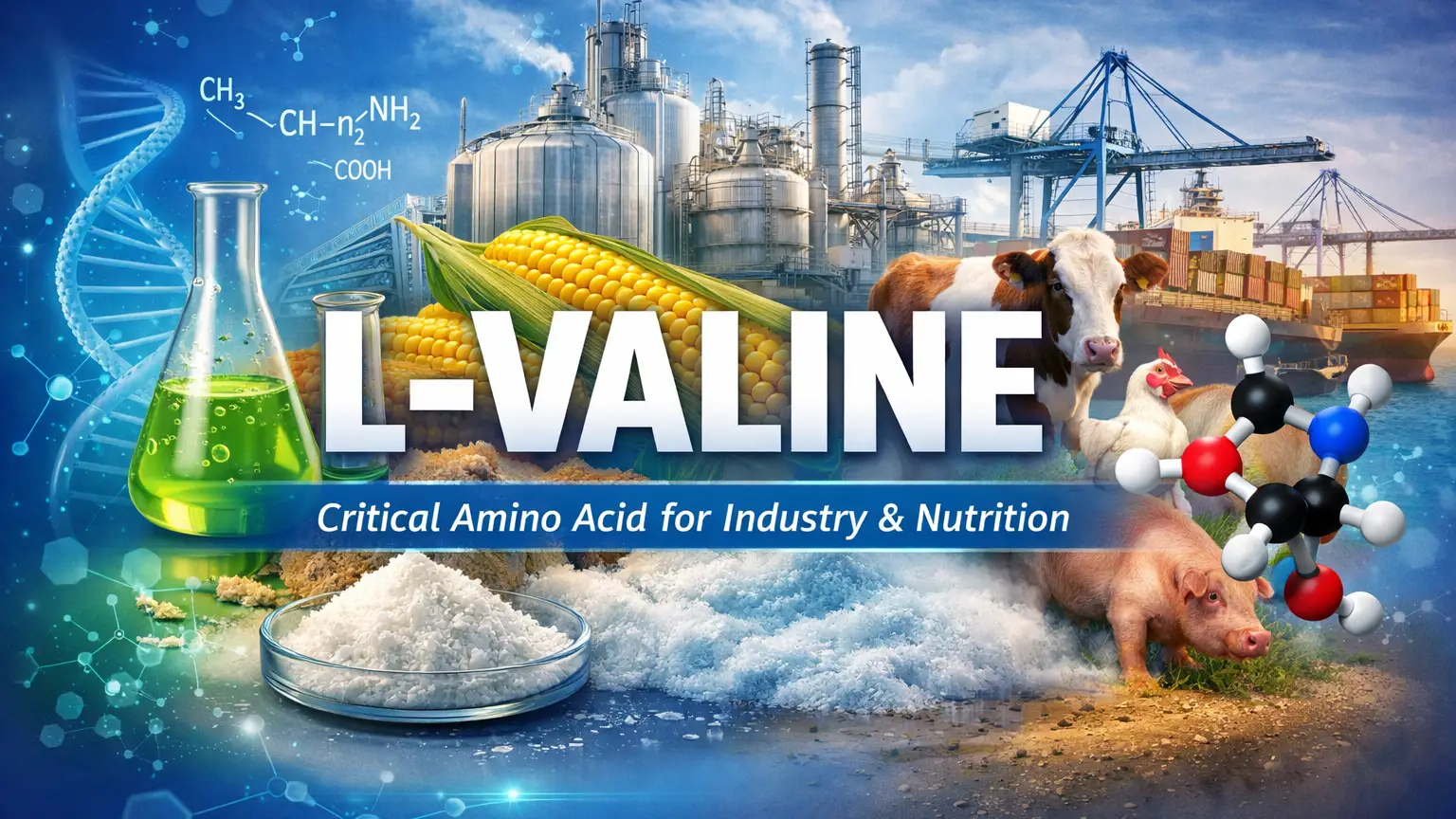
L-valine, a critical branched-chain amino acid, has emerged as a platform chemical within the global feed additive and fermentation-based amino acid industry. Its role in optimizing animal nutrition, particularly in swine and poultry diets, continues to anchor demand growth. As of 2026, the global L-valine market reflects a stable yet evolving supply chain shaped by biotechnology innovation, shifting feed economics, and regional production concentration. With a projected CAGR of 5.8%, the market is increasingly defined by cost efficiencies and sustainability in fermentation processes.
The feed sector remains the primary demand driver, accounting for over 78% of global L-valine consumption. Rising protein consumption in emerging economies has amplified livestock production, thereby increasing reliance on amino acid supplementation. Global consumption volumes are estimated at 420,000–450,000 metric tons annually, supported by precision nutrition strategies that reduce crude protein use while maintaining animal performance. This trend continues to strengthen L-valine’s position as a cost-effective nutritional enhancer.
China dominates global production, contributing approximately 65–70% of total output, followed by emerging capacities in Southeast Asia. Total global production capacity is estimated at 500,000 metric tons, with leading manufacturers investing in strain optimization and fermentation efficiency. Recent expansions have focused on reducing production costs by improving glucose-to-amino acid conversion rates. However, high dependency on corn-based feedstocks ties production economics closely to agricultural commodity cycles.
L-valine prices in 2026 are observed in the range of USD 2,200–2,800 per metric ton, reflecting moderate volatility compared to previous years. Price stabilization is attributed to improved supply-demand balance and better inventory management across major producers. Nevertheless, fluctuations in corn and energy prices continue to influence production costs. Feed manufacturers are increasingly adopting long-term procurement strategies to hedge against sudden price shifts, ensuring cost predictability.
Global trade flows remain heavily export-oriented from Asia, particularly China, to key markets in Europe, North America, and Latin America. Freight costs and geopolitical uncertainties have introduced intermittent supply disruptions, although improved shipping capacity in 2025–2026 has eased bottlenecks. Regional diversification strategies are gaining traction, with buyers seeking alternative suppliers to mitigate dependency risks. Supply chain resilience is now a central consideration for stakeholders navigating fluctuating trade policies and logistics constraints.
As a platform chemical, L-valine continues to underpin advancements in feed efficiency and sustainable livestock production. Its supply chain in 2026 reflects a balance between technological progress and macroeconomic pressures, positioning the market for steady growth. In this evolving landscape, companies are increasingly looking for reliable sourcing partners that combine global reach with operational agility. Tradeasia International stands as a strategic solution provider, offering consistent supply, competitive pricing, and market expertise to support businesses navigating the complexities of the L-valine market.
Sources
L-Valine Market Outlook 2026: Demand, Pricing, and Trends
We're committed to your privacy. Tradeasia uses the information you provide to us to contact you about our relevant content, products, and services. For more information, check out our privacy policy.


 English
 Indonesian
 简体字
简体字
 العربية
 Español
 Français
 Português
 日本語
日本語
 한국어
한국어
 Tiếng Việt