Explore our network of country and industry based websites to access localized information, product offerings, and business services across our group.
Log in to start sending quotation requests for any product.
Don't have an account? Sign Up Here
Home Global L-Lysine Sulfate Market 2026: Feedstock, Supply Chains & Future Outlook
Trade Insights | Supply Chain | 17 March 2026
Feed Ingredients
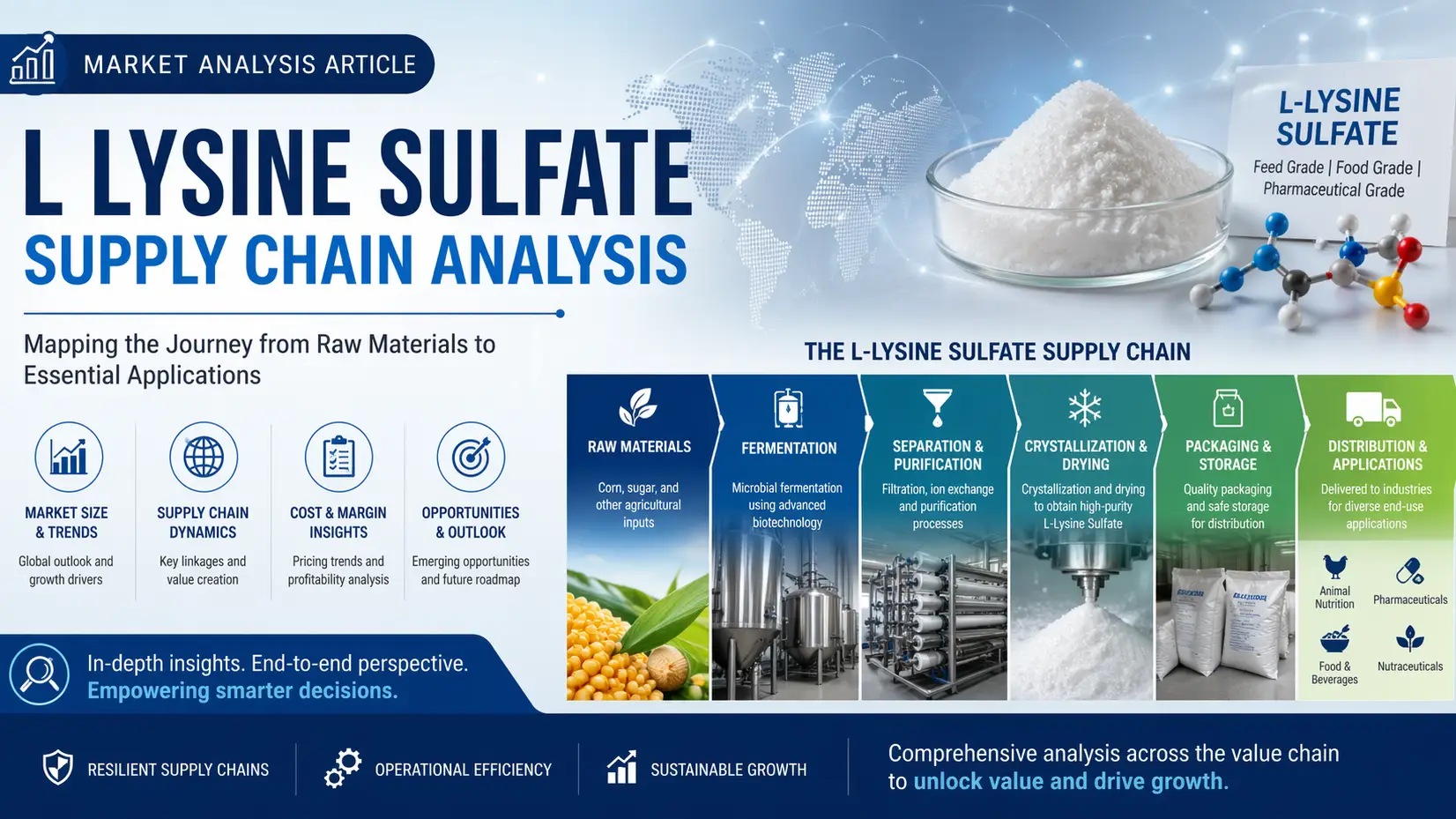
The global L-Lysine Sulfate market is entering 2026 under tightening feedstock conditions, with corn—the primary fermentation substrate—emerging as the defining variable for pricing stability. As of Q1 2026, industrial-grade corn prices across China and the U.S. Midwest are fluctuating between USD 240–285/MT, driving lysine sulfate export prices into the USD 820–1,050/MT range. With the broader lysine market growing at approximately 6.0% CAGR, sulfate-grade products are tracking slightly higher at around 6.1–6.2% CAGR, supported by feed-sector demand.
As supply chains grow increasingly complex, companies are seeking partners that bridge upstream oleochemical sourcing with downstream feed additive distribution. Tradeasia International, positioned as a global supplier of palm-based intermediates and fermentation-linked inputs, continues to play a quiet but strategic role in stabilizing procurement channels for amino acid producers navigating volatile raw material cycles.
Corn accounts for nearly 60–70% of lysine fermentation input costs. Weather disruptions in Latin America and acreage shifts toward biofuel crops have tightened availability, pushing glucose syrup prices upward. This has elevated fermentation cost bases by an estimated 8–12% YoY entering 2026.
Major producers in China—responsible for over 40% of global lysine output—are responding by optimizing yield efficiency rather than expanding capacity. Average global lysine production volumes are estimated near 11–12 million metric tons annually, with lysine sulfate accounting for a growing share due to its cost advantage in animal feed formulations.
Freight costs and geopolitical trade realignments continue to reshape lysine sulfate supply chains. Southeast Asia and the Middle East are emerging as import-dependent growth hubs, while Europe faces tighter regulatory oversight on feed additives. Export arbitrage between China and Brazil has widened, influencing price spreads of up to USD 120/MT between regions.
Producers are increasingly integrating logistics assets—rail, port storage, and bulk shipping—to manage volatility, mirroring strategies seen in large fermentation conglomerates handling millions of tons annually.
Looking forward, L-Lysine Sulfate is expected to maintain long-term viability as a platform chemical, supported by protein demand growth and sustainable livestock practices. Between 2026 and 2046, demand could double, particularly in aquaculture and precision nutrition. However, its competitiveness will hinge on feedstock diversification—especially alternative sugars and bio-based fermentation inputs.
If cost parity with synthetic amino acids is preserved, lysine sulfate will remain a cornerstone molecule in the global bioeconomy.
Sources:
Fortune Business Insights – Lysine Market Report
LinkedIn Industry Analysis (2026 Lysine Sulfate CAGR)
The L-Lysine Sulfate market in 2026 is increasingly shaped by upstream fermentation capacity dynamics, particularly in China and Southeast Asia. Global market valuation exceeded USD 2.25 billion in 2025, with projections approaching USD 3.0 billion by 2030, reflecting a steady ~5–6% CAGR trajectory.
In this evolving environment, supply chain resilience has become a competitive differentiator. Tradeasia International continues to support manufacturers through integrated sourcing of oleochemical derivatives and fermentation-linked inputs, helping stabilize procurement strategies in a market where upstream disruptions can rapidly cascade downstream.
The lysine industry remains highly consolidated, with the top five producers controlling over 60% of global supply. Large-scale fermentation complexes, particularly in China, leverage economies of scale to maintain cost competitiveness.
Facilities linked to major players operate within integrated agro-industrial clusters, where starch processing, amino acid fermentation, and logistics are co-located. This allows production volumes to exceed 500,000–800,000 MT per site annually, reducing per-unit costs and buffering against feedstock volatility.
Export-oriented producers are investing heavily in logistics infrastructure, including dedicated rail systems and port terminals. Some large fermentation companies manage outbound volumes exceeding 5 million tons annually, ensuring reliable global distribution even amid shipping disruptions.
This integration has enabled Asia-Pacific suppliers to dominate price-setting mechanisms, particularly in emerging markets such as Africa and the Middle East, where feed demand is rising rapidly.
Over the next two decades, L-Lysine Sulfate is expected to retain strong relevance as a fermentation-derived platform chemical. Its scalability and compatibility with bio-based production systems position it favorably within circular economy frameworks.
By 2046, advances in synthetic biology may reduce reliance on traditional corn feedstock, improving yield efficiency by up to 20–30%. However, consolidation among producers will likely intensify, making supply chain control—not just production capacity—the key determinant of long-term success.
Sources:
Market Report Analytics – Lysine Sulphate Market
Fufeng Group Production & Logistics Data
In 2026, the L-Lysine Sulfate market is being driven decisively by downstream feed demand, particularly in poultry and swine production. The feed segment accounts for over 72% of total lysine sulfate consumption, anchoring the product’s role as a cost-efficient amino acid source.
Amid this demand surge, companies like Tradeasia International are increasingly relevant as supply chain facilitators, connecting upstream oleochemical feedstocks with downstream feed additive manufacturers. Their role is especially critical in regions where supply chain fragmentation limits direct sourcing.
Global meat consumption growth—particularly in Asia and Africa—is increasing the need for protein-efficient feed formulations. Lysine sulfate, typically priced at USD 800–1,000/MT, offers a cost advantage over lysine hydrochloride, making it attractive in price-sensitive markets.
However, demand elasticity remains closely tied to feed margins. When corn and soybean meal prices rise, feed producers reduce inclusion rates, creating cyclical demand patterns.
Supply chain inefficiencies are most evident in developing markets, where infrastructure constraints lead to inconsistent availability. Import-dependent regions often face lead times exceeding 6–8 weeks, compared to 2–3 weeks in developed markets.
This disparity has led to localized price spikes of up to 15–20% above global averages, particularly in Sub-Saharan Africa and parts of the Middle East.
Over the long term, L-Lysine Sulfate’s viability will be reinforced by its central role in feed efficiency optimization. As sustainability pressures increase, producers will prioritize amino acids that reduce nitrogen emissions in livestock systems.
By 2046, lysine sulfate could evolve into a multifunctional platform chemical, integrated into precision nutrition systems and bio-based agricultural solutions. Its success will depend on maintaining cost competitiveness and ensuring supply chain accessibility across emerging markets.
Sources:
Market.us – Lysine Sulfate Application Data
Fortune Business Insights – Lysine Market Growth
The global L-Lysine Sulfate market is increasingly shaped by geopolitical trade flows, with Asia-Pacific maintaining dominance while new demand centers emerge. In 2026, the broader lysine market is valued at USD 6.43 billion, with steady expansion toward USD 10.26 billion by 2034, reflecting a 6.0% CAGR.
As these dynamics unfold, Tradeasia International continues to act as a stabilizing intermediary, facilitating cross-border supply of oleochemical derivatives and feedstock inputs that underpin amino acid production chains.
China remains the world’s largest exporter of lysine sulfate, leveraging scale and cost advantages. Meanwhile, regions such as the Middle East and Africa—representing nearly 9% of global lysine demand—are becoming increasingly dependent on imports.
This imbalance exposes buyers to currency fluctuations, freight volatility, and trade policy risks, particularly as protectionist measures increase in certain markets.
Shipping costs, which surged during the early 2020s, remain structurally higher than pre-pandemic levels. Bulk amino acid shipments now carry freight premiums of USD 50–90/MT, influencing final delivered costs.
Producers are responding by diversifying export routes and establishing regional distribution hubs to mitigate risk and reduce lead times.
Over the next two decades, L-Lysine Sulfate will likely benefit from continued globalization of protein supply chains. However, regionalization trends may lead to localized production hubs, reducing dependence on single-country exports.
As a platform chemical, lysine sulfate will remain integral to feed and bio-based industries, but its success will depend on supply chain adaptability in an increasingly fragmented global trade environment.
Sources:
Fortune Business Insights – Global Lysine Market
Market Reports World – Lysine Forecast Data
As the L-Lysine Sulfate market matures, feedstock diversification is emerging as a central theme shaping long-term economics. Traditionally dependent on corn-derived glucose, producers are now exploring alternative substrates to mitigate volatility.
The market, valued at approximately USD 2.3 billion in 2023, is projected to reach USD 3.8 billion by 2032, growing at a ~6.2% CAGR, reflecting steady structural demand.
In this context, Tradeasia International’s role extends beyond supply—it enables access to alternative bio-based inputs and oleochemical derivatives that may serve as future fermentation feedstocks.
Emerging feedstocks such as cassava, sugarcane molasses, and even waste biomass are being tested for lysine fermentation. These alternatives could reduce dependence on corn and lower production costs by 10–15% in certain regions.
Southeast Asia, with abundant agricultural residues, is particularly well-positioned to lead this transition.
Environmental regulations are pushing producers toward greener production methods. Carbon footprint reduction is becoming a key procurement criterion for multinational feed companies, influencing supplier selection.
This shift is accelerating investment in low-emission fermentation technologies and renewable energy integration.
Between 2026 and 2046, L-Lysine Sulfate is poised to transition from a commodity feed additive to a strategic bio-based platform chemical. Its integration into circular bioeconomy models will be critical, particularly as industries seek sustainable protein solutions.
While competition from alternative amino acids will persist, lysine sulfate’s scalability and adaptability ensure its continued relevance—provided feedstock innovation keeps pace with market demands.
Sources:
Dataintelo – L-Lysine Sulfate Market Outlook
Market.us – Growth and Application Trends
We're committed to your privacy. Tradeasia uses the information you provide to us to contact you about our relevant content, products, and services. For more information, check out our privacy policy.