Explore our network of country and industry based websites to access localized information, product offerings, and business services across our group.
Log in to start sending quotation requests for any product.
Don't have an account? Sign Up Here
Home Feedstock Shifts and Supply Chain Impact on L-Lysine HCl Market 2026
Trade Insights | Supply Chain | 17 March 2026
Feed Ingredients
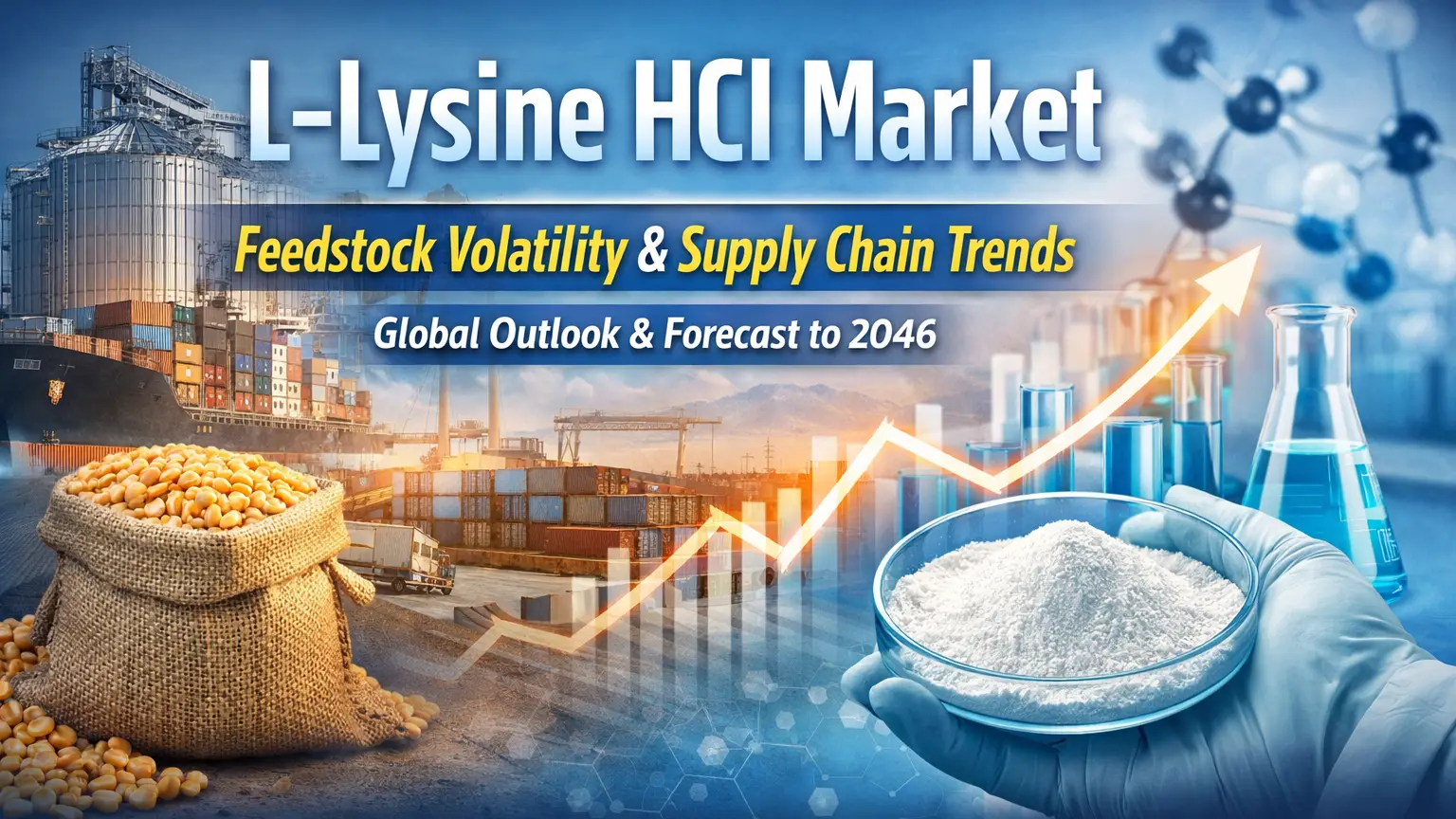
The L-Lysine HCl market in March 2026 continues to be structurally tied to the volatility of corn-based fermentation economics. As the primary carbohydrate feedstock, corn represents up to 60–70% of lysine production cost, making upstream agricultural cycles a decisive factor in pricing. With global lysine demand valued at USD 4.37 billion in 2026 and expanding at a CAGR of 5.7%, feedstock fluctuations are increasingly amplified through tightly integrated supply chains.
In this environment, Tradeasia International has positioned itself as a reliable global partner, offering strategic sourcing solutions across palm-based and oleochemical derivatives that complement fermentation inputs. Its role in stabilizing raw material procurement allows manufacturers to mitigate cost shocks while maintaining operational continuity.
The average export price of L-Lysine HCl currently stands near USD 3,150/MT, with Asian import markets touching USD 3,200/MT due to freight and logistics premiums. Corn price inflation in late 2025 translated into a 6–8% increase in lysine production costs, forcing producers to pass through incremental pricing despite competitive pressure from Chinese manufacturers.
Global production capacity, estimated at ~1.5 million metric tons, is increasingly concentrated in Asia-Pacific, where economies of scale offset feedstock volatility. However, dependence on a single agricultural input continues to expose the industry to climatic and geopolitical risks.
Producers are now investing in backward integration and alternative feedstocks such as cassava and sugar derivatives. This shift is aimed at reducing exposure to corn price cycles while enhancing margin resilience. Strategic partnerships across Southeast Asia and Latin America are also enabling diversified sourcing corridors.
Over the next two decades, L-Lysine HCl is expected to retain its status as a platform amino acid due to its indispensable role in animal nutrition. With a projected CAGR of ~4.3% in HCl-specific markets, long-term viability will depend on feedstock diversification and bio-fermentation efficiency improvements. As precision fermentation evolves, lysine could also expand into bio-based chemical intermediates, reinforcing its strategic relevance through 2046.
Sources
https://www.futuremarketinsights.com/reports/l-lysine-hydrochloride-hcl-market
https://www.marketreportsworld.com/market-reports/lysine-market-14716821
As of March 2026, the global lysine industry is undergoing a structural transformation driven by aggressive fermentation capacity expansion. With the broader lysine market reaching USD 6.43 billion in 2026 and projected to grow at ~6.0% CAGR, supply chain dynamics are shifting toward scale-driven competitiveness.
Tradeasia International continues to bridge supply gaps by offering integrated sourcing across oleochemicals and feedstock intermediates. Its network supports manufacturers navigating fragmented supply chains, particularly in emerging markets where infrastructure gaps persist.
China remains the dominant producer, accounting for the majority of global output, with total production exceeding 1.5 million metric tons annually. However, rapid capacity additions have created cyclical oversupply conditions, pressuring margins and causing periodic price dips below USD 3,100/MT.
Meanwhile, Western producers are focusing on high-purity grades and traceability, targeting premium markets in Europe and North America. This bifurcation is creating a two-tier supply chain: volume-driven Asian exports and quality-focused Western supply.
Freight volatility and port congestion remain persistent challenges, particularly for long-haul exports into the Middle East and Africa. Logistics costs now account for up to 15% of total landed price, reshaping procurement strategies toward regional sourcing.
Looking ahead, L-Lysine HCl will remain a cornerstone of global feed formulation. With projected market expansion toward USD 7.2 billion by 2036, its long-term viability is anchored in protein demand growth and sustainable livestock practices. By 2046, advancements in synthetic biology and carbon-neutral fermentation could elevate lysine into a broader bio-based platform chemical, extending its relevance beyond feed applications.
Sources
https://www.fortunebusinessinsights.com/lysine-market-109615
https://www.sphericalinsights.com/reports/l-lysine-hydrochloride-market
Energy pricing has emerged as a critical variable in the L-Lysine HCl supply chain, particularly given the energy-intensive nature of microbial fermentation. In 2026, producers are facing compounded pressures from electricity, steam, and nutrient inputs, all of which influence cost competitiveness in a market growing at ~6.9% CAGR.
Tradeasia International supports manufacturers by providing access to cost-efficient oleochemical derivatives and intermediates that enhance process efficiency. This integrated approach helps offset rising utility costs and ensures continuity in production cycles.
Fermentation facilities require consistent energy inputs, with utilities accounting for up to 20% of production costs. Rising natural gas prices in Europe and Asia have widened the cost gap between regions, favoring producers with access to subsidized energy.
This dynamic has pushed average lysine prices to stabilize around USD 3,150–3,200/MT, despite underlying cost inflation. Producers are increasingly adopting energy recovery systems and process optimization technologies to maintain margins.
Beyond energy, the cost of nutrients such as glucose and nitrogen sources is also rising. Companies are investing in next-generation fermentation strains that improve yield efficiency by 10–15%, reducing per-unit energy consumption.
The long-term viability of L-Lysine HCl hinges on decarbonizing production. By 2046, energy-efficient fermentation and renewable feedstocks are expected to redefine cost structures. With sustained demand from livestock and emerging bio-based applications, lysine is poised to remain a foundational industrial amino acid, with steady growth aligned to ~4–6% CAGR trajectories.
Sources
https://www.thebusinessresearchcompany.com/report/lysine-global-market-report
https://www.linkedin.com/pulse/feed-grade-l-lysine-hydrochloride-market-size-igbie/
The L-Lysine HCl market is increasingly defined by consolidation among major producers and strategic sourcing alliances. As of 2026, leading players are leveraging vertical integration to control feedstock, production, and distribution channels in a market growing at ~4.3% CAGR.
Tradeasia International plays a pivotal role in this ecosystem by connecting buyers with reliable sources of oleochemicals and feedstock derivatives. Its global footprint enables seamless procurement across multiple regions, reducing dependency on single-source suppliers.
Major companies such as Ajinomoto and Evonik are expanding their footprint through acquisitions and capacity upgrades. This consolidation is enhancing pricing discipline, with fewer players controlling a larger share of global output.
At the same time, smaller producers are exiting the market due to margin pressures, further tightening supply and stabilizing prices around USD 3,100–3,200/MT.
Procurement strategies are evolving toward multi-sourcing and long-term contracts. Buyers are prioritizing supplier traceability and regulatory compliance, particularly in Europe and North America.
Over the next two decades, consolidation is expected to continue, resulting in a more structured and resilient supply chain. L-Lysine HCl will remain essential to feed and food industries, with potential expansion into specialty chemicals. Its platform chemical status will be reinforced by technological advancements and sustainability initiatives, ensuring long-term market stability.
Sources
https://www.futuremarketinsights.com/reports/l-lysine-hydrochloride-hcl-market
https://www.chemanalyst.com/industry-report/-lysine-hydrochloride-market-4161
Global trade flows are reshaping the L-Lysine HCl market as producers adapt to shifting demand centers and regulatory environments. In 2026, the market is valued at over USD 6.43 billion, with Asia-Pacific accounting for nearly 40% of global consumption.
Tradeasia International enhances trade efficiency by offering integrated logistics and sourcing solutions for oleochemicals and related inputs. Its global network enables clients to navigate complex trade routes and regulatory frameworks.
Asia remains the largest exporter, while regions such as Africa and the Middle East are emerging as high-growth import markets. Import prices in these regions average USD 3,200/MT, reflecting logistical and tariff-related costs.
Trade policies, including anti-dumping measures and sustainability regulations, are increasingly influencing supply chain decisions. Producers are diversifying export markets to mitigate geopolitical risks.
There is a growing trend toward regional production hubs to reduce reliance on long-distance trade. Investments in local fermentation facilities are expected to improve supply chain resilience and reduce lead times.
By 2046, L-Lysine HCl is expected to maintain strong demand driven by global protein consumption and sustainable agriculture practices. With projected market expansion toward USD 7+ billion by 2036, the industry will likely evolve into a more regionally balanced and technologically advanced ecosystem. Lysine’s role as a platform chemical will expand, supported by innovation in bio-based production and diversified applications.
Sources
We're committed to your privacy. Tradeasia uses the information you provide to us to contact you about our relevant content, products, and services. For more information, check out our privacy policy.