
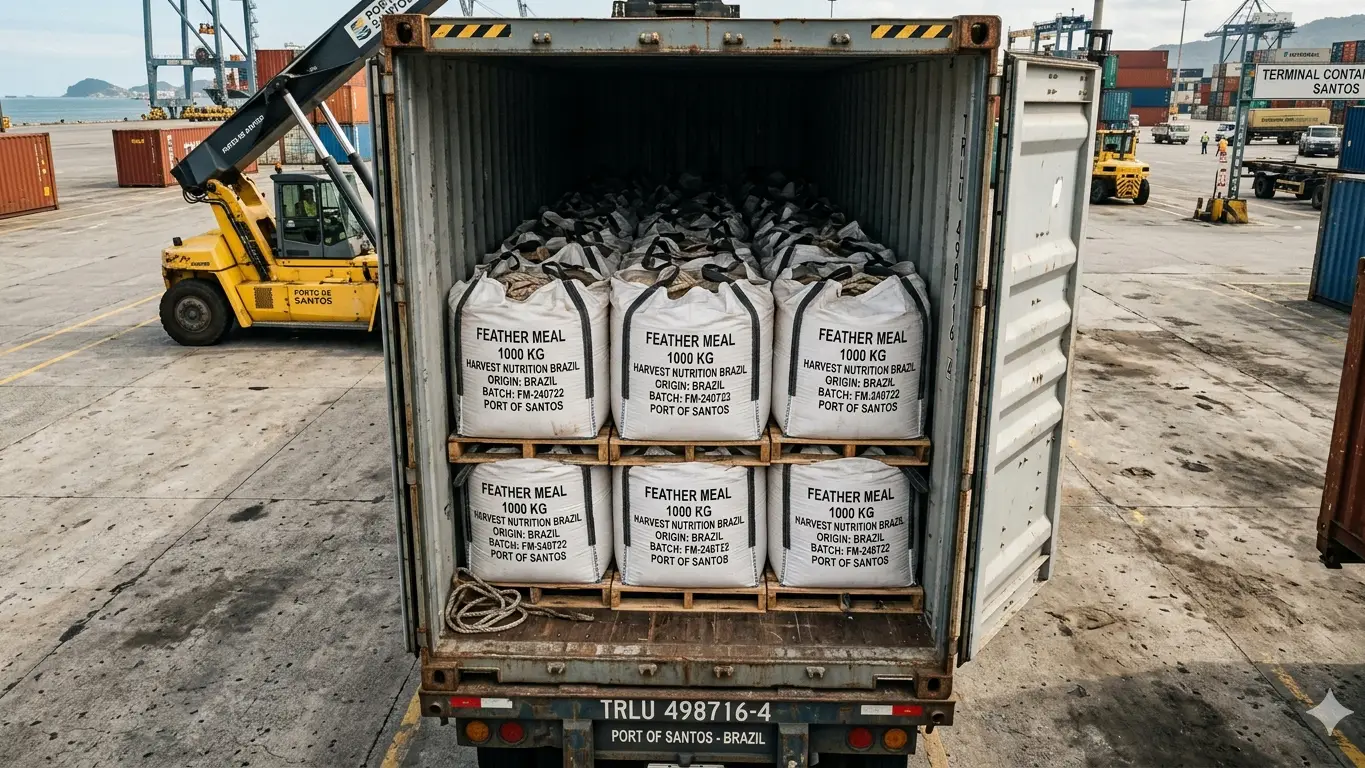
Feather meal is primarily produced in the United States, Brazil, China, and the European Union, which together account for approximately 75–80% of global rendering capacity. As a processed dry protein meal, it ships in bulk containers or supersacks from major poultry processing hubs — U.S. Gulf Coast ports, Santos (Brazil), and Chinese coastal terminals — to aquafeed mills concentrated in Southeast Asia, Norway, and Chile. For aquaculture buyers in 2026, the key procurement risk is not availability but quality consistency: processing method determines digestibility, and digestibility determines whether feather meal performs in a formulation or becomes an expensive mistake.
Why Feather Meal Is Now a Blue Economy Ingredient
Feather meal was not originally designed for fish. It was a rendering industry co-product, produced primarily for ruminant and poultry feed, and its entry into aquaculture feeds was slow precisely because unprocessed keratin — the structural protein that makes up 90% of a feather's mass — is nearly indigestible in its natural form. That changed as pressure hydrolysis and enzymatic processing technologies matured, and as fishmeal prices climbed high enough to make the economics of upgrading feather meal processing commercially viable.
By 2025, aquaculture had become the fastest-growing end-use sector for hydrolyzed feather meal (HFM). The Food and Agriculture Organization reported that aquaculture now supplies more than 57% of fish consumed globally, and the sector's sustainability credentials rest partly on reducing reliance on wild-capture fishmeal — a finite, geographically concentrated, and price-volatile ingredient. Fishmeal benchmarked at approximately USD 1,446 per metric ton in June 2025, per IMF World Bank data, and averaged USD 1,722 per metric ton in July 2025 as Peruvian supply recovered. Hydrolyzed feather meal trades at roughly 40–55% of that price per unit of crude protein delivered, depending on processing quality and origin — a cost differential that drives formulators to maximize its inclusion within nutritional tolerances.
The blue economy framing matters commercially because it shapes both demand and regulatory access. Sustainability certification schemes — ASC (Aquaculture Stewardship Council), BAP (Best Aquaculture Practices), and the GlobalG.A.P. Aquaculture standard — increasingly require feed ingredient traceability. Feather meal, sourced from certified poultry processing operations and processed under veterinary oversight, qualifies as a circular economy ingredient in most major regulatory frameworks. That regulatory positioning is one of the reasons Skretting, one of the world's largest aquafeed producers, reported that approximately 10% of its protein supply came from terrestrial animal proteins including feather meal as of its 2022 disclosures.
Where Feather Meal Is Produced: The Four Rendering Regions
Feather meal production is structurally tied to one feedstock: poultry processing volume. Feathers cannot be stockpiled in their raw form; they are a wet, bulky, rapidly degrading by-product. Rendering plants are therefore co-located with or adjacent to large poultry slaughter operations. This geographic constraint creates four production regions that collectively dominate global supply.
| Production Region | Key Producing Countries | Estimated Global Supply Share (2025) | Primary Export Format |
|---|---|---|---|
| North America | USA, Canada | ~35% | Bulk bag / container, FOB Gulf Coast or East Coast ports |
| South America | Brazil, Argentina | ~18% | Bulk bag / container, FOB Santos, Paranaguá |
| Asia-Pacific | China, India, Southeast Asia | ~27% | Domestic consumption dominant; some CFR export to regional buyers |
| Europe | Netherlands, Germany, Poland, Spain | ~12% | Intra-EU supply chain; limited export outside region |
| Rest of World | Australia, Mexico, South Africa | ~8% | Primarily domestic or regional |
United States is the world's largest single-country producer of feather meal, underpinned by an industrial-scale broiler processing sector concentrated in the Delmarva Peninsula, the Carolinas, Georgia, Arkansas, and Alabama. Darling Ingredients — through its rendering network and its Sonac brand — is the dominant U.S. producer after its USD 1.1 billion acquisition of Valley Proteins in May 2022, which added 18 rendering facilities across the southern and mid-Atlantic United States. Tyson Foods and JBS USA Holdings (through Pilgrim's Pride) also operate captive rendering capacity producing feather meal as a co-product of their poultry processing. West Coast Reduction handles production on the Pacific corridor.
Brazil is the second-largest production base and the primary export-oriented supplier to Asia-Pacific buyers. JBS S.A. and BRF S.A. both operate rendering capacity integrated with their poultry processing. Darling Ingredients expanded into Brazil through its USD 560 million acquisition of FASA Group in May 2022, adding 16 plants with approximately 1.3 million metric tons of annual by-product processing capacity. Brazil's advantage for Asian aquafeed buyers is cost structure: lower labor and energy costs relative to the U.S. and EU, with direct access to Santos and Paranaguá ports for container shipments on established South America–Asia trade lanes.
China is the most complex region to characterize. Domestic poultry production is large — China slaughters approximately 11–13 billion broilers annually — but rendering infrastructure remains fragmented compared to the U.S. and Brazilian models. Most Chinese feather meal production serves domestic compound feed mills rather than export markets. Wudi Musen Biological Co. is among the more active Chinese producers serving export channels. Guangdong Haid Group integrates feather meal into proprietary aquafeed formulations but does not operate as a significant merchant seller. For foreign buyers, China is primarily a demand competitor for regional feather meal supplies, not a reliable export source.
Europe operates under the EU's Animal By-Products Regulation (EC) No 1069/2009, which classifies feather meal as a Category 3 material requiring processing to a defined standard before use in feed. Darling Ingredients' Sonac subsidiary is the dominant European merchant supplier, with rendering plants in the Netherlands, Germany, and — following the January 2024 acquisition of Miropasz Group — three additional facilities in southeastern Poland. Those Polish plants process 250,000 metric tons of poultry by-products annually, strengthening Sonac's position in Central and Eastern European aquafeed markets. J.G. Pears (UK) and Saria Group (Germany, part of the Tönnies network) cover secondary production.
The Feedstock Dependency That Shapes Every Supply Decision
Feather meal supply cannot be managed independently of poultry production. This is the first principle every aquafeed procurement team must internalize.
Feather volume is structurally fixed: the poultry industry generates approximately 3–4 kg of feathers per 100 kg of live weight processed, and those feathers must be rendered within hours or days. Rendering plants have no incentive to hold back supply and no ability to produce more feather meal than the parent poultry sector generates. This means feather meal supply is largely inelastic in both directions — it rises only when poultry slaughter rises, and it falls only when the poultry sector contracts. A regional outbreak of Highly Pathogenic Avian Influenza (HPAI) can eliminate rendering feedstock across an entire corridor within weeks.
The 2022–2023 HPAI wave in the United States resulted in the culling of approximately 58 million birds — the worst outbreak in U.S. poultry history. Feather meal production from affected regions contracted sharply, and buyers who relied on spot purchases from U.S. suppliers without alternative origin options faced both price spikes and availability gaps. Term contracts with secondary origin coverage — Brazilian or European — were the only effective protection.
Energy costs are a secondary but important production cost driver. Pressure hydrolysis at temperatures of 130–160°C for 20–40 minutes is energy-intensive, and rendering plants in Europe and some U.S. regions are exposed to natural gas and electricity price volatility. When European energy prices spiked in 2021–2022 following Russia's invasion of Ukraine, rendering economics deteriorated in Western Europe, contributing to production cost increases that flowed through to buyers in CFR terms.
Processing Quality: The Procurement Variable That Fishmeal Doesn't Have
Fishmeal quality varies, but a 65% protein fishmeal from a reputable Peruvian producer has a reasonably predictable digestibility profile. Feather meal does not have this consistency. Processing method — not protein content alone — determines whether a feather meal will perform in a fish diet.
Raw keratin protein digestibility in fish is typically below 20%. Properly hydrolyzed feather meal, processed using steam pressure hydrolysis or enzymatic treatment, achieves in vitro pepsic digestibility of 70–85% and crude protein levels of 80–85% on a dry matter basis. Poorly hydrolyzed feather meal — overprocessed or processed from low-quality feedstock — can produce Maillard reaction products that reduce amino acid bioavailability, particularly lysine, below useful thresholds.
The research literature in 2024–2025 reinforces this quality sensitivity by species:
- Gilthead seabream (Sparus aurata): HFM can replace 25% of fishmeal protein without compromising growth or fillet composition (ScienceDirect, 2024).
- Hybrid catfish: Feather meal can replace up to 15% of total diet without negative growth effects.
- African catfish (Clarias gariepinus): 5% HFM is the optimal inclusion level; 15% is feasible with amino acid supplementation (Aquaculture International, 2025).
- Rainbow trout: HFM at 30–45% fishmeal replacement is viable when combined with supplemental lysine, methionine, and probiotics (Springer Nature, 2024).
The practical implication for buyers: crude protein specification alone is an insufficient procurement criterion for feather meal. A Certificate of Analysis (CoA) must include in vitro pepsic digestibility (target: minimum 75%) and an amino acid profile confirming lysine content above degradation thresholds. In vivo performance data from the supplier — documented trials in the target species or a species with comparable digestive physiology — is the only complete assurance of product performance.
Trade Flows: How Feather Meal Moves from Rendering Plant to Aquafeed Mill
Feather meal is a dense, dry product at the point of export — typically 50 kg woven polypropylene bags on pallets, or loose bulk in 1,000 kg supersacks loaded in 20-foot or 40-foot containers. It is not classified as a hazardous material and does not require temperature control during transit. This makes it logistically straightforward compared to fishmeal, which carries moisture and oxidation management requirements.
| Trade Route | Origin Ports | Destination Region | Typical Transit Time | Primary Buyer Segment |
|---|---|---|---|---|
| U.S. Gulf Coast to Southeast Asia | Houston, New Orleans | Vietnam, Indonesia, Thailand | 25–32 days via Suez/transhipment | Tilapia, catfish, shrimp feed mills |
| Brazil (Santos) to Southeast Asia | Santos, Paranaguá | Vietnam, China, Philippines | 28–38 days | Shrimp and pangasius feed mills |
| EU (Rotterdam, Antwerp) to Norway | Rotterdam, Antwerp | Stavanger, Bergen | 3–7 days short-sea | Salmon aquafeed producers |
| U.S. East Coast to Chile | Baltimore, Savannah | Valparaíso | 18–24 days | Salmon feed sector |
| China domestic | Dalian, Qingdao | Guangdong, Fujian | Road/coastal | Domestic freshwater aquaculture |
The Red Sea disruption from 2023 through most of 2025 added 10–14 days and significant bunker surcharges to U.S.-to-Asia and Brazil-to-Asia lanes rerouted around the Cape of Good Hope. For aquafeed buyers in Southeast Asia sourcing U.S. or South American feather meal, this freight volatility translated directly into landed cost increases. Buyers who shifted more volume to Brazilian origins during this period secured a freight advantage on Cape routing, because Brazilian ports already operated on Cape-compliant schedules for Asia-bound cargo.
Regulatory compliance is the friction point for European and U.S.-origin feather meal entering Asian markets. China, Vietnam, and Indonesia maintain import registration requirements for processed animal proteins, and Certificate of Origin, veterinary health certificates, and processing standard documentation (confirming treatment temperature and time profiles) are required at customs clearance. Buyers who have not pre-registered their suppliers with the relevant national authority — China's GACC, Vietnam's MARD, or Indonesia's BKIPM — face hold times of 30–90 days at port, which can effectively render a spot-purchase strategy unworkable.
Supply Risk Summary: What Can Break a Feather Meal Procurement Program
| Risk Factor | Risk Level | Trigger Event | Last Precedent | Buyer Mitigation |
|---|---|---|---|---|
| HPAI outbreak in primary supply region | HIGH | Regional poultry cull event | 2022–2023 U.S. (58M birds culled) | Dual-origin term contracts; Brazilian backup |
| Processing quality failure (batch digestibility below spec) | MEDIUM-HIGH | Supplier plant operational disruption | Continuous risk; no single headline event | Mandatory CoA with digestibility + amino acid data |
| Freight lane disruption (Red Sea / Cape rerouting) | MEDIUM | Geopolitical escalation at key chokepoints | 2023–2025 Red Sea disruption | Prefer Brazilian origin for Asia buyers; build 8–10 week safety stock |
| EU PAP regulatory reversal | LOW | BSE-linked livestock event in the EU | 2001 PAP ban (reversed 2021) | Monitor EFSA advisory outputs; maintain plant-protein backup formulation |
| Import registration lapse at destination | MEDIUM | Administrative gap in exporter/importer registration | Frequent; particularly for China GACC | Pre-qualify all suppliers for destination market registration; 90-day renewal cycle |
| Energy cost spike affecting EU/US rendering margins | MEDIUM | Natural gas price event | 2021–2022 European energy crisis | Lock in term contracts before Q4 European gas market peaks |
Pricing Structure and the Fishmeal Price Link
Feather meal does not trade on a public exchange. There is no feather meal equivalent of the IFFO fishmeal price index. Prices are negotiated bilaterally between renderer and feed mill, and published assessments from Argus Media and ICIS cover the broader rendered protein category with limited feather meal granularity.
In practice, hydrolyzed feather meal prices follow fishmeal prices directionally, with a typical discount of 40–60% on a per-tonne basis. When fishmeal moves from USD 1,400/MT to USD 1,700/MT — as it did between early 2022 and mid-2023 — HFM inclusion in aquafeed formulations becomes more attractive, formulators increase substitution rates, and HFM demand rises, which in turn pulls HFM prices up. The price differential narrows when fishmeal is cheap (pre-2020 period), which suppresses feather meal aquafeed demand.
As of mid-2025, with global fishmeal averaging approximately USD 1,446–1,722/MT (IMF/FRED data, June–July 2025), HFM from U.S. or Brazilian origin with 80%+ crude protein and verified digestibility is estimated to trade at approximately USD 600–800/MT CFR Southeast Asia, depending on freight, specification, and contract structure. Unhydrolyzed or low-digestibility feather meal trades at USD 350–500/MT but is not suitable for aquafeed applications without reformulation risk.
The buyer's calculation is not simply price per tonne. It is price per unit of digestible protein delivered at the farm gate, net of feed conversion ratio (FCR) impact. A high-quality HFM at USD 750/MT that achieves 80% in vivo protein digestibility delivers better economic value in a salmon diet than a low-quality product at USD 450/MT that achieves 50% digestibility and depresses FCR — because feed is 60–70% of aquaculture operating cost, and FCR degradation compounds across the entire production cycle.
Frequently Asked Questions
Q: Who are the largest global producers of hydrolyzed feather meal for aquafeed?
Darling Ingredients is the largest publicly traded renderer globally, operating feather meal production across the United States (via Valley Proteins), Brazil (via FASA Group), and Europe (via Sonac and Miropasz Group in Poland). Tyson Foods and JBS (through Pilgrim's Pride) produce feather meal as a co-product of U.S. poultry processing but sell primarily into domestic feed channels. For international aquafeed buyers, Darling/Sonac, Brazilian integrated poultry operators, and select Chinese producers are the primary sources.
Q: How is feather meal shipped internationally to aquafeed mills?
Feather meal exports move primarily in 20-foot or 40-foot containers, packed in 50 kg woven polypropylene bags on pallets or in 1,000 kg supersacks. It requires no temperature control during transit. Key export corridors are U.S. Gulf/East Coast to Southeast Asia (25–35 days), Santos/Paranaguá (Brazil) to Southeast Asia (28–38 days), and Rotterdam/Antwerp to Norwegian salmon feed producers (3–7 days short-sea). Import registration for the exporting plant must be completed in the destination country before shipment — this is a hard requirement for China (GACC), Vietnam (MARD), and Indonesia (BKIPM).
Q: What drives feather meal prices for aquafeed buyers?
Feather meal prices move directionally with fishmeal, because the two are partial substitutes in formulation and buyers shift inclusion rates as the price ratio changes. When fishmeal exceeds approximately USD 1,400/MT, aquafeed formulators maximize HFM inclusion within nutritional limits, increasing HFM demand and supporting its price. Energy costs affect rendering production margins in Europe and the United States. HPAI outbreaks in primary production regions reduce feedstock supply and tighten prices. Brazilian origin typically offers a structural cost advantage over U.S. origin for Asia-Pacific buyers because of lower processing cost and competitive Cape-route freight.
Q: What are the main supply chain risks for feather meal in aquafeed procurement?
The two highest-impact risks are HPAI outbreaks in major producing regions — the 2022–2023 U.S. outbreak culled 58 million birds and significantly disrupted North American rendering throughput — and processing quality failures that produce batches with digestibility below specification. Quality risk is mitigated by specifying minimum in vitro pepsic digestibility (75%+) in the purchase contract and requiring batch-level CoA. Supply concentration risk is mitigated by maintaining dual-origin contract coverage and 8–10 weeks of safety stock at destination.
Q: How do aquafeed buyers typically source feather meal in 2026?
Most aquafeed buyers above 200 MT/month consumption operate term contracts with one or two primary suppliers, typically covering 80–90% of expected volume with the remainder purchased on spot to manage seasonal variation. Contract durations are typically 6–12 months. Index-linked pricing (tied to soybean meal or fishmeal benchmarks) is less common for feather meal than for more commoditized proteins, and bilateral negotiation against a cost-plus framework remains the norm. Buyers in Southeast Asia working with Brazilian or U.S. origins typically use LC (letter of credit) or usance LC as the payment instrument, with CFR destination port as the standard shipping term.