Explore our network of country and industry based websites to access localized information, product offerings, and business services across our group.
Log in to start sending quotation requests for any product.
Don't have an account? Sign Up Here
Home Citrus Pulp Feedstock Volatility and Supply Chain Shifts Shaping Markets in 2026
Trade Insights | Supply Chain | 03 March 2026
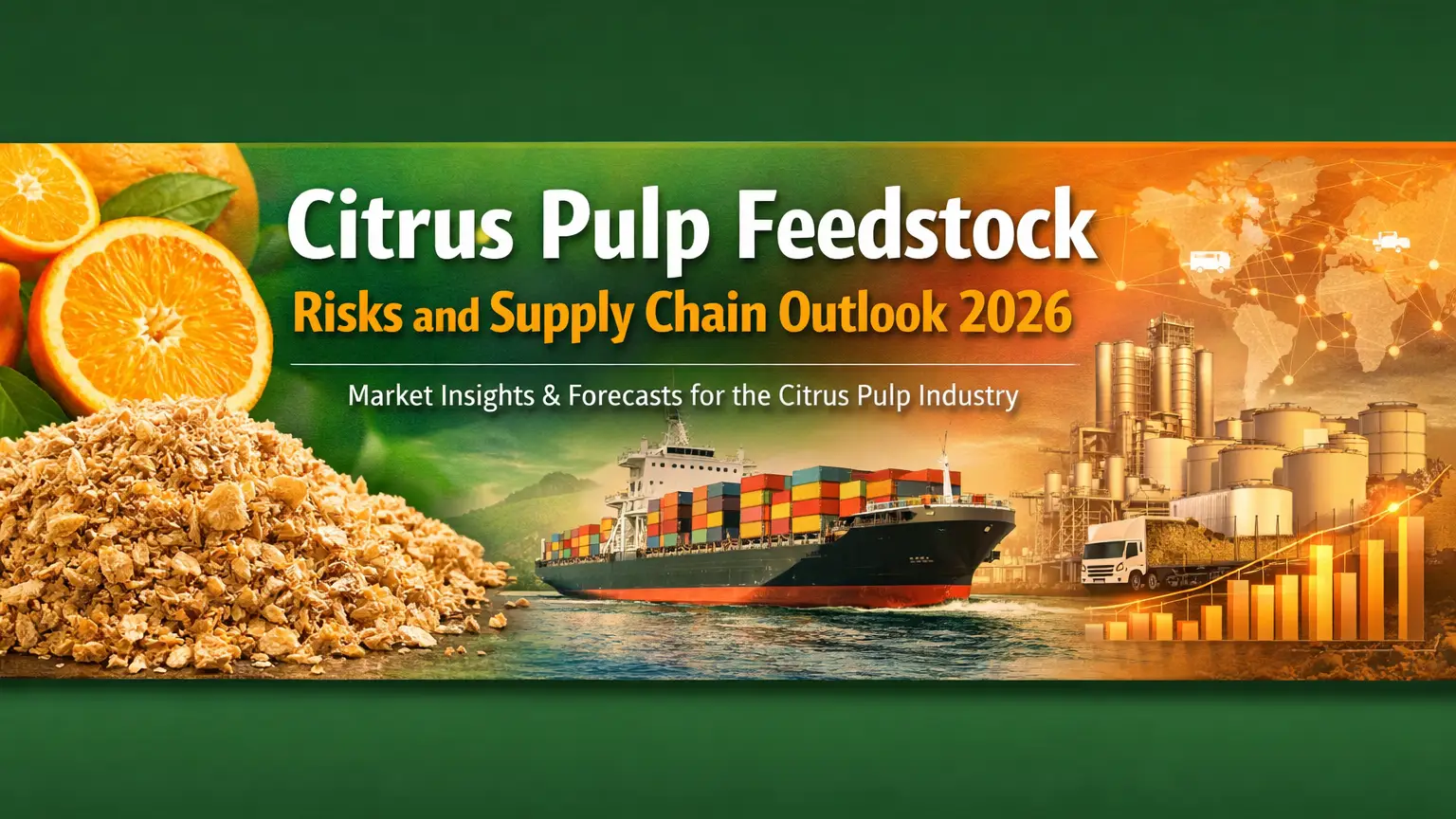
In 2026, citcrus pulp is increasingly positioned as a strategic platform chemical within agro-industrial value chains, bridging the food processing and animal nutrition sectors. Derived primarily from citrus juice extraction residues, citrus pulp is no longer viewed as a low-value byproduct but as a traded commodity with expanding applications in feed formulations and bio-based industries. The global citrus pulp market is closely tied to orange production cycles, processing efficiencies, and sustainability mandates, with market expansion supported by a projected CAGR of 4.2% (2024–2029). Prices are stabilizing in the range of USD 120–190/MT, depending on drying and pelletizing processes, while global output exceeds 8.5 million metric tons annually.
Citrus pulp supply remains highly dependent on concentrated juice production hubs in Brazil, the United States, and parts of the Mediterranean. Brazil alone accounts for over 45% of global output, leveraging vertically integrated citrus processing clusters. This integration reduces waste disposal costs while ensuring steady feedstock availability for downstream feed manufacturers, reinforcing citrus pulp’s role in circular bioeconomy systems.
Modern dehydration and pelletization technologies have significantly improved recovery yields, reducing moisture content below 12% and enhancing storage stability. These improvements have increased commercial utilization rates by nearly 18% over the past five years, allowing processors to capture higher margins. Energy-efficient drying systems are also reducing production costs by up to USD 15–25/MT, strengthening competitiveness in global feed markets.
International trade flows are shifting as Asia-Pacific livestock industries expand. China and Southeast Asia collectively import over 2.1 million metric tons annually, driven by demand for cost-effective fiber-rich feed ingredients. However, logistical challenges such as bulk density and seasonal supply volatility continue to influence freight premiums, particularly in long-haul maritime routes.
Market pricing is increasingly influenced by citrus harvest variability and competing feed alternatives such as beet pulp. Sustainability pressures are also accelerating demand for traceable, low-carbon feed inputs. Carbon accounting frameworks are encouraging processors to adopt waste-to-value models, reinforcing citrus pulp’s long-term positioning as a sustainable industrial feedstock.
As citcrus pulp evolves into a recognized platform chemical, its role in integrated supply chains is expected to deepen across feed, bioenergy, and circular economy applications. The interplay of agricultural output, processing innovation, and global trade dynamics will continue to define its market trajectory through 2026 and beyond. In this evolving landscape, companies seeking reliable sourcing, flexible logistics, and consistent quality standards may benefit from the integrated solutions offered by Tradeasia International, a global player supporting industrial buyers across diversified commodity markets.
Sources
We're committed to your privacy. Tradeasia uses the information you provide to us to contact you about our relevant content, products, and services. For more information, check out our privacy policy.


 English
 Indonesian
 简体字
简体字
 العربية
 Español
 Français
 Português
 日本語
日本語
 한국어
한국어
 Tiếng Việt