Explore our network of country and industry based websites to access localized information, product offerings, and business services across our group.
Log in to start sending quotation requests for any product.
Don't have an account? Sign Up Here
Home Blood Meal Supply Chain 2026: Global Trade, Pricing & Production Insights
Trade Insights | Supply Chain | 23 April 2026
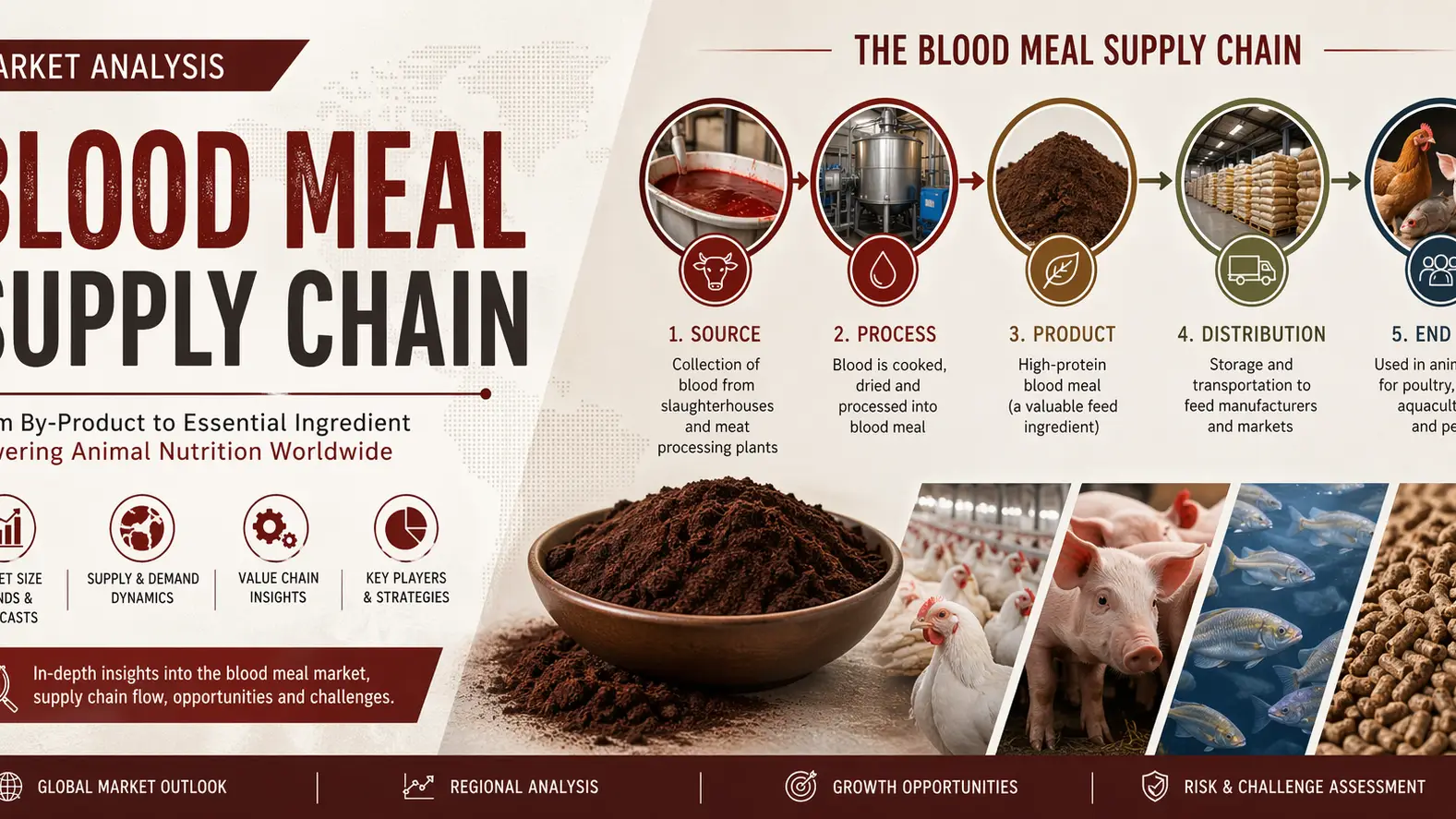
Blood meal, a high-protein animal by-product derived from rendering slaughterhouse blood, continues to strengthen its position as a critical platform feed ingredient in global agriculture and aquaculture systems. As of 2026, the blood meal supply chain is undergoing structural transformation driven by tightening protein demand, sustainability pressures, and evolving rendering technologies. The market is projected to expand at a steady 5.2% CAGR, supported by rising demand for alternative protein inputs in feed formulations, with global production volumes estimated at approximately 1.8 million metric tons (MT) annually.
The upstream segment of the blood meal supply chain remains heavily dependent on slaughterhouse throughput across North America, Europe, and parts of Asia-Pacific. Variability in livestock cycles directly influences raw blood availability, creating seasonal supply fluctuations. Emerging economies are increasing centralized abattoir operations, improving collection efficiency and reducing wastage, which is gradually stabilizing feedstock inflows.
Rendering technology advancements have significantly improved protein retention and pathogen control in blood meal production. Modern sterilization and flash-drying systems now enable crude protein levels exceeding 85%, aligning with premium feed requirements. However, compliance with stringent EU and FDA feed safety regulations continues to increase processing costs, pushing average production expenses toward USD 450–700/MT, depending on energy input intensity.
International trade routes for blood meal are increasingly shaped by regional feed deficits and surplus rendering capacity. Export hubs in the United States and Brazil supply high-demand regions in Southeast Asia and the Middle East. Freight volatility and cold-chain-adjacent handling requirements contribute to landed cost fluctuations, with global market prices ranging between USD 600–1,200/MT in 2026.
Feed manufacturers are increasingly incorporating blood meal as a cost-effective protein alternative to fishmeal and soybean meal. Aquaculture and poultry sectors account for over 70% of total demand. Price volatility is primarily driven by livestock slaughter cycles, feed grain substitution trends, and energy costs, reinforcing the need for resilient procurement strategies.
As blood meal solidifies its role as a sustainable protein feed ingredient, supply chain resilience and cross-border trade optimization are becoming strategic priorities. Industry players are increasingly seeking integrated sourcing and distribution partners to manage volatility and ensure consistent quality. In this evolving landscape, Tradeasia International stands as a reliable global solutions provider, offering streamlined procurement support and supply continuity across key feed ingredient markets.
Sources
We're committed to your privacy. Tradeasia uses the information you provide to us to contact you about our relevant content, products, and services. For more information, check out our privacy policy.


 English
 Indonesian
 简体字
简体字
 العربية
 Español
 Français
 Português
 日本語
日本語
 한국어
한국어
 Tiếng Việt