Explore our network of country and industry based websites to access localized information, product offerings, and business services across our group.
Log in to start sending quotation requests for any product.
Don't have an account? Sign Up Here
Home Bakery Meal Supply Chain Dynamics and Trade Flows Outlook for 2026 Market
Trade Insights | Supply Chain | 27 April 2026
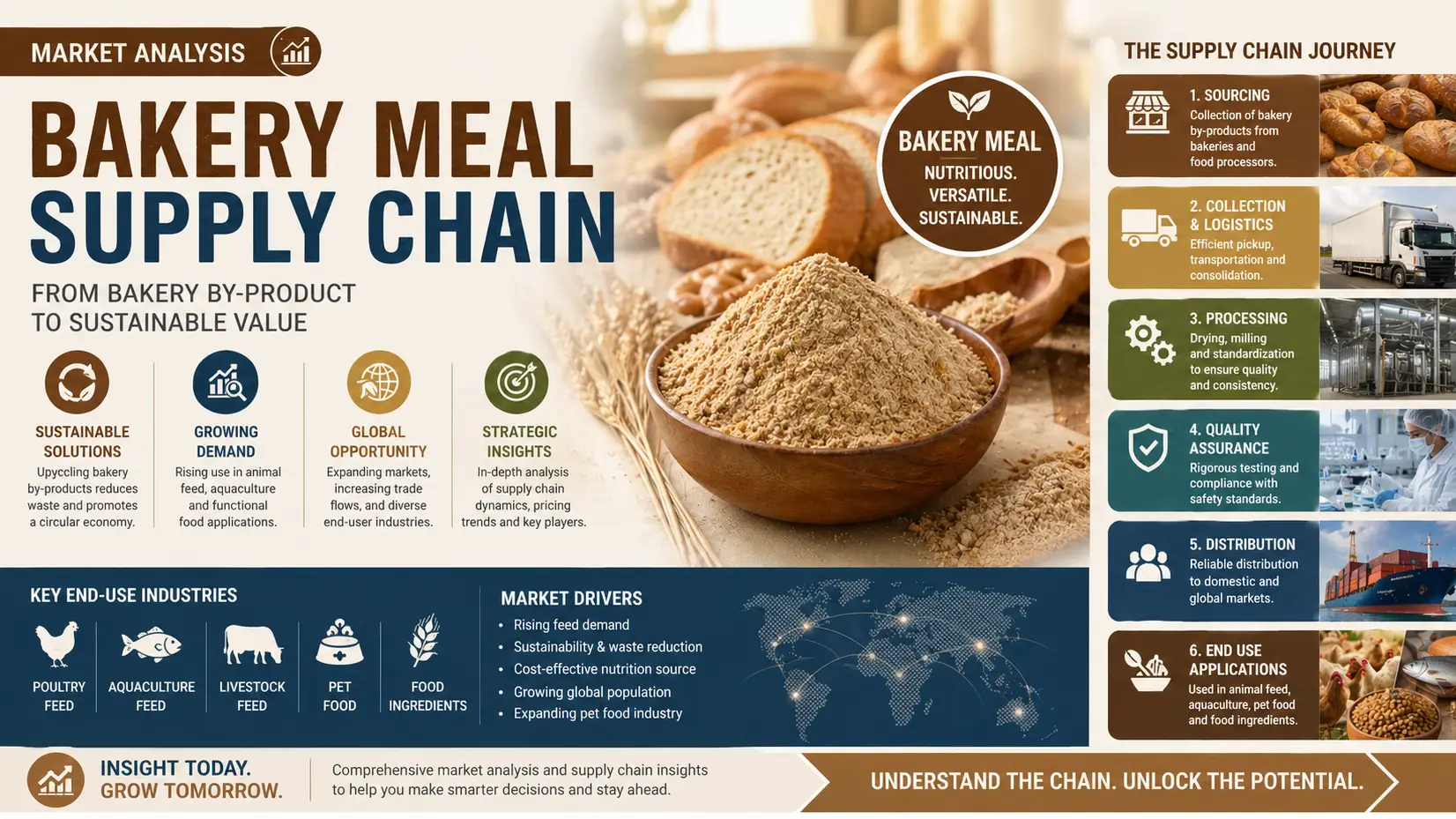
In 2026, the bakery meal market continues to strengthen as a circular feed ecosystem material, functioning as a platform ingredient within bio-based supply chains linking food waste recovery and animal nutrition industries. Global output is estimated at 2.8 million MT, supported by a steady 5.2% CAGR, while average transaction prices range between USD 180–260/MT, reflecting regional feedstock availability and drying energy costs. As feed manufacturers intensify cost optimization strategies, bakery meal has evolved into a strategically traded commodity shaped by food processing efficiency, logistics integration, and regulatory compliance across multiple regions.
The upstream segment of the supply chain is dominated by industrial bakeries, retail chains, and food manufacturers generating surplus bread and confectionery waste. Europe remains the most structured collection hub, recovering nearly 35% of global input streams. The efficiency of sourcing networks directly impacts profitability, as raw bakery residues account for over 60% of production economics. Increasing digital traceability systems are improving feedstock consistency, reducing contamination risks, and stabilizing input availability for processors.
Processing facilities play a central role in transforming perishable bakery waste into stable meal products. Thermal drying and milling technologies are widely used to achieve moisture levels below 10%, ensuring extended shelf life. Energy costs remain a key variable, accounting for nearly 25% of total production expenditure. Quality standards are increasingly harmonized, particularly in North America and Europe, where feed-grade certification frameworks are tightening to support safe integration into livestock diets.
The logistics structure of bakery meal is heavily regional due to its low unit value and high bulk density. Over 70% of trade remains intra-regional, minimizing transportation costs. However, cross-border shipments are growing in Asia-Pacific, driven by feed demand expansion. Freight fluctuations and storage limitations significantly influence pricing volatility, especially in export-oriented hubs where margins are sensitive to fuel surcharges and port handling efficiency.
Demand is primarily anchored in poultry, swine, and ruminant feed formulations, where bakery meal serves as a cost-effective energy source. Rising feed protein substitution strategies have increased its incorporation rate by nearly 12% over the past five years. Additionally, agro-industrial buyers are exploring bakery meal as a sustainable alternative in compound feed blending, further reinforcing its role in circular economy frameworks across livestock production systems.
As the bakery meal supply chain matures, its positioning as a scalable, sustainable feed ingredient continues to gain momentum within global agricultural markets. With production efficiency improving and trade networks expanding, the material is increasingly recognized as a stable component in cost-sensitive feed formulations. In this evolving landscape, Tradeasia International plays a pivotal role as a global solution provider, supporting procurement efficiency, cross-border supply reliability, and integrated distribution networks for industrial buyers seeking consistent access to bakery meal and related feed ingredients across emerging and established markets.
Sources
We're committed to your privacy. Tradeasia uses the information you provide to us to contact you about our relevant content, products, and services. For more information, check out our privacy policy.


 English
 Indonesian
 简体字
简体字
 العربية
 Español
 Français
 Português
 日本語
日本語
 한국어
한국어
 Tiếng Việt




















