Explore our network of country and industry based websites to access localized information, product offerings, and business services across our group.
Log in to start sending quotation requests for any product.
Don't have an account? Sign Up Here
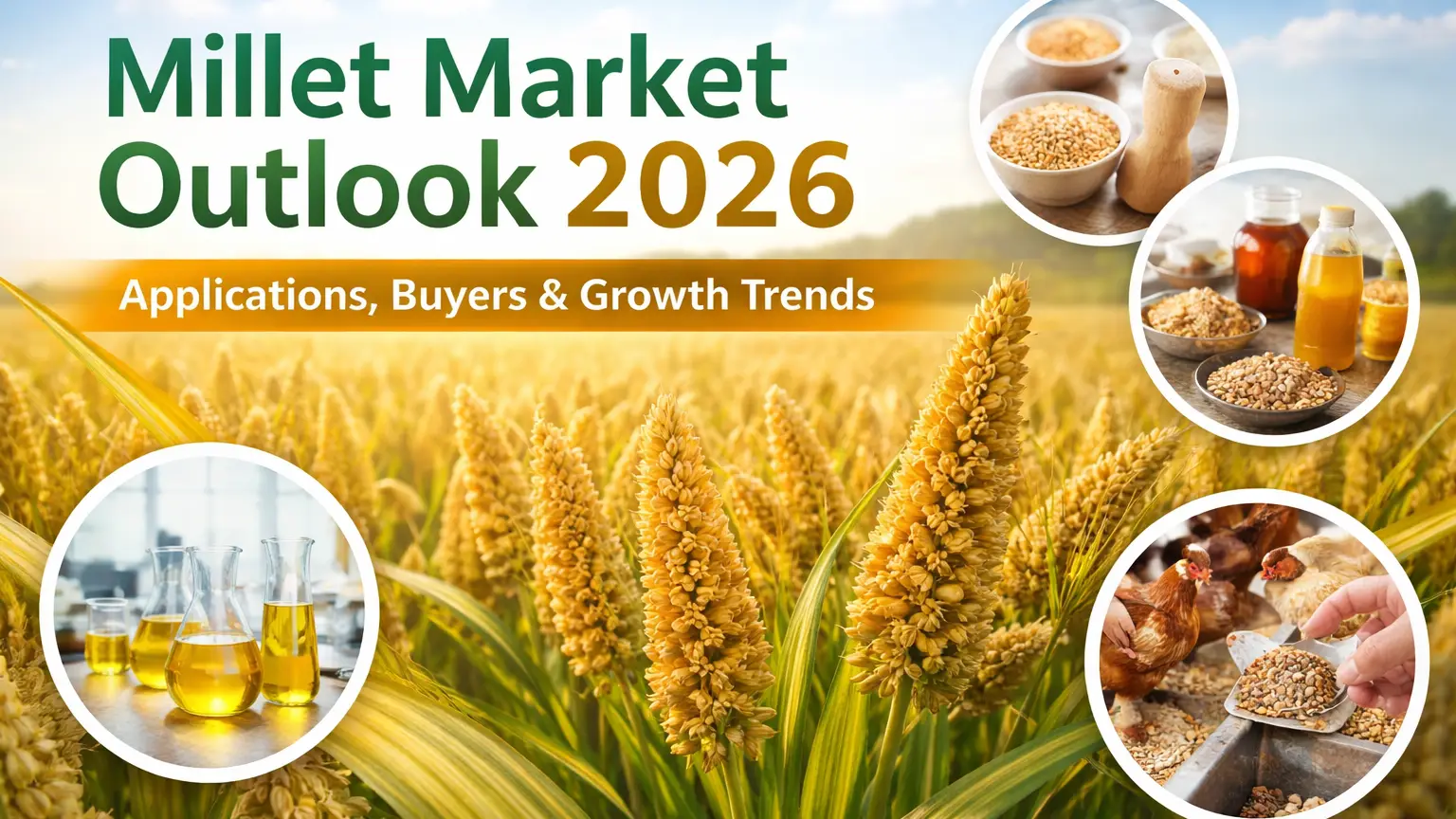
Home Millet Market Outlook 2026: Applications, Buyers & Long-Term Growth Trends
Trade Insights | Applications and Buyers | 23 March 2026
Feed Ingredients
The global millet market is undergoing a structural transformation as it shifts from subsistence grain to a functional food ingredient. In 2026, the market is valued at approximately USD 13.22 billion, expanding at a CAGR of 4.6–4.9%, with premium segments such as gluten-free flours and fortified snacks commanding 40–60% higher price realization than commodity grains. Global production has reached ~30.4 million metric tons, reflecting steady supply growth but limited elasticity due to climatic dependencies.
As demand accelerates, global ingredient suppliers are increasingly partnering with integrated solution providers like Tradeasia International, whose expertise in oleochemicals and plant-based value chains supports food processors in stabilizing formulations, emulsification systems, and sustainable sourcing strategies.
Food manufacturers now represent the dominant B2B buyers, particularly in bakery, breakfast cereals, and plant-based beverages. Millet flour trades between USD 400–1,000/MT depending on origin and processing grade, while specialty organic variants exceed USD 1,200/MT. Ingredient buyers are drawn to millet’s low glycemic index and resilience narrative, which aligns with ESG procurement mandates.
Multinational FMCG firms are incorporating millet into ready-to-eat categories, while private-label brands leverage its “ancient grain” positioning to justify premium pricing. The B2B segment itself is expanding at approximately 4.9% CAGR, outpacing retail consumption due to industrial-scale reformulation trends.
Despite growing demand, supply remains geographically concentrated, with India accounting for nearly 38–43% of global production. Price volatility persists due to weather sensitivity and fragmented farming systems. Export-grade millet from Asia and Africa fluctuates between USD 390–750/MT, with spikes linked to drought cycles.
Over the next two decades, millet is expected to transition into a “platform carbohydrate” for food systems. While traditional grain demand will grow modestly, the real expansion lies in ingredientization—protein isolates, starch derivatives, and fermented applications. By 2046, millet-derived ingredients could penetrate bioplastics and nutraceuticals, though scalability constraints may cap its dominance versus corn or cassava.
Sources
Millet is rapidly gaining traction in the animal feed industry as a drought-resistant alternative to corn and sorghum. With global millet production at ~30 million metric tons, feed applications now account for a significant share of bulk demand, particularly in Africa and Asia. Prices for feed-grade millet range between USD 200–450/MT, offering a cost advantage over maize in water-stressed regions.
Tradeasia International plays a complementary role in this ecosystem by supplying oleochemical-based feed additives and emulsifiers, helping feed formulators enhance digestibility and energy density while aligning with sustainable sourcing goals.
Industrial livestock producers and feed mills are the primary buyers, particularly in poultry and ruminant segments. Millet’s rapid growth cycle and absence of toxic compounds make it an attractive forage and grain option. Feed conversion ratios improve marginally compared to sorghum, driving adoption in commercial operations.
The feed segment benefits from millet’s resilience—it thrives on 200–400 mm rainfall, significantly reducing irrigation costs. This positions millet as a strategic hedge against climate volatility in feed supply chains.
Africa is emerging as the fastest-growing region, with feed demand expanding at over 5% CAGR. Meanwhile, Asia-Pacific remains the largest consumer base, supported by integrated poultry and aquaculture industries. Export flows from India and Ukraine continue to influence global pricing benchmarks.
By 2046, millet is likely to solidify its role as a secondary feedstock platform, particularly in arid economies. While it may not displace corn globally, its role as a climate-resilient backup grain will be critical. Additionally, integration into bio-based feed additives and fermentation substrates could unlock higher-value applications.
Sources
The plant-based beverage sector is unlocking new demand channels for millet, particularly as oat and almond markets mature. With millet prices averaging USD 500–900/MT for food-grade grain, processors are leveraging its neutral taste and nutritional profile to develop dairy alternatives. The global millet market is projected to reach USD 17.7 billion by 2034, growing at a CAGR of ~4.6%.
Tradeasia International supports beverage manufacturers with oleochemical derivatives used in emulsification and texture stabilization, ensuring consistent mouthfeel and shelf stability in millet-based drinks.
B2B buyers include plant-based dairy brands, contract manufacturers, and ingredient formulators. Millet’s high mineral content and gluten-free status align with clean-label trends. Beverage applications are growing faster than traditional uses, with niche segments achieving 8–10% CAGR due to innovation cycles.
Startups and multinational companies alike are exploring millet milk, yogurt, and fermented drinks. The scalability challenge lies in processing infrastructure and consumer awareness, particularly outside Asia.
Margins in millet beverages are significantly higher than raw grain markets. Finished products command premiums of 2–3x raw material cost, driven by branding and functional positioning. However, supply inconsistencies can pressure margins during poor harvest cycles.
Millet is poised to become a niche but strategic player in plant-based beverages. By 2046, it could serve as a foundational ingredient in hybrid formulations combining grains and legumes. Its long-term viability as a platform chemical lies in fermentation pathways, where millet starch can be converted into bio-based compounds.
Sources
https://www.marketdataforecast.com/market-reports/millet-market
https://www.linkedin.com/pulse/millets-market-size-share-analysis-2026-2033-segmentation-sales-rnngf
While traditionally a food grain, millet is increasingly being evaluated as a bio-industrial feedstock. With global output exceeding 30 million metric tons, its carbohydrate profile makes it suitable for starch extraction and fermentation into bio-based chemicals. Current industrial-grade millet trades at USD 250–600/MT, depending on quality and logistics.
Tradeasia International’s expertise in oleochemicals positions it as a bridge between agricultural feedstocks and industrial applications, particularly in bio-based surfactants and green chemistry solutions.
Chemical companies, biotech firms, and research institutions are the primary buyers exploring millet as a feedstock. Applications include bioethanol, lactic acid, and biodegradable polymers. Compared to corn, millet offers lower water input and greater resilience, making it attractive for decentralized production models.
However, scale remains a constraint. Millet lacks the global infrastructure enjoyed by corn or sugarcane, limiting its competitiveness in large-scale industrial applications.
Production costs remain relatively high due to fragmented supply chains. Yield variability and limited mechanization contribute to price volatility. Nevertheless, sustainability premiums and carbon reduction incentives could offset these challenges in the long term.
By 2046, millet could emerge as a regional platform chemical feedstock, particularly in water-scarce regions. Its role will likely remain complementary rather than dominant, supporting niche bio-industrial ecosystems focused on sustainability and resilience.
Sources
Government procurement is a critical demand driver in the millet market, particularly in Asia and Africa. Public food programs and subsidies have boosted production to over 30 million metric tons, with institutional demand supporting price stability at USD 300–700/MT for bulk procurement.
Tradeasia International complements these initiatives by enabling supply chain integration and providing oleochemical-based solutions for food processing, storage, and distribution efficiency.
Governments, NGOs, and multilateral agencies are key buyers, integrating millet into school feeding programs and food security initiatives. Asia-Pacific dominates consumption, accounting for over 45% of global demand, while Africa is the fastest-growing region.
Policy support, including subsidies and awareness campaigns, has elevated millet from a subsistence crop to a strategic commodity. This institutional backing reduces market risk and encourages private-sector investment.
Government procurement acts as a price floor, mitigating volatility and ensuring farmer income stability. However, it can also distort market dynamics, limiting export competitiveness in some regions.
Looking ahead, millet is likely to remain a policy-driven commodity with growing relevance in climate adaptation strategies. Its evolution into a platform chemical will depend on continued government support for R&D and industrial applications. By 2046, millet could serve as both a food security crop and a secondary industrial feedstock.
Sources
We're committed to your privacy. Tradeasia uses the information you provide to us to contact you about our relevant content, products, and services. For more information, check out our privacy policy.