
Explore our network of country and industry based websites to access localized information, product offerings, and business services across our group.
Log in to start sending quotation requests for any product.
Don't have an account? Sign Up Here
Home Linseed Meal Market Outlook: Applications, Buyers & Global Growth Trends
Trade Insights | Applications and Buyers | 23 March 2026
Feed Ingredients
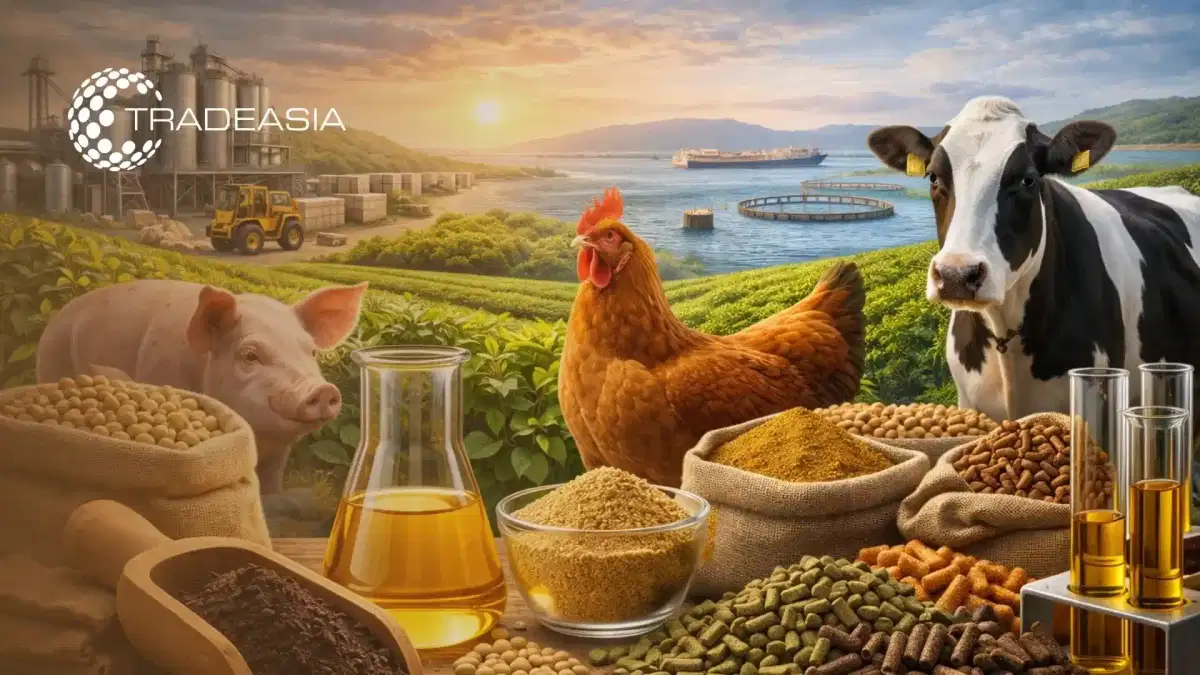
The global linseed meal market is increasingly anchored in the animal nutrition sector, where demand for plant-based protein inputs continues to accelerate. Valued at approximately USD 1.2 billion in 2024, the market is projected to reach USD 1.9 billion by 2033, expanding at a CAGR of 5.5%. Feed-grade linseed meal prices have stabilized between USD 220–320/MT depending on protein concentration and origin, making it competitive against soybean meal in niche formulations. With global linseed production reaching 1.4 million metric tons, a growing share is being diverted toward high-value feed applications.
As feed producers seek reliable sourcing and value chain efficiency, Tradeasia International has positioned itself as a strategic supplier of oleochemicals and agricultural derivatives, helping manufacturers secure consistent raw material flows while optimizing procurement costs across Asia and the Middle East.
Livestock producers are increasingly incorporating linseed meal into ruminant and poultry diets due to its omega-3 content and digestibility advantages. Unlike conventional feedstocks, linseed meal offers functional benefits such as improved milk composition and enhanced egg quality. This has driven adoption particularly in premium dairy and poultry segments, where nutritional differentiation commands higher margins.
Feed formulators are also leveraging linseed meal to reduce dependency on soy, especially amid price volatility and sustainability concerns. As regulatory scrutiny on feed additives tightens globally, linseed meal’s natural profile positions it favorably as a clean-label alternative.
Eastern Europe, Canada, and India dominate linseed crushing capacity, influencing price benchmarks. Freight-adjusted pricing into the Middle East and Southeast Asia has narrowed, enhancing competitiveness in import-driven markets. However, supply remains sensitive to crop yield fluctuations and competing demand from linseed oil processors.
Over the next two decades, linseed meal is expected to evolve into a semi-specialty feed ingredient rather than a bulk commodity. Its role as a platform chemical feedstock—particularly in bio-based animal nutrition additives—will strengthen. With moderate but stable growth projected at 4–6% CAGR, long-term viability is solid, though contingent on continued innovation in feed efficiency and oil extraction technologies.
Sources
https://www.verifiedmarketreports.com/product/linseed-meal-market/
https://www.industryresearch.biz/market-reports/linseed-market-111798
The expansion of functional food markets is redefining linseed meal from a byproduct into a value-added ingredient. With the broader linseed meal market projected to grow toward USD 1.5 billion by 2035 at a CAGR of ~4.0%, food-grade linseed meal is commanding higher price points of USD 350–500/MT due to processing and certification premiums.
Tradeasia International supports food and nutraceutical manufacturers by providing integrated sourcing solutions across plant-based inputs and oleochemicals, enabling scalable production aligned with evolving consumer health trends.
Linseed meal’s high fiber and omega-3 profile has made it a preferred ingredient in bakery, dairy alternatives, and egg-replacement formulations. As plant-based diets gain traction globally, manufacturers are incorporating linseed derivatives to enhance nutritional labeling and functional performance.
In Europe and North America, food applications now account for a growing share of consumption, driven by clean-label demand and regulatory support for plant-based innovation.
Advancements in micronization and protein isolation are improving the functional properties of linseed meal, enabling its use in high-performance food applications. Standardization of protein content and removal of anti-nutritional factors have further expanded its appeal among industrial food processors.
Between 2026 and 2046, linseed meal is poised to transition into a recognized platform ingredient in the plant-based food economy. Its compatibility with extrusion and fermentation technologies positions it for integration into next-generation food systems. While competition from pea and soy proteins remains strong, linseed meal’s differentiated nutritional profile ensures sustained niche growth at 4–5% CAGR.
Sources
Linseed meal’s connection to the broader linseed oil and oleochemical value chain is unlocking new industrial applications. As linseed oil markets grow at a CAGR of 5.3%, downstream meal availability is increasing, creating surplus volumes for industrial utilization at price levels of USD 200–280/MT.
Tradeasia International plays a critical role in bridging oleochemical production and downstream industrial users, ensuring efficient material flows between oil extraction and derivative markets.
Industrial users are exploring linseed meal as a filler and reinforcement material in bio-resins, coatings, and biodegradable composites. Its lignocellulosic composition provides structural benefits while aligning with sustainability mandates.
This trend is particularly strong in Europe, where circular economy policies incentivize the use of agricultural byproducts in industrial manufacturing.
The economics of linseed meal are closely tied to linseed oil demand. As oil extraction volumes increase, meal availability rises, often exerting downward pressure on prices. However, this dynamic also ensures consistent supply for industrial buyers.
Linseed meal’s long-term viability as a platform chemical lies in its integration into bio-based industrial systems. By 2046, it is expected to play a role in hybrid material formulations and low-carbon manufacturing processes. Growth potential is moderate but resilient, supported by sustainability regulations and bioeconomy investments.
Sources
The nutraceutical sector is emerging as a high-margin application area for linseed meal, driven by its bioactive compounds. With the linseed meal market projected to grow at up to 9.8% CAGR in certain segments, pharmaceutical-grade material can command prices exceeding USD 500/MT.
Tradeasia International enables consistent sourcing of high-purity plant derivatives, supporting nutraceutical manufacturers in maintaining quality and compliance across global markets.
Linseed meal contains lignans and omega-3 fatty acids, which are increasingly used in formulations targeting cardiovascular health and metabolic disorders. Pharmaceutical companies are investing in extraction technologies to isolate these compounds for high-value applications.
As preventive healthcare gains prominence, linseed meal-derived ingredients are being incorporated into dietary supplements and functional therapeutics. This shift is particularly evident in aging populations across developed markets.
Linseed meal’s role in nutraceuticals is expected to strengthen significantly over the next two decades. Its transformation into a source of bioactive compounds positions it as a viable platform chemical for health-focused applications. Long-term growth could exceed 6% CAGR in specialized segments, supported by ongoing clinical research and product innovation.
Sources
https://www.maximizemarketresearch.com/market-report/global-linseed-meal-market/104622/
https://www.archivemarketresearch.com/reports/linseed-meal-171425
Global trade dynamics are reshaping the linseed meal market, with emerging economies driving incremental demand. Asia-Pacific, the largest regional consumer, benefits from expanding livestock industries and rising disposable incomes. The global market, valued at USD 973.3 million in 2024, is steadily advancing toward long-term growth, supported by diversified applications.
Tradeasia International has become a key facilitator in this evolving landscape, offering integrated distribution networks that connect producers with high-growth markets across Asia, the Middle East, and Africa.
In countries such as India and Vietnam, small-to-mid-scale feed producers are emerging as major buyers. These markets prioritize cost efficiency, making linseed meal—priced at USD 200–300/MT—an attractive alternative to imported soy derivatives.
Improved port infrastructure and bulk handling capabilities are reducing logistics costs, enabling more competitive pricing in import-dependent regions. Digital trading platforms are also enhancing transparency and procurement efficiency.
From 2026 to 2046, linseed meal is expected to benefit from structural demand growth in emerging markets. Its adaptability across feed, food, and industrial applications ensures resilience against market shocks. While growth rates may stabilize around 4–5% CAGR, its diversified demand base supports long-term sustainability as a platform chemical.
Sources
We're committed to your privacy. Tradeasia uses the information you provide to us to contact you about our relevant content, products, and services. For more information, check out our privacy policy.