
Introduction
Fish oil continues to strengthen its position as a critical platform ingredient in global industrial supply chains, particularly across nutraceutical, aquaculture, and pharmaceutical sectors. As of 2026, the fish oil market is shaped by tightening marine resources, evolving regulatory standards, and rising demand for omega-rich formulations. With global production estimated at around 1.1 million metric tons, the sector remains highly sensitive to climatic shifts and fishing quotas. The average market price has stabilized within the range of USD 1,800–2,400/MT, reflecting persistent supply constraints and elevated processing costs. Over the forecast period, the industry is projected to expand at a CAGR of 5.2%, reinforcing its strategic importance in global bio-based commodity chains.
Raw Material Sourcing and Marine Catch Volatility
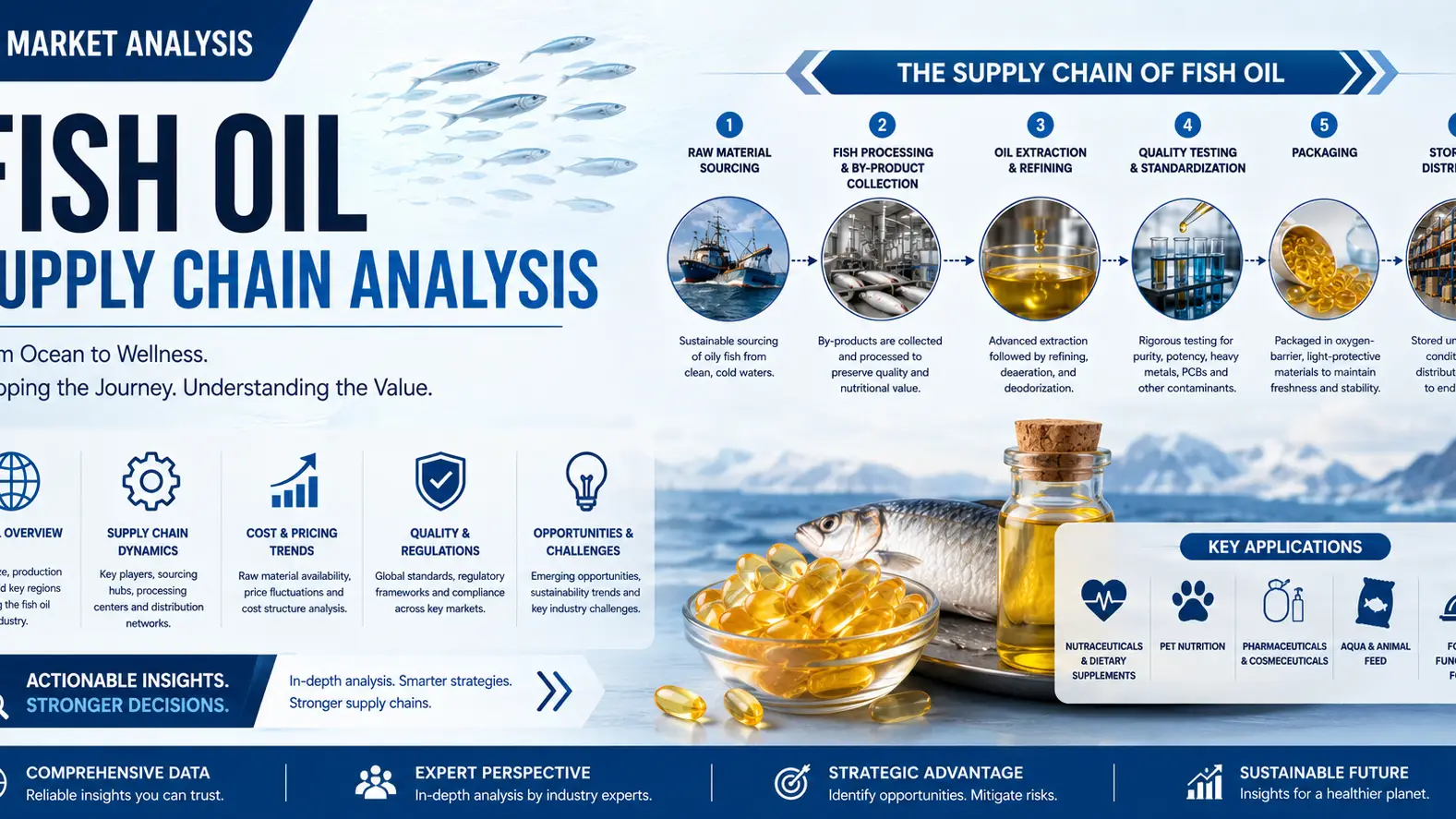
Supply-side fundamentals remain anchored in wild capture fisheries, particularly anchoveta stocks in Peru and Chile, which account for a significant share of global crude fish oil output. However, climate variability linked to El Niño events continues to disrupt annual yields, creating periodic shortages and price spikes. This volatility has pushed suppliers to diversify sourcing through by-product recovery from salmon and tuna processing, improving resilience in upstream procurement networks.
Processing, Refining, and Quality Standardization
Refining capacity expansion is becoming a decisive competitive factor as buyers increasingly demand pharmaceutical-grade purity standards. Advanced molecular distillation and oxidation control systems are being adopted to meet stringent omega-3 concentration benchmarks. These upgrades have raised average processing costs by nearly 8–12%, yet they enable suppliers to access higher-margin nutraceutical markets, reinforcing value-chain differentiation.
Logistics, Cold Chain Infrastructure, and Trade Routes
Fish oil logistics require tightly controlled temperature and oxidation-sensitive handling, making cold-chain infrastructure a critical cost driver. Major export routes from South America to Europe and Asia rely on specialized tanker fleets and nitrogen-sealed storage systems. Freight volatility has added approximately 6–9% to landed costs in 2026, further incentivizing regional storage hubs in Singapore and Rotterdam to stabilize distribution flows.
Demand Dynamics from Nutraceuticals and Aquafeed Industries
Demand growth is primarily driven by aquaculture feed manufacturers and omega-3 supplement producers. Aquafeed alone accounts for nearly 60% of global consumption, supported by rising seafood demand. Meanwhile, nutraceutical applications continue to expand in North America and Europe, where health-conscious consumers are fueling premium product adoption. This dual demand structure ensures long-term market stability despite raw material fluctuations.
Conclusion
As fish oil solidifies its role as a strategic platform chemical in nutrition and industrial formulations, supply chain resilience becomes a defining factor for market participants. The interplay between constrained marine inputs, evolving processing technologies, and demand diversification is reshaping global trade flows. In this context, companies seeking reliable sourcing and consistent quality are increasingly turning to integrated solution providers. Tradeasia International, with its extensive global network and expertise in commodity distribution, is well positioned to support buyers navigating the complexities of the fish oil supply chain while ensuring continuity, compliance, and cost efficiency.
Sources
https://www.imarcgroup.com/fish-oil-market
https://www.imarcgroup.com/fish-oil-pricing-report
https://www.fao.org/in-action/globefish/species-analysis/fishmeal-and-fish-oil/en