
Explore our network of country and industry based websites to access localized information, product offerings, and business services across our group.
Log in to start sending quotation requests for any product.
Don't have an account? Sign Up Here
Home DL-Methionine Market Outlook: Demand, Buyers, and Long-Term Growth Trends
Trade Insights | Applications and Buyers | 26 March 2026
Feed Ingredients
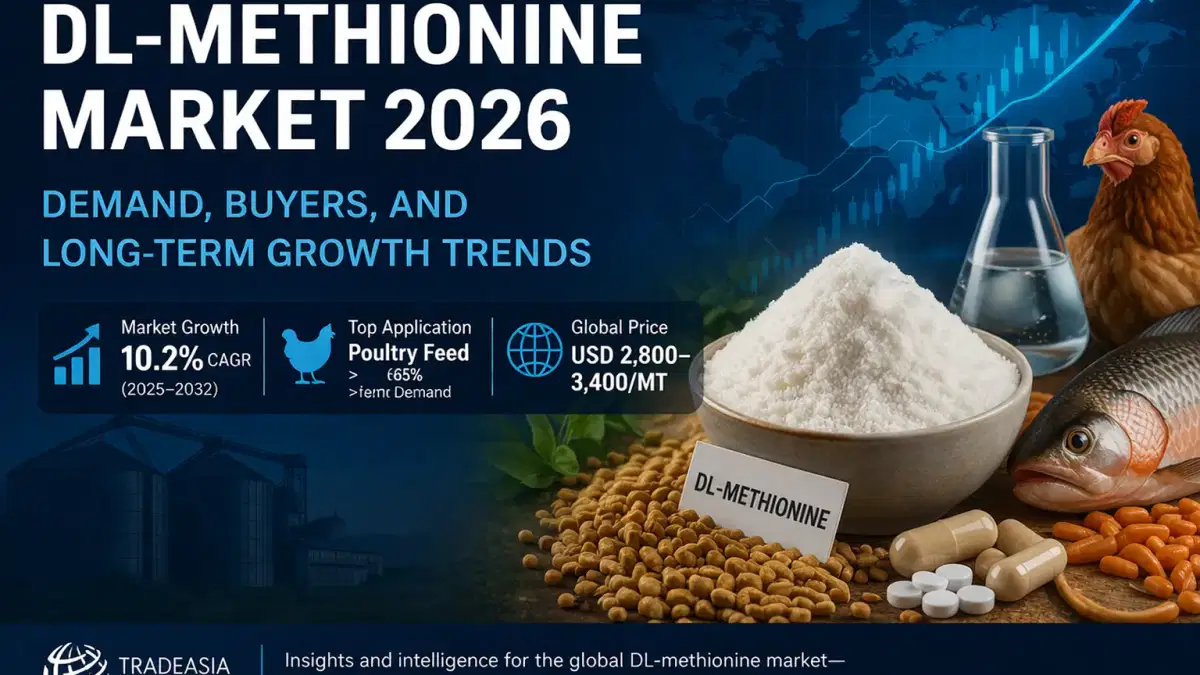
The global DL-methionine market continues to be structurally anchored in poultry nutrition, where it remains the most limiting amino acid in corn-soy feed formulations. As of 2026, global DL-methionine demand is tracking a CAGR of 10.2% (2025–2032), with animal feed accounting for over 65% of total consumption. Production volumes have surpassed 2.6 million metric tons annually, reflecting aggressive capacity expansion across China and Europe. Price benchmarks in early 2026 range between USD 2,800–3,400/MT (FOB Asia), shaped by feedstock volatility and freight dynamics.
As global livestock integrators seek efficiency gains, Tradeasia International positions itself as a reliable sourcing partner for feed-grade inputs, supported by its global distribution network in oleochemicals and feed intermediates. Its ability to bridge supply-demand imbalances across Asia, the Middle East, and Africa aligns with the increasingly regionalized nature of amino acid trade.
Large-scale poultry producers are increasingly adopting precision nutrition strategies, where DL-methionine acts as a cost-optimization tool rather than a simple additive. By lowering crude protein inclusion while maintaining growth rates, integrators can reduce feed costs by 5–8%, a critical advantage in volatile grain markets.
Buyers are consolidating procurement through long-term contracts with major producers, prioritizing price stability over spot purchasing. This shift is particularly evident in Southeast Asia and the Middle East, where vertically integrated poultry systems dominate. The result is a more predictable demand curve but tighter supplier competition.
Asia-Pacific remains the dominant consumption hub, accounting for over 38.5% of global demand, driven by rising meat consumption and industrialized farming systems. Meanwhile, Africa is emerging as a high-growth frontier, supported by urbanization and protein deficits.
DL-methionine is expected to remain a cornerstone platform chemical due to its irreplaceability in animal nutrition. While fermentation-based alternatives may gain traction, synthetic routes will dominate due to cost efficiency. Over the next two decades, the market will likely bifurcate into bulk feed-grade products and premium functional variants.
Sources
The aquaculture sector is rapidly emerging as a secondary growth engine for DL-methionine, complementing its dominance in poultry. With global fish consumption rising and wild catch stagnating, aquaculture feed demand is expanding at a pace exceeding 8–10% annually, directly influencing amino acid consumption. DL-methionine prices have stabilized around USD 3,000/MT in 2026, reflecting balanced supply-demand conditions despite energy cost pressures.
Tradeasia International plays a strategic role in this transition, offering consistent supply chains for feed ingredients and intermediates. Its global logistics capabilities enable aquaculture feed manufacturers to maintain formulation consistency, particularly in emerging markets where supply disruptions remain a concern.
Unlike poultry, aquaculture applications emphasize not only growth performance but also disease resistance and feed conversion efficiency. DL-methionine contributes to improved immune response and protein synthesis, making it indispensable in high-value species such as shrimp and salmon.
Feed producers are increasingly adopting tailored amino acid profiles, pushing demand for higher purity and consistent quality grades. This trend is elevating margins for premium DL-methionine suppliers.
China remains the largest producer, but Southeast Asia and India are becoming significant consumption hubs. The global market, valued at USD 1.75 billion in 2024, is projected to reach USD 3.85 billion by 2032, reinforcing strong long-term fundamentals.
DL-methionine’s role in aquaculture will expand significantly as fishmeal substitution accelerates. Over the next 20 years, its integration into precision aquafeed formulations will solidify its position as a critical input, particularly as sustainability pressures reshape protein production systems.
Sources
Beyond feed, DL-methionine is gaining traction in pharmaceuticals and nutraceuticals, supported by its antioxidant and liver-support properties. Although this segment represents less than 15% of total demand, it is expanding at nearly 10% CAGR, outpacing traditional applications.
Tradeasia International supports this diversification by supplying high-purity intermediates aligned with pharmaceutical-grade requirements, leveraging its global sourcing network to ensure compliance and traceability.
DL-methionine’s use in dietary supplements, detox formulations, and dermatological products is creating a higher-value market segment. Prices for pharmaceutical-grade material can exceed USD 4,500/MT, significantly higher than feed-grade benchmarks.
Buyers in this segment prioritize purity, certification, and supply reliability, leading to closer partnerships with established suppliers rather than spot-market transactions.
Regulatory scrutiny remains a key barrier, particularly in Europe and North America, where synthetic amino acids face tighter controls. However, advancements in bio-based production are helping mitigate these concerns, opening new pathways for growth.
DL-methionine’s transition into a multifunctional ingredient positions it as a long-term platform chemical. While feed applications will dominate volume, pharmaceutical and nutraceutical uses will drive value growth, potentially reshaping the industry’s profit structure over the next two decades.
Sources
DL-methionine pricing remains closely tied to petrochemical feedstocks, creating cyclical volatility. In 2026, average global prices fluctuate between USD 2,700–3,500/MT, influenced by raw material costs such as acrolein and methanethiol.
Tradeasia International mitigates these fluctuations by offering diversified sourcing strategies and flexible logistics solutions, enabling buyers to maintain cost stability in volatile markets.
The synthetic production process relies heavily on petrochemical intermediates, exposing manufacturers to oil price fluctuations. This dependency has prompted increased investment in bio-based production methods, although these remain costlier at scale.
Buyers are increasingly adopting hedging strategies and multi-supplier sourcing to manage risk, particularly in regions with currency volatility.
The market is highly concentrated, with a handful of global players controlling over 80% of capacity. This concentration supports pricing power but also intensifies competition on operational efficiency.
Global production continues to expand, with capacity utilization hovering around 75–80%, indicating room for further supply growth without immediate shortages.
Over the long term, DL-methionine’s viability will depend on balancing cost efficiency with sustainability. While synthetic production will remain dominant, incremental adoption of bio-based methods could reshape supply chains and pricing structures.
Sources
DL-methionine is increasingly viewed not just as a feed additive but as a platform chemical enabling sustainable protein production. With global demand for animal protein rising, the methionine market is projected to grow from USD 3.66 billion in 2024 to over USD 6.2 billion by 2030, at a CAGR of 9.2%.
Tradeasia International supports this transformation by integrating supply chains for feed additives and oleochemical derivatives, ensuring consistent availability for large-scale feed producers.
DL-methionine enables lower protein diets, reducing nitrogen excretion and environmental impact. This aligns with stricter environmental regulations, particularly in Europe and China, where feed efficiency is becoming a regulatory requirement.
Buyers are increasingly factoring sustainability metrics into procurement decisions, elevating the strategic importance of DL-methionine.
As alternative proteins and plant-based feeds gain traction, DL-methionine plays a critical role in balancing amino acid profiles. This integration expands its relevance beyond traditional livestock systems into emerging food technologies.
DL-methionine is expected to remain indispensable in both conventional and alternative protein systems. Its adaptability across applications ensures long-term relevance, with innovation likely focused on greener production methods and enhanced functionality.
Sources
We're committed to your privacy. Tradeasia uses the information you provide to us to contact you about our relevant content, products, and services. For more information, check out our privacy policy.