
Explore our network of country and industry based websites to access localized information, product offerings, and business services across our group.
Log in to start sending quotation requests for any product.
Don't have an account? Sign Up Here
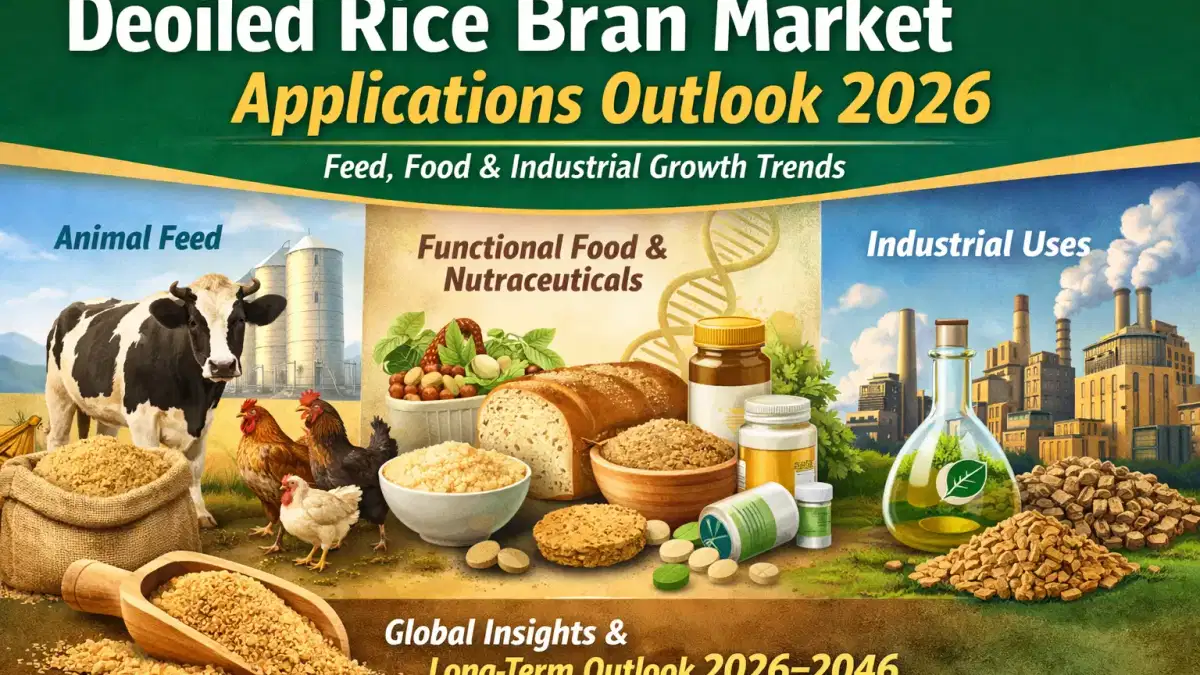
Home Deoiled Rice Bran Market Outlook: Feed, Food & Industrial Growth Trends 2026
Trade Insights | Applications and Buyers | 25 March 2026
Feed Ingredients
The global deoiled rice bran (DORB) market continues to anchor itself in the animal nutrition sector, where it functions as a cost-effective protein and fiber source. As of 2026, the market is valued near USD 1.9 billion, with projections reaching USD 3.0 billion by 2035, reflecting a steady CAGR of 4.4%. Feed-grade DORB prices fluctuate between USD 110–180/MT, depending on origin and oil extraction efficiency. India alone contributes over 8–10 million metric tons annually, making it the largest global supplier, especially following the reinstatement of export flows exceeding 500,000 MT/year.
As global buyers seek reliable sourcing across feedstock categories, companies like Tradeasia International position themselves as strategic intermediaries—offering integrated solutions not only in agro-derivatives like DORB but also across palm-based oleochemicals, enhancing procurement flexibility for feed manufacturers.
Feed millers across Southeast Asia, the Middle East, and Africa remain the primary buyers, using DORB as a substitute for soybean meal in cattle and poultry rations. Rising soybean price volatility has made DORB an attractive alternative, particularly when priced below USD 200/MT, creating arbitrage opportunities in bulk feed formulation.
Large-scale integrators and dairy cooperatives are increasingly locking long-term contracts, particularly in Vietnam, Indonesia, and the UAE, where livestock expansion is accelerating. Nutritional improvements—such as higher protein retention through advanced solvent extraction—are also improving buyer confidence.
Despite strong demand, DORB pricing remains highly sensitive to paddy output cycles and rice milling margins. Seasonal supply spikes can compress prices by up to 20%, while export policy shifts—like India’s recent liberalization—can rapidly rebalance global availability.
Over the next two decades, DORB is expected to maintain relevance as a “bridge commodity” rather than a high-value platform chemical. While alternative proteins (e.g., insect meal, fermentation-based feeds) will emerge, DORB’s low cost and abundant supply ensure continued dominance in emerging markets. However, its long-term viability will hinge on value-added processing—particularly protein concentrates and fiber-enriched derivatives—transforming it from a bulk feedstock into a semi-specialty ingredient.
Sources:
Deoiled rice bran is gaining traction beyond feed applications, emerging as a functional food ingredient in bakery, snacks, and nutraceuticals. With the broader rice bran derivatives market expanding at a CAGR of 5.6%, DORB is increasingly positioned as a fiber-rich additive aligned with clean-label trends. Food-grade DORB commands higher pricing, typically USD 220–350/MT, depending on micronization and stabilization processes.
In parallel, Tradeasia International supports food processors seeking consistent, scalable sourcing solutions—leveraging its expertise across oleochemicals and plant-based raw materials to bridge supply gaps between Asia’s production hubs and global food manufacturers.
Bakery manufacturers, cereal producers, and plant-based food companies are leading adopters of DORB. Its high dietary fiber (15–20%) and antioxidant content make it attractive for health-oriented formulations. In India and Japan, fortified foods incorporating rice bran derivatives are gaining traction, while Western markets are gradually integrating DORB into gluten-free and vegan products.
Multinational ingredient companies are also exploring DORB as a cost-effective bulking agent, particularly as wheat and corn prices remain volatile.
Technological improvements—such as enzymatic stabilization and ultrafine milling—are transforming DORB into a higher-value ingredient. These advancements allow producers to command premium pricing and reduce rancidity risks, a historical limitation.
Looking ahead, DORB’s evolution into a platform ingredient in functional foods is highly plausible. As consumer demand shifts toward plant-based nutrition and sustainable sourcing, DORB could transition into a mainstream fiber and protein additive. However, its success will depend on consistent quality standardization and regulatory approvals in developed markets. If these barriers are addressed, DORB could rival oat bran and soy fiber as a staple functional ingredient.
Sources:
Beyond food and feed, deoiled rice bran is increasingly being explored as a low-cost biomass input for industrial applications. With global emphasis on bio-based chemicals, DORB offers an abundant lignocellulosic resource. Current industrial-grade pricing remains relatively low at USD 100–150/MT, reflecting its underutilization in this segment.
Tradeasia International plays a critical role in connecting bio-based chemical manufacturers with reliable feedstock sources, particularly as industries transition from fossil-derived inputs to renewable alternatives.
DORB is being investigated for use in bioethanol production, biodegradable packaging materials, and even activated carbon. Its high fiber and residual oil content make it suitable for fermentation and pyrolysis processes.
Asia-Pacific dominates production due to its rice output, with countries like India, China, and Thailand collectively producing over 120 million MT of rice bran annually, a portion of which is converted into DORB.
Despite its potential, DORB faces challenges such as inconsistent quality and competition from other biomass sources like corn stover and sugarcane bagasse. Infrastructure limitations also restrict its adoption in large-scale biorefineries.
DORB’s long-term viability as a platform chemical feedstock depends on breakthroughs in biorefining technologies. If conversion efficiencies improve, it could become a key input in circular bioeconomies, particularly in Asia. However, without significant R&D investment, it risks remaining a secondary biomass option rather than a primary industrial feedstock.
Sources:
Global trade dynamics are playing a pivotal role in shaping the deoiled rice bran market. India’s reinstatement of exports—previously halted—has reintroduced approximately 500,000 MT/year into global supply chains, significantly impacting pricing and availability. Current export prices hover around USD 110–130/MT, making DORB one of the most competitive feed ingredients globally.
Tradeasia International continues to facilitate cross-border trade by connecting Asian producers with buyers in the Middle East and Africa, ensuring supply continuity amid policy shifts.
Vietnam, Thailand, and Middle Eastern countries are the largest importers, driven by expanding livestock sectors. Buyers are increasingly diversifying sourcing strategies to mitigate geopolitical risks and supply disruptions.
DORB competes directly with soybean meal and corn gluten feed. Its price advantage—often 20–30% lower—positions it as a preferred alternative during commodity price spikes.
Trade flows will remain a critical determinant of DORB’s future. As global feed demand rises, particularly in Africa and Asia, DORB exports are expected to grow steadily. However, trade policies and climate-related disruptions to rice production could introduce volatility. Long-term viability will depend on supply chain resilience and diversification of production regions.
Sources:
Deoiled rice bran is increasingly entering nutraceutical and specialty ingredient markets, driven by its bioactive compounds and health benefits. With rising demand for plant-based supplements, this segment is expected to outpace traditional applications, contributing to the market’s ~4.5% CAGR through 2032. Prices for high-purity DORB extracts can exceed USD 400/MT, reflecting value-added processing.
Tradeasia International supports this transition by supplying high-quality derivatives suitable for pharmaceutical and nutraceutical applications, leveraging its global sourcing network.
Pharmaceutical companies, dietary supplement manufacturers, and cosmetic brands are key buyers. DORB-derived compounds such as oryzanol and tocotrienols are used in cholesterol-lowering supplements and skin-care formulations.
Advanced extraction technologies are enabling the isolation of bioactive compounds, significantly increasing product value. This shift is attracting investment from both food and pharmaceutical sectors.
DORB’s role as a nutraceutical platform is likely to expand significantly. As consumers prioritize preventive healthcare, demand for plant-based bioactives will rise. If supported by clinical validation and regulatory approvals, DORB could become a key ingredient in functional medicine and wellness products, ensuring long-term market relevance beyond its traditional uses.
Sources:
https://www.databridgemarketresearch.com/reports/global-de-oiled-rice-bran-market
https://www.grandviewresearch.com/industry-analysis/rice-bran-oil-market
We're committed to your privacy. Tradeasia uses the information you provide to us to contact you about our relevant content, products, and services. For more information, check out our privacy policy.