Introduction
The global Vitamin B12 (cobalamin) market in 2026 continues to strengthen as a critical micronutrient across healthcare, food, and livestock sectors. Positioned as an essential biological compound rather than a bulk commodity, Vitamin B12 demonstrates strong resilience in demand due to its role in neurological health, red blood cell formation, and metabolic regulation. Market expansion is supported by a steady 7.2% CAGR, with average pricing ranging between USD 25,000–35,000/MT, reflecting its high-value, low-volume nature. Global production remains limited at approximately ~25 metric tons annually, reinforcing its strategic supply sensitivity across end-user industries.
Pharmaceutical & Nutraceutical Demand Landscape
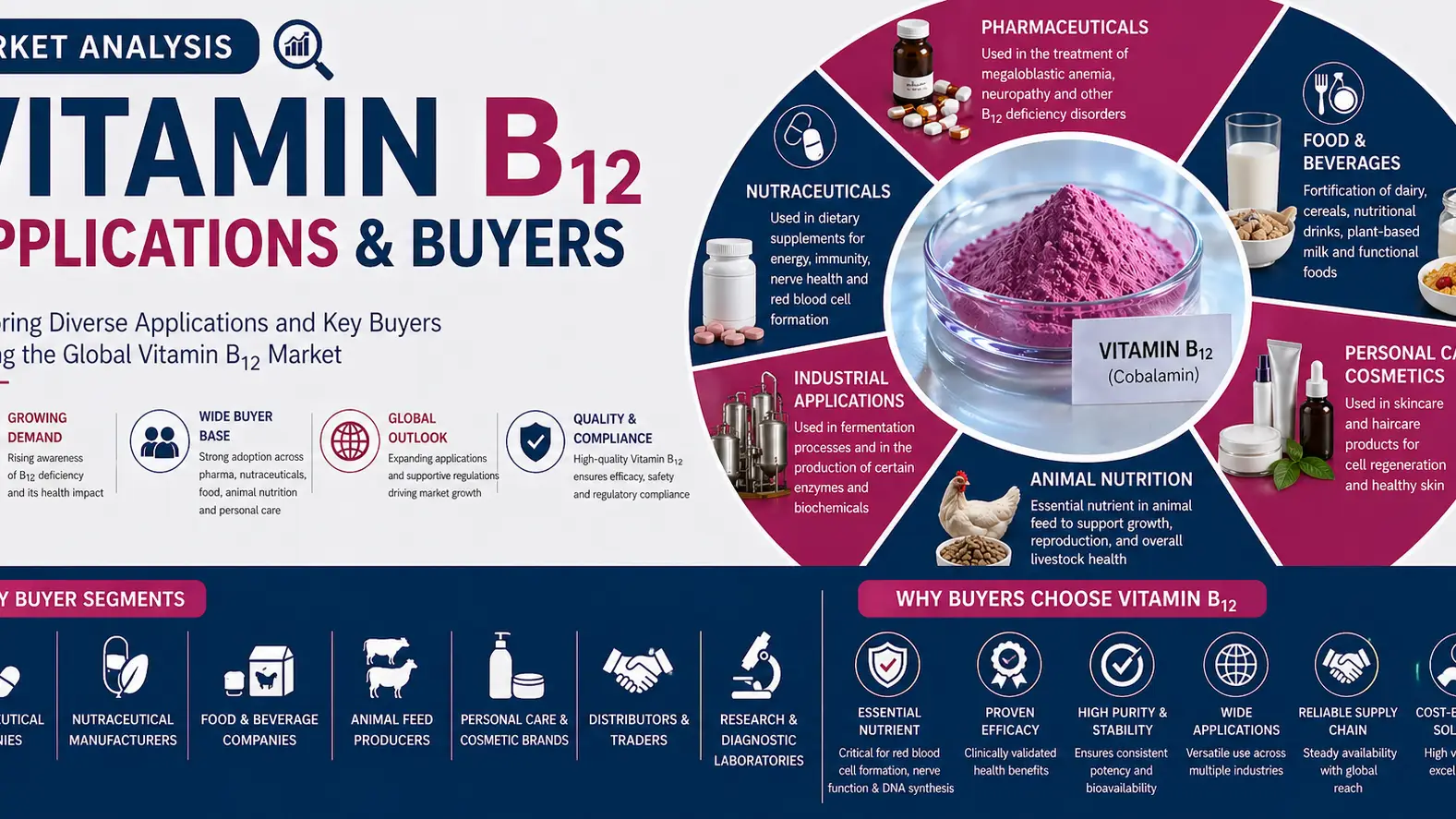
Pharmaceutical companies and nutraceutical manufacturers remain the dominant buyers of Vitamin B12, driven by rising cases of anemia, neurological disorders, and dietary deficiencies. Oral supplements, injectables, and fortified multivitamins account for the majority of consumption. In 2026, this segment represents over 40% of total demand, with branded supplement firms in North America, Europe, and Asia-Pacific securing long-term contracts to stabilize supply chains amid fluctuating raw material costs.
Animal Feed Industry Consumption Drivers
The livestock and aquaculture sectors are increasingly integrating Vitamin B12 into feed premixes to improve growth performance, fertility, and feed efficiency. Poultry and swine industries are the largest consumers, particularly in China, Brazil, and Southeast Asia. Feed-grade Vitamin B12 demand has expanded steadily as industrial farming intensifies, with feed manufacturers prioritizing consistent bioavailability and cost-efficient formulations despite elevated input pricing.
Food Fortification and Functional Applications
Food and beverage fortification is emerging as a key growth avenue, particularly in processed cereals, dairy alternatives, and energy drinks. Governments in developing economies are mandating micronutrient enrichment programs to combat malnutrition, indirectly expanding industrial procurement channels. Buyers in this segment prioritize stable, water-soluble formulations suitable for mass production while maintaining regulatory compliance across global food safety frameworks.
Production Economics, Pricing, and Supply Chain Dynamics
Vitamin B12 production remains highly concentrated, relying on microbial fermentation processes involving specialized bacterial strains. Limited production capacity contributes to price volatility, with spot prices averaging USD 30,000/MT in 2026. Supply chains are sensitive to fermentation yield efficiency, energy costs, and regulatory constraints. Manufacturers are increasingly investing in process optimization and downstream purification technologies to enhance scalability and reduce production bottlenecks.
Conclusion
As Vitamin B12 continues to evolve as a high-value bioactive compound, its market structure remains tightly linked to pharmaceutical innovation, feed efficiency demands, and global nutrition policies. While supply remains constrained, long-term demand fundamentals remain strong across all major end-use sectors. In this context, reliable sourcing and integrated distribution networks become essential for industrial buyers seeking stability and consistency. Companies like Tradeasia International play a strategic role as global solution providers, bridging producers and end-users through efficient supply chain connectivity and technical-grade chemical distribution support.
Sources