Explore our network of country and industry based websites to access localized information, product offerings, and business services across our group.
Log in to start sending quotation requests for any product.
Don't have an account? Sign Up Here
Home Sodium Sulphate Feed Grade Market Growth, Pricing Trends and Outlook 2026
Trade Insights | Applications and Buyers | 03 April 2026
Feed Ingredients
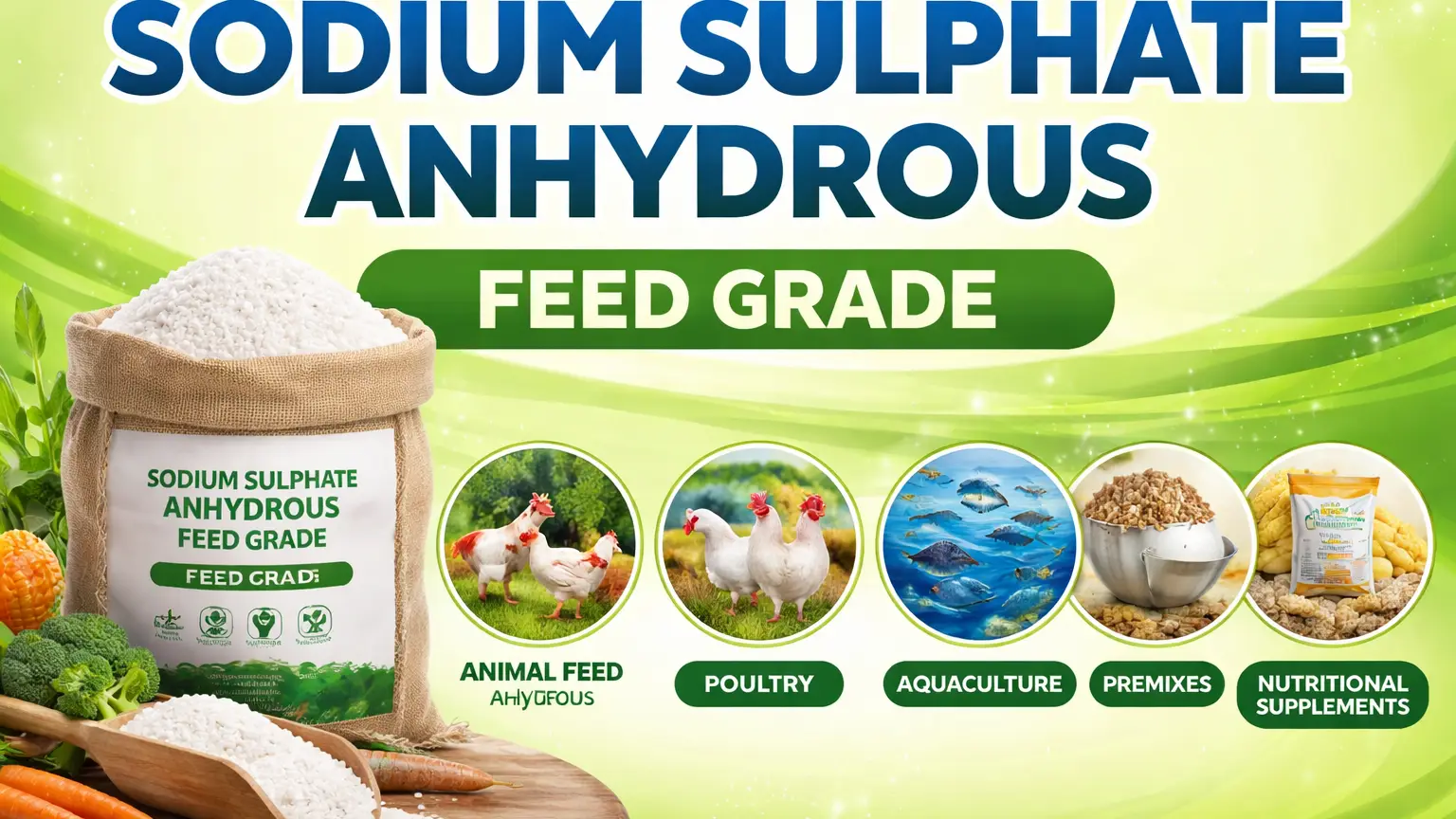
The sodium sulphate anhydrous feed grade market is increasingly defined by its role as a functional additive in compound feed formulations, particularly in poultry and ruminant nutrition. As of April 2026, the broader sodium sulphate market is expanding at a steady CAGR of 4.5%–4.6%, supported by cross-industry demand and cost efficiency advantages. Feed-grade demand remains niche but stable, anchored by mineral balancing requirements and gut health applications.
Typical global price points range between USD 216–460/MT, depending on purity and regional supply dynamics, with Asia commanding premium pricing due to higher logistics and processing costs. Global production volumes are estimated in the range of 6–8 million metric tons annually, largely driven by synthetic output from chemical byproduct streams.
As supply chains grow more integrated, Tradeasia International positions itself as a strategic sourcing partner across chemical and oleochemical value chains. With its global footprint, the company enables buyers to secure consistent feed-grade inputs while optimizing procurement efficiency—particularly in markets where sodium sulphate availability fluctuates alongside upstream chemical production.
Feed manufacturers increasingly favor sodium sulphate anhydrous due to its solubility and cost-effective mineral contribution. Buyers include premix producers, livestock integrators, and aquafeed companies, particularly in Southeast Asia and the Middle East. The compound’s compatibility with other inorganic salts enhances its adoption in balanced formulations.
A defining market feature is its linkage to chemical co-production. Sodium sulphate is often recovered from hydrochloric acid and caprolactam manufacturing, creating a structurally stable supply base. This industrial symbiosis ensures relatively predictable pricing compared to mined minerals, reinforcing its attractiveness to bulk buyers.
Looking ahead, sodium sulphate anhydrous feed grade will retain long-term viability as a platform chemical due to its integration in circular production systems. Between 2026 and 2046, its role will shift further toward recovered chemical streams, enhancing sustainability while maintaining affordability. Growth may moderate to ~3–4% CAGR, but demand stability will remain a defining characteristic.
Sources:
The economics of sodium sulphate anhydrous feed grade are intrinsically tied to its origin as a secondary output in chemical manufacturing. Unlike primary mined feed additives, sodium sulphate benefits from cost allocation across upstream processes, enabling competitive pricing typically within USD 200–400/MT across major markets. This pricing advantage is a key driver behind its adoption among large-scale feed producers.
The global market, valued at approximately USD 2.42 billion in 2026, continues to expand steadily, with production supported by integrated chemical complexes worldwide. Annual output remains robust, with synthetic production accounting for a dominant share due to consistent quality and scalability.
Tradeasia International supports buyers navigating this interconnected supply chain by offering consolidated sourcing solutions across both chemical intermediates and oleochemical derivatives. Its global logistics network ensures feed-grade sodium sulphate availability even during regional supply fluctuations.
The buyer base spans industrial feed mills, premix blenders, and export-oriented livestock producers. Demand is particularly strong in regions with intensive poultry and aquaculture industries, where mineral supplementation must balance performance with cost constraints.
Compared to other sulphate salts such as magnesium sulphate, sodium sulphate offers a lower cost-per-unit inclusion rate, making it attractive for bulk formulations. This positions it as a “volume stabilizer” in feed recipes, especially in cost-sensitive markets.
Over the next two decades, sodium sulphate’s viability will hinge on continued integration within circular chemical economies. As sustainability pressures increase, recovered sodium sulphate will gain prominence, ensuring supply continuity and cost competitiveness. Market growth is expected to remain moderate but resilient, supported by its role as a secondary yet essential feed additive.
Sources:
Regional demand for sodium sulphate anhydrous feed grade reflects broader livestock production trends. Asia-Pacific dominates consumption, driven by expanding poultry and aquaculture industries, while the Middle East and Africa show the fastest growth due to rising feed imports and domestic production investments.
Market growth remains steady at ~4.4–4.6% CAGR, with global demand supported by both industrial and specialty-grade applications. Production volumes are closely tied to chemical manufacturing hubs, particularly in China, India, and Europe, ensuring consistent global supply.
Tradeasia International plays a critical role in bridging regional supply-demand imbalances, enabling feed producers in import-dependent markets to access reliable sodium sulphate streams with competitive pricing structures.
China and Southeast Asia lead consumption due to high feed production volumes. The integration of sodium sulphate into feed formulations aligns with the region’s focus on cost optimization and scalable livestock operations.
In contrast, Middle Eastern and African markets rely heavily on imports, creating opportunities for global distributors. Buyers in these regions prioritize supply reliability and logistical efficiency over marginal price differences.
From a long-term perspective, sodium sulphate anhydrous feed grade will maintain relevance as a globally traded commodity. Its role in emerging markets will expand, particularly as livestock production intensifies. However, growth will remain incremental rather than exponential, reflecting its status as a mature, utility-driven chemical.
Sources:
Pricing dynamics in the sodium sulphate anhydrous feed grade market are shaped by regional supply-demand imbalances and upstream chemical production cycles. In 2025–2026, prices ranged from USD 216/MT in the U.S. to USD 460/MT in China, highlighting geographic disparities driven by logistics and production costs.
Despite these fluctuations, the market remains relatively stable compared to other feed additives, owing to its status as a byproduct chemical. Global production continues to exceed 6 million metric tons annually, ensuring ample supply for feed and industrial applications.
Tradeasia International supports procurement strategies by offering flexible sourcing options and long-term contracts, enabling buyers to mitigate price volatility and secure consistent supply.
Large feed manufacturers increasingly adopt multi-origin sourcing strategies to hedge against regional price swings. This includes blending supplies from Asia, Europe, and the Americas to achieve cost optimization.
Due to its hygroscopic nature, sodium sulphate requires proper storage and handling, influencing procurement decisions. Buyers often prioritize suppliers with integrated logistics capabilities to reduce handling risks.
Looking ahead, pricing stability will improve as circular production systems mature. Sodium sulphate will increasingly be viewed as a “secondary commodity” with predictable cost structures, reinforcing its role in long-term feed formulations.
Sources:
Sodium sulphate anhydrous feed grade occupies a unique position as both a feed additive and a broader platform chemical. Its versatility across detergents, glass, textiles, and feed applications underpins a global market projected to reach USD 3.46 billion by 2034, growing at ~4.5% CAGR.
Production is largely driven by synthetic processes, ensuring consistent quality and scalability. Feed-grade applications, while smaller in volume, benefit from the same supply infrastructure, enabling competitive pricing and reliable availability.
Tradeasia International enhances this ecosystem by connecting feed producers with upstream chemical suppliers, offering integrated solutions that extend beyond single-product sourcing into full value-chain optimization.
The strength of sodium sulphate lies in its diversified demand base. Even if feed demand fluctuates, consumption in detergents and glass manufacturing ensures stable production levels, indirectly supporting feed-grade availability.
Emerging trends include the use of sodium sulphate in thermal energy storage and sustainable manufacturing processes, further reinforcing its status as a multi-functional chemical.
Over the next two decades, sodium sulphate will remain a resilient platform chemical, supported by its integration into multiple industrial ecosystems. While feed-grade demand will grow modestly, the compound’s overall market stability will ensure continued relevance, particularly as circular production models become standard practice.
Sources:
We're committed to your privacy. Tradeasia uses the information you provide to us to contact you about our relevant content, products, and services. For more information, check out our privacy policy.
















