Introduction
L-tryptophan has evolved into a critical platform chemical within the global amino acids value chain, serving as a precursor for serotonin, melatonin, and niacin synthesis. In 2026, the market reflects a convergence of nutritional science, livestock efficiency demands, and pharmaceutical innovation. Valued across multiple downstream sectors, the global tryptophan market is projected to grow at a CAGR of 9.7%, reaching approximately USD 688 million in 2026, supported by rising demand in both feed-grade and pharmaceutical-grade applications. (Market Growth Reports)
Expanding Animal Nutrition Demand Driving Volume Growth
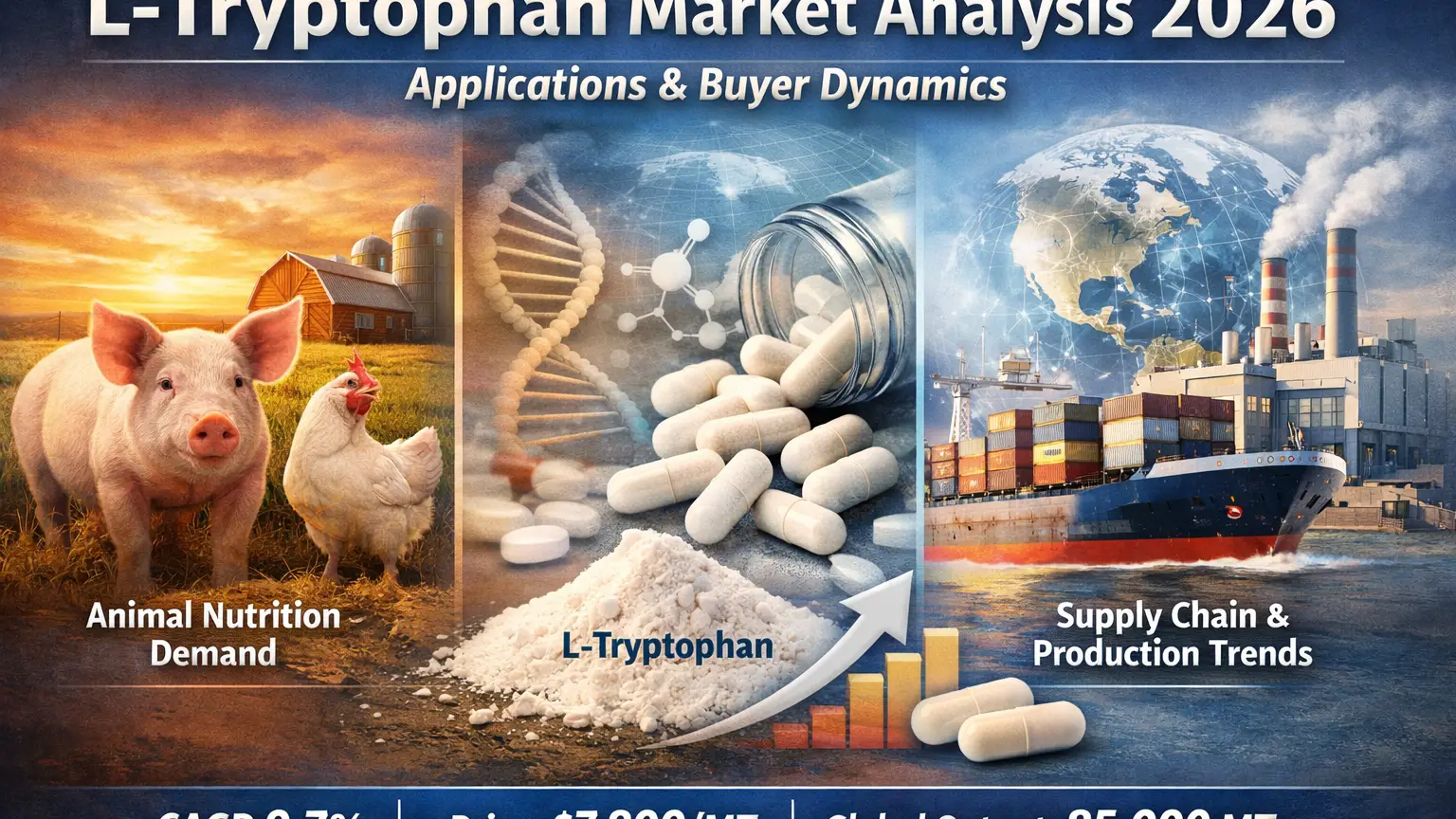
Animal feed remains the dominant application segment, accounting for the majority of global consumption. In 2024, global production reached approximately 85,000 metric tons, with nearly half concentrated in Asia-Pacific. (Market Growth Reports) The functional role of L-tryptophan in improving feed conversion ratios and animal health has made it indispensable in poultry and swine nutrition.
Buyers in this segment—primarily large-scale feed producers—prioritize consistent purity (>98%) and long-term supply contracts. Volume-driven procurement strategies are common, with price sensitivity tied closely to grain and fermentation input costs.
Pharmaceutical and Nutraceutical Applications Shaping Value Premiums
Beyond feed, L-tryptophan is gaining traction in pharmaceuticals and nutraceuticals, particularly for sleep regulation and mood enhancement products. This segment commands higher margins due to stringent quality and regulatory requirements.
Pharma-grade buyers emphasize traceability and certification, often sourcing from producers employing advanced fermentation technologies. The broader L-tryptophan market is forecast to expand at an aggressive CAGR of up to 22% in high-value segments, reflecting strong innovation pipelines. (Market Growth Reports)
Pricing Trends and Supply Chain Volatility
Market pricing remains cyclical, influenced by fermentation feedstock costs and regional supply imbalances. As of 2024–2025 benchmarks, tryptophan prices in China hovered around USD 7,800/MT, with fluctuations driven by inventory levels and export dynamics. (IMARC Group)
Bulk buyers—especially in Asia and Europe—are increasingly adopting hedging strategies and diversified sourcing to mitigate volatility. Meanwhile, contract pricing models are gaining traction to stabilize procurement costs in long-term supply agreements.
Regional Production Shifts and Buyer Consolidation
Production capacity is heavily concentrated in Asia, particularly China, which accounts for a significant share of global output. Europe and North America, producing approximately 18,000 MT and 15,000 MT respectively, remain key import-dependent regions. (Market Growth Reports)
On the buyer side, consolidation among feed manufacturers and nutraceutical brands is reshaping purchasing power, enabling larger contracts and integrated sourcing strategies. This trend favors suppliers with scalable production and global distribution capabilities.
Conclusion
As a platform chemical, L-tryptophan bridges agriculture, healthcare, and nutrition, reinforcing its role in high-growth, bio-based value chains. Its dual positioning—high-volume feed additive and high-value pharmaceutical intermediate—ensures sustained demand across economic cycles.
For buyers navigating this evolving landscape, partnering with globally integrated suppliers is increasingly critical. Companies like Tradeasia International are positioned to support procurement strategies with reliable sourcing, competitive pricing, and consistent quality across regions—offering a practical pathway to secure supply in a dynamic global market.
Sources