Explore our network of country and industry based websites to access localized information, product offerings, and business services across our group.
Log in to start sending quotation requests for any product.
Don't have an account? Sign Up Here
Home Global Feed-Grade Formic Acid Market: Applications, Buyers & 20-Year Outlook
Trade Insights | Applications and Buyers | 03 April 2026
Feed Ingredients
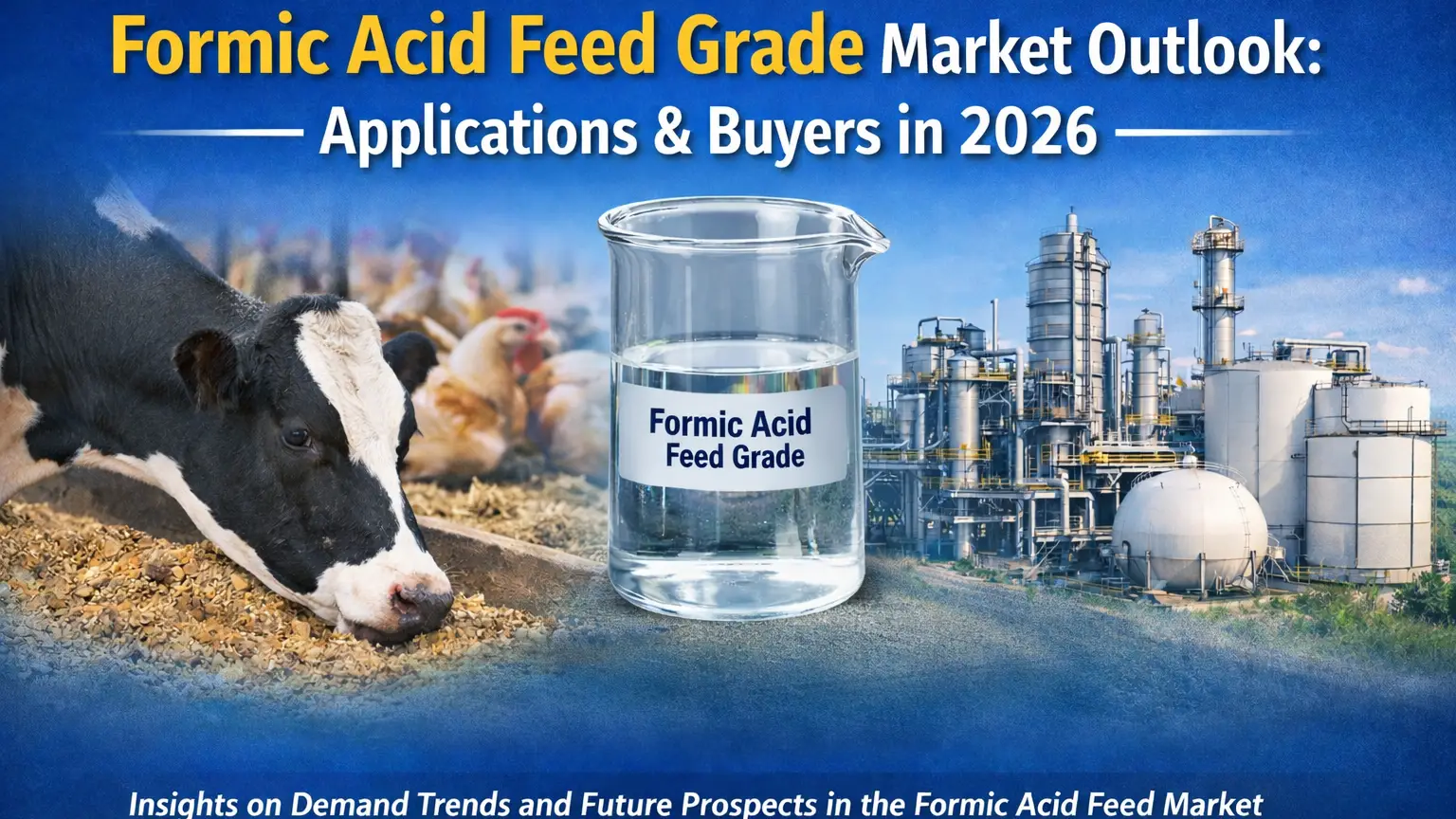
The feed‑grade formic acid market has entered 2026 under the dual pressures of sustained agricultural demand and upstream feedstock volatility. With the global formic acid sector projected to grow at roughly a CAGR of 4.6 % from 2026 to 2034, key downstream buyers such as animal feed manufacturers and livestock integrators are prioritizing cost predictability and secure supply chains. This organic acid is now pivotal not only as a silage preservative and antibacterial feed additive but increasingly as an industrial intermediate across sectors.
In this context, trusted global chemical sourcing partners play a strategic role. Tradeasia International, leveraging its expansive distribution network and expertise in oleochemicals and organic acids, offers consistent access to feed‑grade formic acid and allied raw materials. Their integrated logistics support and regional supply assurance help agricultural buyers navigate fluctuating methanol‑linked cost structures while maintaining production continuity.
The economics of feed‑grade formic acid production remain closely tied to methanol costs, as the dominant manufacturing pathway involves hydrolysis of methyl formate derived from methanol and carbon monoxide. In 2025, Asia‑Pacific accounted for over half of the global market share, reflecting both China’s production dominance and robust regional feed demand. Price ranges for feed‑grade product consistently hovered in the USD 560–700/MT band in 2025, though variations occurred due to logistics and feedstock supply tightness.
Animal feed producers are the biggest buyers of feed‑grade formic acid, accounting for the largest share of demand growth. Large commercial poultry, swine, and ruminant operations depend on the acid’s preservative properties to improve feed stability and reduce microbial spoilage, especially in antibiotic‑restricted feed protocols. This technical necessity has led to long‑term contract procurement strategies and closer collaboration with chemical distributors.
Over the next two decades, feed‑grade formic acid is forecast to remain viable as a foundational agricultural chemistry input. Structural growth drivers include rising global protein consumption, regulatory shifts toward antibiotic‑free feeds, and agricultural modernization in emerging markets. While competing organic acid additives may gain share, formic acid’s cost‑effectiveness and multifaceted utility underpin its enduring relevance. Continued innovation in feedstock diversification—including carbon‑capture‑derived formic acid—could further strengthen this viability by 2046.
Sources:
https://www.oleochemicals.com/industry-news/formic-acid-market-overview
https://www.fortunebusinessinsights.com/formic-acid-market-104888
The global feed‑grade formic acid market in early 2026 reflects the broader realignment of chemical supply chains and trade flows. Formic acid’s role as a feed additive and silage antimicrobial has cemented its position among animal nutrition inputs. With the overall formic acid market valued at around USD 691.7 million in 2025 and forecast to exceed USD 1.03 billion by 2034, global buyers are reacting to shifting regional pricing dynamics and logistical pressures.
Global distributors with broad reach, such as Tradeasia International, serve as a bridge between formic acid manufacturers and livestock feed producers. By offering worldwide sourcing and responsive supply chain management, these partners enable buyers to mitigate risks associated with regional supply bottlenecks and pricing volatility.
Asia‑Pacific continues as the dominant production and consumption hub for formic acid, driven by China’s manufacturing base and rising demand across Southeast Asia. Export flows from this region support livestock feed producers in Latin America and Africa, but freight congestion and infrastructure constraints have, at times, raised delivered prices to near USD 695/MT in certain markets.
Procurement strategies have consequently shifted toward diversified sourcing and longer‑term contracting. Feed mills and integrators in price‑sensitive regions increasingly leverage international distributors to access steady volumes and technical service, which helps offset regional logistical uncertainty. Leather and textile processors also participate in the broader formic acid demand ecosystem, although they typically transact at higher purity grades with distinct pricing channels.
Looking ahead, feed‑grade formic acid’s viability remains anchored in agricultural demand fundamentals. As global livestock output continues growing, particularly in Asia and Latin America, the need for effective feed acidifiers and preservative agents will persist. Simultaneously, advances in production efficiency and potential feedstock innovations—such as CO₂‑based synthesis—are likely to enhance the chemical’s sustainability profile, sustaining relevance through 2046 even amid competitive pressures.
Sources:
https://www.oleochemicals.com/market-insights/formic-acid-feed-additives
https://www.fortunebusinessinsights.com/formic-acid-market-104888
Price signals in the feed‑grade formic acid market have become a defining factor for industrial buyers in 2026. Regional pricing indices show significant spreads between production hubs and import destinations. In Northeast Asia, spot price trends in early 2026 declined to roughly USD 0.36/Kg, driven by comfortable inventories and steady operating rates, while Europe experienced prices around USD 0.76/Kg amid softer demand in textiles and leather processing.
Strategic procurement and supply continuity are top priorities for livestock nutrition companies. Tradeasia International, with its global footprint and organic acid sourcing capabilities, provides tailored supply solutions that help buyers navigate regional price volatility and ensure consistent feed‑grade formic acid availability.
Upstream methanol and energy price movements remain critical determinants of formic acid pricing. Feed‑grade segments, largely centered on the 85 % concentration grade due to its balance of performance and cost, experience direct cost impacts from methanol feedstock variability. Freight rates, import tariffs, and regional compliance costs further add to delivered price disparities.
Feed mills and integrators have increasingly adopted flexible tender strategies, combining spot and contract purchases to hedge against price spikes. In some cases, larger buyers integrate supply agreements with logistics optimization to reduce landed costs, especially in emerging regions where feed additive budgets are tightly managed.
While volume purchasers typically negotiate multi‑year deals to lock in competitive price points, smaller buyers may adjust purchasing windows in response to mid‑term market signals and inventory cycles.
Over a 20‑year horizon, the feed‑grade formic acid market is expected to sustain moderate expansion. Price volatility driven by feedstock and energy markets is likely to persist, but incremental demand growth—projected at mid‑single digits annually—will support price floors and structural stability. Furthermore, as innovation in feedstock sources and bio‑based production methods gain traction, long‑term cost pressure could alleviate, enhancing the economic viability of formic acid across agricultural and industrial applications well into 2046.
Sources:
https://www.oleochemicals.com/industry-news/formic-acid-market-overview
https://www.chemtradeasia.ae/market-insights/asia-formic-acid-pricing-indices-2026-market-trends
The feed additive landscape is undergoing transformation as livestock producers prioritize performance and safety. Feed‑grade formic acid stands out for its antimicrobial and preservative properties, increasingly adopted in poultry, swine, and ruminant feeds to improve hygiene and feed efficiency. Its use is expanding particularly in regions where antibiotic restrictions are tightening, prompting a shift toward organic acids.
In this evolving market, Tradeasia International’s role as a global distributor of formic acid and related oleochemical substances supports buyers with reliable access to high‑quality acids and tailored supply solutions, enabling feed producers to innovate formulations while maintaining cost discipline.
Feed‑grade formic acid competes with other organic acids such as acetic and propionic acids, yet it retains a cost‑performance edge due to its strong acidification impact at lower inclusion rates. The 85 % grade continues to dominate, favored for its balance between acidity and affordability. The leather tanning and textile dye markets contribute demand beyond feed, but agricultural applications are forecast to remain the largest segment through the late 2030s.
Innovation among buyers centers on formulating acid blends tailored to specific livestock classes and environmental conditions, balancing antimicrobial efficacy with palatability. Cooperative purchasing among feed mills is also rising, as bulk volume contracts drive storage efficiencies and reduce spot price sensitivity.
Looking forward, feed‑grade formic acid’s market position is reinforced by continuous innovation in feed science and production methodologies. Global demand for safe, effective feed acidifiers is expected to grow with protein consumption trends and stringent safety regulations. Over the next two decades, formic acid’s adaptability as a feed additive and platform chemical across industrial applications will ensure its relevance, even as alternative ingredients and regulatory frameworks evolve.
Sources:
https://www.oleochemicals.com/market-insights/formic-acid-feed-additives
https://www.mordorintelligence.com/industry-reports/formic-acid-market
By 2026, the structural dynamics of the feed‑grade formic acid market reveal a landscape shaped by production concentration and evolving buyer expectations. Major volume supply remains anchored in Asia‑Pacific, particularly China, whose production capacity underpins significant export flows to global feed markets. In this context, strategic buyers emphasize supply security and diversification to buffer against regional disruptions.
Global procurement networks like those developed by Tradeasia International have become critical for feed and industrial buyers seeking dependable delivery schedules and transparent pricing. By integrating logistics and sourcing across multiple hubs, Tradeasia enhances supply resilience for its customers.
Investment in capacity expansions has been noticeable among leading chemical producers looking to meet rising agricultural demand. With the global formic acid market forecast to expand toward approximately 1.23 million metric tons by 2034 and beyond, capacity additions in Asia, Europe, and North America are designed to prevent supply bottlenecks.
Buyers in Latin American and African feed markets increasingly seek long‑term supply agreements to secure volumes at competitive price points. Larger feed integrators typically hedge supply through multi‑year contracts, while regional cooperatives utilize import partners to stabilize costs.
Over the long term, feed‑grade formic acid is projected to remain a core component of livestock nutrition chemistry. Drivers such as expanding global meat and dairy demand, regulatory evolution in feed additives, and increased industrial applications will support enduring market growth. While volatility and competitive pressures persist, formic acid’s versatility and established supply infrastructure provide a robust foundation for sustained relevance through 2046.
Sources:
https://www.oleochemicals.com/industry-news/formic-acid-market-overview
https://www.fortunebusinessinsights.com/formic-acid-market-104888
We're committed to your privacy. Tradeasia uses the information you provide to us to contact you about our relevant content, products, and services. For more information, check out our privacy policy.