Explore our network of country and industry based websites to access localized information, product offerings, and business services across our group.
Log in to start sending quotation requests for any product.
Don't have an account? Sign Up Here
Home Broken Rice Market Trends 2026: Feed, Fuel, Food & Biochemical Demand
Trade Insights | Applications and Buyers | 25 March 2026
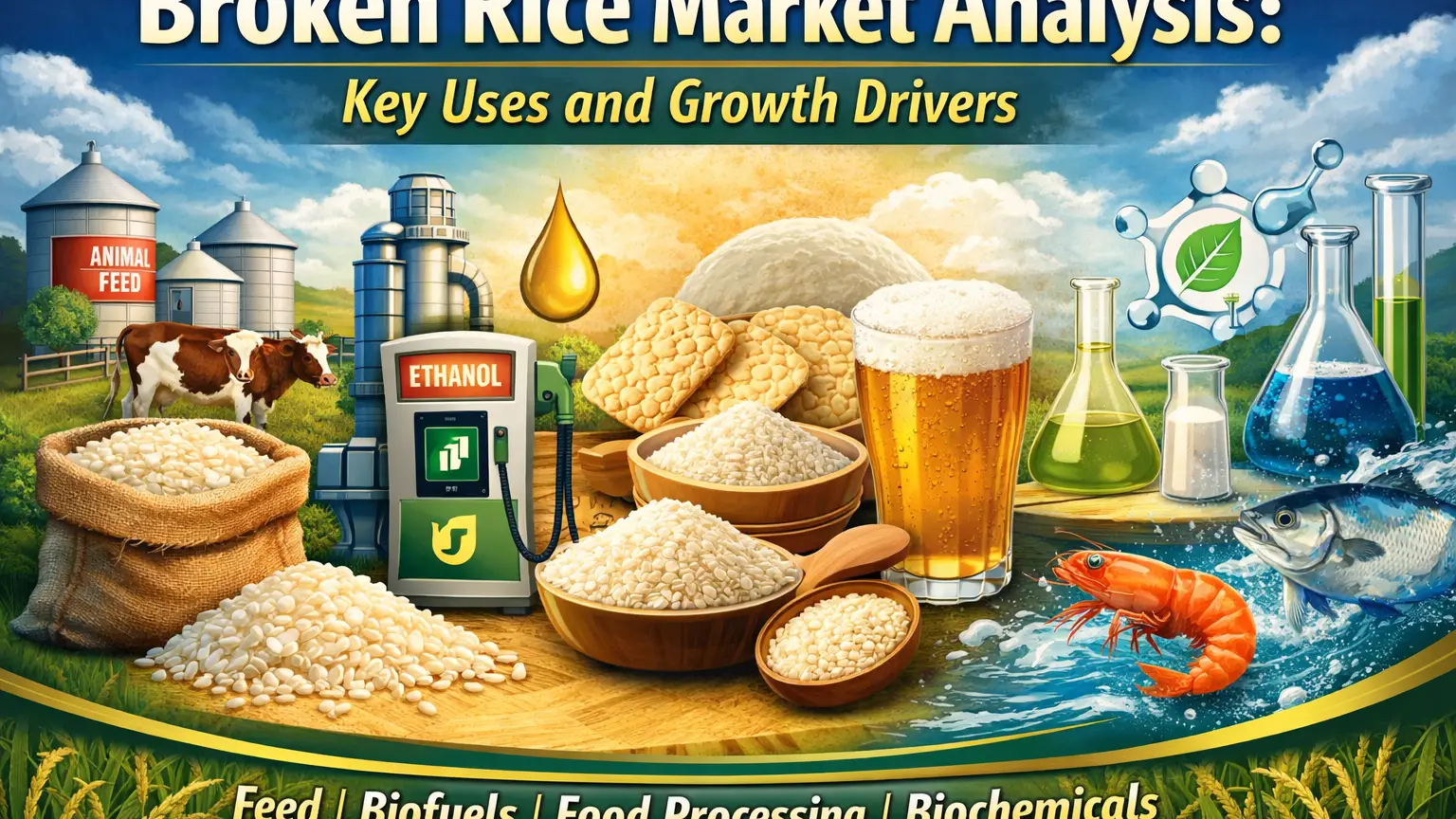
In 2026, broken rice has evolved from a low-value milling by-product into a strategically traded agro-industrial feedstock, widely integrated across food, feed, and fermentation industries. Positioned within global rice production exceeding 520 million metric tons annually, broken rice accounts for nearly 8–12% of total milled rice output, creating a significant secondary supply stream. Market valuation continues to strengthen, supported by a projected CAGR of 4.3% (2022–2026), driven by rising demand in cost-sensitive protein feed formulations and processed food manufacturing. Average global pricing fluctuates between USD 260–410/MT, depending on origin, grain quality, and end-use classification.
The most dominant application remains animal feed, particularly in poultry and aquaculture sectors where broken rice serves as a high-energy carbohydrate alternative to corn. Feed manufacturers across Asia-Pacific consume over 18 million MT annually, with Vietnam, India, and Thailand acting as primary sourcing hubs. Additionally, food processing industries utilize broken rice in noodles, rice flour, snacks, and brewing applications, especially in beer production where starch consistency is critical. Emerging fermentation industries are also incorporating it into ethanol and bio-based ingredient production, reinforcing its role as a flexible industrial input.
Global pricing structures are increasingly influenced by milling yields, export restrictions, and freight volatility. India and Thailand collectively control over 35% of global export supply, creating benchmark pricing behavior across Asia and Africa. Freight-adjusted landed costs in African markets can exceed USD 420/MT, particularly in drought-sensitive regions reliant on imports. Meanwhile, domestic oversupply cycles in Southeast Asia often push local prices down to USD 240/MT, creating arbitrage-driven trade flows. This volatility is reshaping procurement strategies among bulk commodity traders.
The buyer ecosystem is diversifying beyond traditional feed millers to include large-scale food processors, ethanol producers, and government procurement agencies managing food security programs. Integrated poultry corporations in China and Indonesia are increasingly locking in long-term contracts to stabilize feed costs, while African importers rely heavily on spot-market purchasing. Strategic procurement is now shifting toward vertically integrated supply chains, where millers directly engage with exporters to reduce intermediary margins and ensure consistent quality grading.
Sustainability considerations are reshaping broken rice utilization, as industries seek lower-carbon agricultural inputs compared to maize and wheat. With global food inflation pressures persisting, broken rice is gaining traction as a cost-efficient stabilizer in staple food production systems. Its low processing requirement and high digestibility further enhance its attractiveness in emerging economies facing feed cost volatility.
Broken rice is no longer a secondary commodity but a structurally important input across food security and industrial feed systems. As global supply chains become more efficiency-driven, its role as a flexible, low-cost agricultural input will continue expanding. In this evolving landscape, Tradeasia International provides integrated sourcing, logistics coordination, and market intelligence solutions, enabling buyers to secure consistent quality supply across volatile commodity cycles while optimizing procurement efficiency in global agro-trade networks.
Sources
We're committed to your privacy. Tradeasia uses the information you provide to us to contact you about our relevant content, products, and services. For more information, check out our privacy policy.


 English
 Indonesian
 简体字
简体字
 العربية
 Español
 Français
 Português
 日本語
日本語
 한국어
한국어
 Tiếng Việt



















