Explore our network of country and industry based websites to access localized information, product offerings, and business services across our group.
Log in to start sending quotation requests for any product.
Don't have an account? Sign Up Here
Home How Export Restrictions Are Changing Blood Meal Trade Flows
Trade Insights | Supply Chain | 19 December 2025
1. Introduction
2. Global Blood Meal Market Overview and Key Trade Routes
3. How Export Restrictions Are Reshaping Blood Meal Flows
4. Product Focus: Blood Meal Specifications, Grades, and Uses
5. Benefits of Sourcing Blood Meal via chemtradeasia.com
6. Conclusion
Blood meal is a high-protein product derived from animal blood, typically collected from bovine, porcine, or poultry slaughterhouses and then dried and processed into a stable powder or granules. For decades, it has been a critical input in the United States for animal feed formulations, aquaculture diets, and organic fertilizers due to its high crude protein content—often above 80%—and rich amino acid profile. However, the global trade flows that once ensured relatively predictable availability are undergoing rapid change.
In recent years, export restrictions, sanitary regulations, and shifting domestic priorities in key producing countries have begun to reshape how blood meal moves around the world. Policies intended to protect local industries, manage disease risks, or stabilize domestic prices are now influencing which origins are available to US buyers, what quality specifications can be reliably sourced, and at what cost. These changes are particularly important for import-dependent markets like the United States, where local rendering capacity does not always meet demand for specific grades and volumes.
Within this evolving landscape, digital trading platforms such as chemtradeasia.com are emerging as vital tools for buyers in the US and other importing countries. By aggregating suppliers across Asia, Latin America, and Europe, and by providing transparent product data and logistics support, these platforms help mitigate the volatility created by export restrictions and regulatory shifts. Understanding how these trade dynamics work—and how to leverage professional platforms and diversified supply chains—is now essential for any US company relying on blood meal as a feed or fertilizer input.
The global blood meal market is closely tied to the meat processing and rendering industries. Major producing regions include South America (notably Brazil and Argentina), Asia (China, India, and several Southeast Asian countries), and parts of Europe. According to industry analyses, global blood meal production has been growing in line with rising meat consumption and slaughter rates, with the overall animal by-product market valued in the tens of billions of dollars annually. Blood meal occupies a niche within this broader sector, but it is strategically important because of its high protein content and role in specialized feed formulations.
Historically, the main trade routes for blood meal have flowed from surplus-producing countries to protein-deficit markets. South American producers, especially Brazil, have supplied large volumes to North America, Europe, and parts of Asia. At the same time, Asian producers have exported to neighboring countries and to the Middle East. The United States, while having its own rendering industry, has often imported specific blood meal grades—such as spray-dried bovine blood meal or specialized porcine blood meal—to meet demand from aquaculture, pet food, and high-performance livestock feed producers.
These trade flows are influenced by a combination of factors: relative raw material availability, rendering technology, logistics infrastructure, and regulatory frameworks. Shipping routes from Brazil and Argentina to the US Gulf and East Coast ports, or from Southeast Asia to the US West Coast, have been particularly important. Platforms like chemtradeasia.com have capitalized on these established trade lanes by connecting US buyers with vetted suppliers in Indonesia, Vietnam, India, and other exporting countries, enabling more efficient matching of specification requirements with available production capacity.
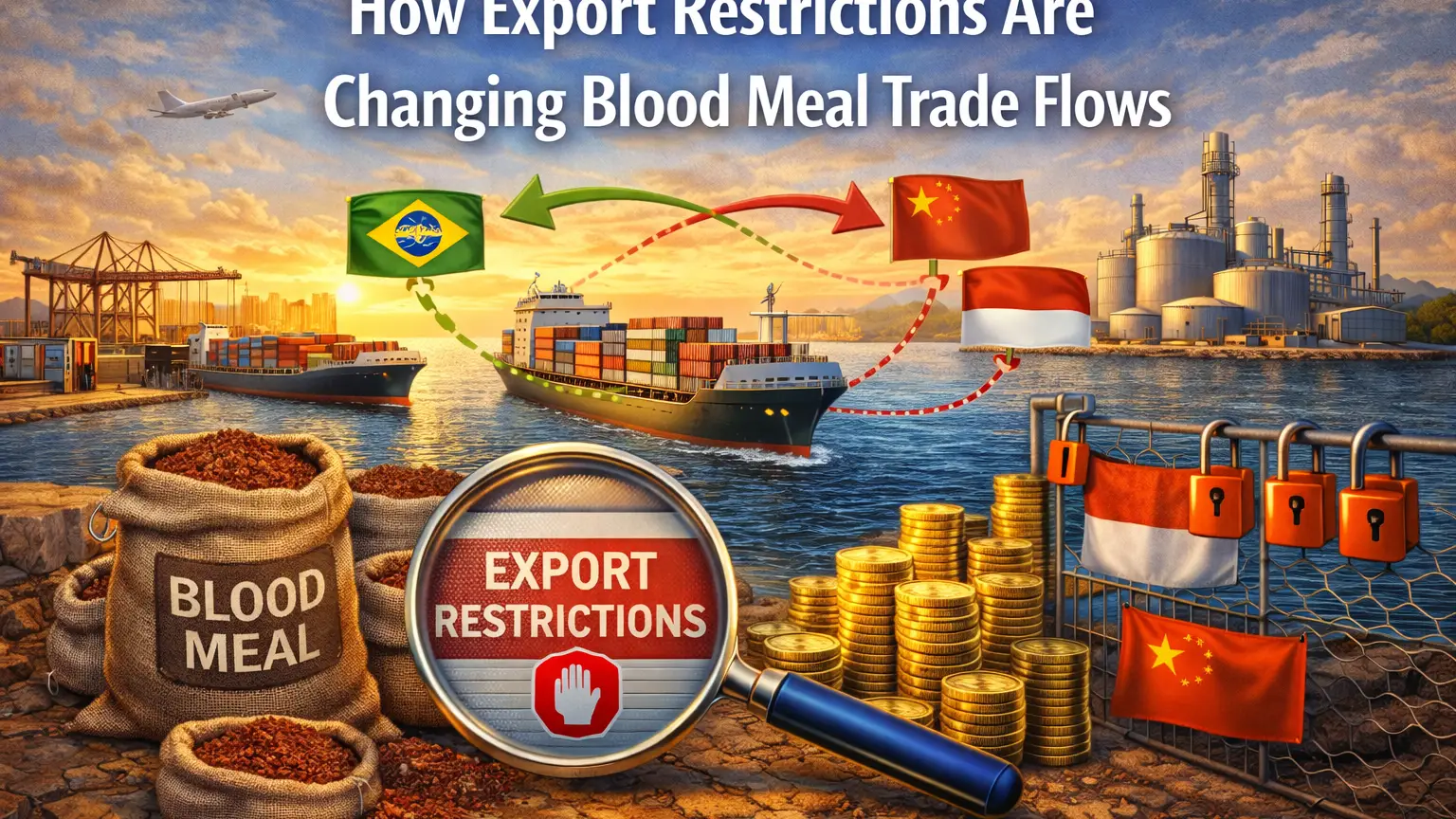
Export restrictions come in many forms: outright export bans, export licensing requirements, minimum export prices, sanitary and phytosanitary (SPS) barriers, and informal administrative measures that slow or complicate shipments. In the case of blood meal, governments may impose restrictions to protect domestic feed industries, respond to animal disease outbreaks, or comply with international health standards. For example, concerns around bovine spongiform encephalopathy (BSE) and other animal diseases have historically led to strict controls on animal by-products in several regions, affecting both intra-regional and intercontinental trade.
For US buyers, these restrictions can manifest as sudden supply disruptions, longer lead times, or shifts in available origins. When a major exporter tightens controls or prioritizes domestic feed and fertilizer needs, exporters may reduce the volume available for shipment abroad, or divert cargoes to closer regional markets. This was observed in several commodity sectors during the COVID-19 pandemic, when countries tightened export rules on agricultural and feed-related products to safeguard local supply. While blood meal may not always be in the spotlight like grains or vegetable oils, it is subject to similar policy dynamics and logistical bottlenecks.
These changes are altering trade flows in subtle but significant ways. US importers may find that traditional suppliers in one region are less consistent, pushing them to explore alternative origins such as Southeast Asia or secondary producers in Africa. Export licensing or stricter SPS documentation can also increase transaction costs and the need for compliance expertise. Platforms such as chemtradeasia.com help navigate this environment by actively monitoring regulatory developments in exporting countries, maintaining multiple supplier relationships, and providing documentation support. This diversification reduces dependency on any single origin and allows US buyers to pivot more quickly when export restrictions arise.
Blood meal is not a single uniform product; it encompasses a range of grades and specifications depending on species origin, processing method, and intended application. Typical commercial blood meal products have crude protein levels between 80% and 90%, low moisture content (often below 10%), and varying fat and ash levels. Spray-dried blood meal, for example, tends to have a more consistent amino acid profile and better digestibility, making it attractive for high-value feed applications. Ring-dried or drum-dried products may be more economical but with slightly different functional properties.
For animal feed, especially aquaculture and pet food, key specifications include digestible lysine content, microbiological safety, and absence of contaminants. Aquafeed producers in the US often demand high-quality bovine or porcine blood meal with controlled particle size and strict pathogen control to meet performance and safety standards. In poultry and swine feed, blood meal is used as a concentrated protein supplement, allowing formulators to reduce reliance on more expensive protein sources such as fishmeal. chemtradeasia.com lists detailed technical data sheets for blood meal products, including typical amino acid profiles, microbial limits, and recommended inclusion rates, enabling nutritionists and formulators to select appropriate grades.
Beyond feed, blood meal is widely used in the United States as an organic nitrogen fertilizer, particularly in horticulture, turf management, and specialty crops. With nitrogen content often around 12–13%, it provides a slow-release nutrient source compatible with organic certification standards when properly processed. Garden supply companies and organic farms value blood meal for its ability to boost vegetative growth while also acting, in some cases, as a natural animal repellent. Through chemtradeasia.com, buyers can source blood meal grades tailored for fertilizer applications—sometimes with coarser granulation or specific packaging formats—distinct from the fine, feed-grade powders demanded by feed mills and aquafeed plants.
In the context of export restrictions and shifting trade flows, the way US companies source blood meal becomes as important as the product itself. chemtradeasia.com operates as a multi-origin sourcing platform that connects buyers with a network of blood meal producers across Asia, Latin America, and other regions. By aggregating supply from multiple countries, the platform helps mitigate the risk that a single country’s export policy or logistical disruption will compromise a buyer’s entire supply chain. This is particularly valuable for US feed manufacturers and fertilizer blenders that require consistent monthly or quarterly volumes.
Another key benefit lies in transparency and product information. Each blood meal listing on chemtradeasia.com is accompanied by technical specifications, typical analysis data, and information about origin and processing method. Buyers can compare spray-dried versus ring-dried products, bovine versus porcine origin, and feed-grade versus fertilizer-grade options. This level of detail supports quality assurance and regulatory compliance, especially when importing into the United States, where the Food and Drug Administration (FDA), the Association of American Feed Control Officials (AAFCO), and organic certification bodies impose clear standards on ingredient quality and labeling.
Logistics and documentation support further enhance the value proposition. Export restrictions often involve complex documentation requirements, such as veterinary health certificates, origin declarations, and specific SPS attestations. chemtradeasia.com works with its supplier base and logistics partners to ensure that shipments are accompanied by the necessary documents and that they comply with both the exporting country’s rules and US import regulations. This reduces the administrative burden on US buyers and lowers the risk of cargo delays or rejections at port. Combined with competitive pricing and the ability to lock in contracts from multiple origins, these features make chemtradeasia.com a practical tool for navigating the evolving blood meal trade environment.
Export restrictions and regulatory shifts are steadily reshaping the global trade flows of blood meal. For the United States, a market that relies on both domestic rendering and strategic imports, these changes translate into new risks around supply continuity, pricing, and quality assurance. Traditional sourcing patterns—from a few dominant exporting countries—are giving way to more diversified, multi-origin strategies as buyers seek to protect themselves from policy-driven disruptions and logistical uncertainties.
In this environment, understanding product specifics—such as protein levels, processing methods, and end-use suitability—is essential, but so is the choice of sourcing channel. Platforms like chemtradeasia.com provide US buyers with access to a broad portfolio of blood meal products, transparent technical data, and structured logistics and documentation support. By leveraging these capabilities, feed manufacturers, aquaculture producers, pet food companies, and organic fertilizer blenders in the United States can better manage the impact of export restrictions and maintain reliable supply.
Looking ahead, continued vigilance regarding international regulatory developments, combined with strategic partnerships and digital sourcing tools, will be key to securing high-quality blood meal at competitive terms. Companies that proactively diversify origins, verify product specifications, and work with professional intermediaries will be best positioned to thrive as global blood meal trade flows continue to evolve.
We're committed to your privacy. Tradeasia uses the information you provide to us to contact you about our relevant content, products, and services. For more information, check out our privacy policy.


 English
 Indonesian
 简体字
简体字
 العربية
 Español
 Français
 Português
 日本語
日本語
 한국어
한국어
 Tiếng Việt




















