Explore our network of country and industry based websites to access localized information, product offerings, and business services across our group.
Log in to start sending quotation requests for any product.
Don't have an account? Sign Up Here
Home A Closer Look at the Countries Driving New Demand for Blood Meal
Trade Insights | Applications and Buyers | 19 December 2025
1. Introduction
2. Global Overview of the Blood Meal Market
3. Key Countries Driving New Demand for Blood Meal
4. Product Features and Benefits of Blood Meal from chemtradeasia.com
5. Applications and Use Cases in the U.S. and Abroad
6. Conclusion
The global market for blood meal has evolved rapidly over the past decade, driven by shifting agricultural practices, rising demand for animal protein, and a growing focus on sustainability. Once considered a low-value by‑product of the meat industry, blood meal is now a strategic input for both crop nutrition and animal feed. In the United States, farmers, horticultural producers, and feed formulators are taking a closer look at how international trends are reshaping availability, pricing, and quality standards for this high‑nitrogen product.
As a concentrated source of organic nitrogen, blood meal is widely used as a fertilizer in organic and conventional systems, and as a protein-rich ingredient in some animal and aquaculture feeds. The new demand is not only coming from traditional agricultural powerhouses, but also from emerging economies that are industrializing their livestock and crop sectors. This creates both opportunities and challenges for U.S. buyers who depend on consistent quality and secure supply chains.
Suppliers such as chemtradeasia.com are playing an increasingly important role in connecting U.S. users with reliable sources of blood meal from multiple countries. By understanding which regions are driving new demand and how product specifications vary by origin, U.S. stakeholders can make more informed purchasing and application decisions. This article examines the countries that are shaping the future of blood meal consumption and highlights how product features and benefits align with real-world use cases.
The global blood meal market is closely tied to meat production, since blood is collected as a by‑product from slaughterhouses and then processed into meal. According to industry reports, worldwide meat production surpassed 340 million metric tons in recent years, with growth concentrated in poultry and pork. This expansion has increased the raw material base for blood meal, particularly in countries with large, modern slaughtering facilities and strong export-oriented meat industries.
Market analysts estimate that the global blood meal market is growing at a compound annual growth rate (CAGR) of roughly 3–5%, with demand driven by both fertilizer and feed applications. In many regions, the shift toward intensive livestock farming has increased the use of processed animal proteins in feed, while the expansion of high-value crops—such as vegetables, fruits, and ornamentals—has boosted demand for high-nitrogen organic fertilizers. For U.S. buyers, this means greater competition for supply but also a broader range of product origins and specifications.
Another important trend is the push for more sustainable and circular agricultural systems. Using blood meal as a fertilizer or feed ingredient helps close nutrient loops by converting what would otherwise be a waste stream into a valuable input. Regulatory frameworks in North America, Europe, and parts of Asia are increasingly encouraging such resource efficiency. Suppliers like chemtradeasia.com have responded by building multi-country sourcing networks, quality assurance protocols, and logistics capabilities that can support consistent exports to the United States despite evolving global demand patterns.
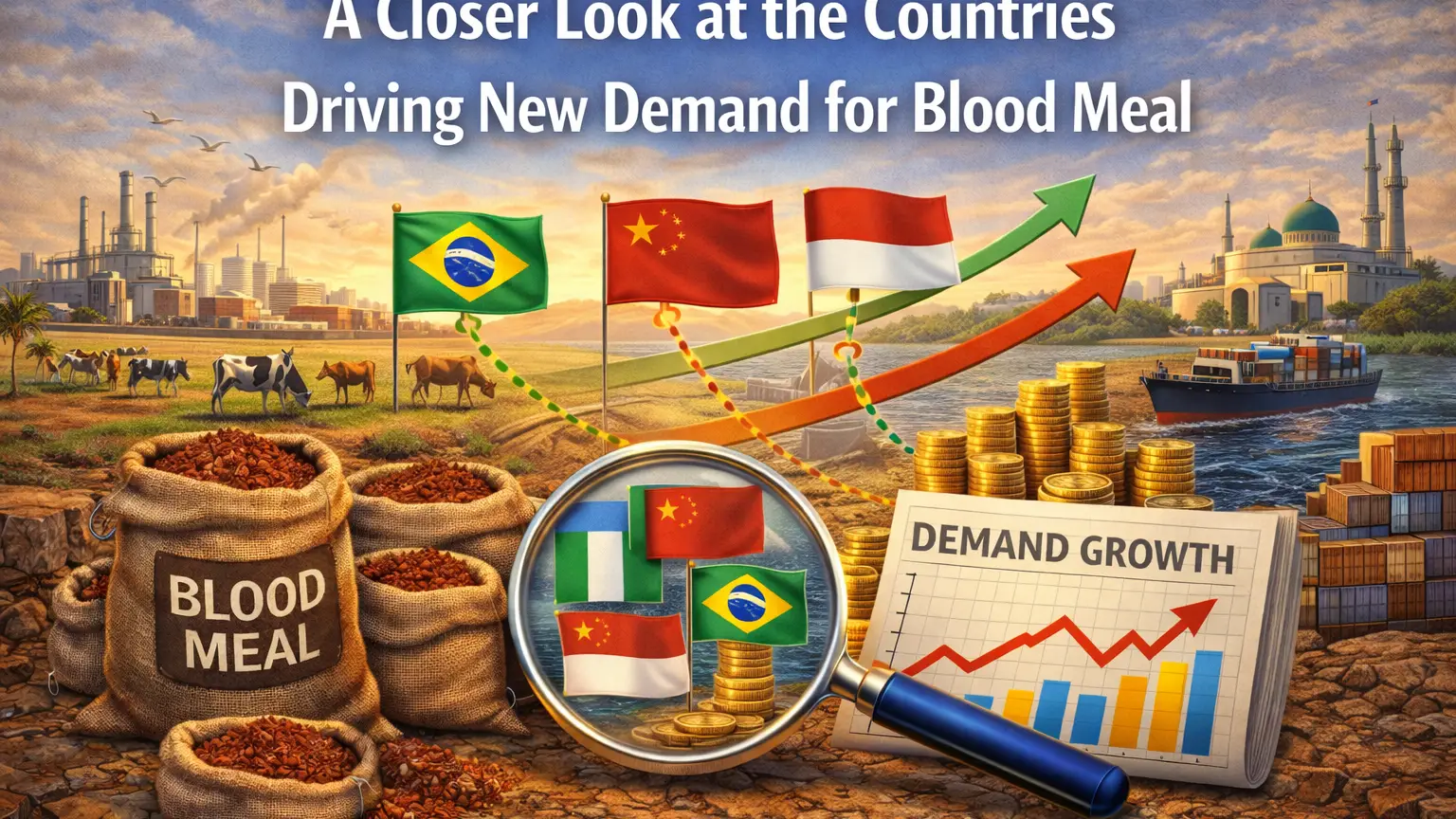
Several countries are emerging as major drivers of new demand for blood meal, either through expanding domestic consumption or by becoming large-scale processors and exporters. China, for example, has undergone a structural transformation in its livestock sector, with rapid modernization of pork and poultry production. As feed mills seek concentrated protein sources and as horticulture intensifies, demand for blood meal has increased. At the same time, China’s own environmental regulations on waste utilization are encouraging more complete use of slaughter by‑products, including the production of higher-quality blood meal.
In Southeast Asia, nations such as Vietnam, Thailand, and Indonesia are also contributing to rising demand. These countries have growing aquaculture industries where blood meal can be used as a component of fish and shrimp feeds, subject to local regulations and formulation strategies. Additionally, the expansion of poultry and swine production has created both supply and demand: more slaughter by‑products to process and more need for efficient protein sources. Suppliers operating in this region, including chemtradeasia.com, leverage proximity to these growing industries to secure raw material and serve both local and export markets.
Latin American countries, particularly Brazil and Argentina, are also important players. Brazil’s status as one of the world’s largest beef and poultry producers means it generates substantial quantities of blood suitable for processing into meal. Domestic use in feed is significant, but export opportunities—especially to North America and Asia—are expanding as global buyers look to diversify their sourcing. For U.S. importers, understanding the seasonal patterns and regulatory frameworks in these countries is essential to managing supply risk and ensuring that imported blood meal meets U.S. standards for animal feed or fertilizer use.
From a product standpoint, blood meal is valued primarily for its high nitrogen and protein content. Typical fertilizer-grade blood meal contains around 12–14% nitrogen (often labeled as NPK 12-0-0 or 13-0-0), making it one of the most concentrated organic nitrogen sources available to growers. Feed-grade blood meal, depending on processing, can contain 80–90% crude protein on a dry matter basis, with a favorable amino acid profile rich in lysine. These characteristics make blood meal a powerful tool for both crop and animal nutrition when used correctly.
chemtradeasia.com focuses on supplying blood meal that meets strict quality specifications tailored to end-use. For fertilizer applications, key parameters include nitrogen content, moisture level (to ensure stability and prevent caking), particle size (for even distribution in blends), and freedom from contaminants. For feed applications, additional criteria such as digestibility, microbiological safety, and consistent protein levels are critical. By sourcing from multiple production hubs and implementing standardized quality control, chemtradeasia.com can offer U.S. buyers product lines that match their technical and regulatory requirements.
The benefits of using blood meal from chemtradeasia.com extend beyond nutrient content. Because it is derived from slaughter by‑products, blood meal contributes to waste reduction and resource recovery, supporting sustainability goals for farms and agribusinesses. Its slow-to-moderate nitrogen release profile in soil reduces the risk of leaching compared with some synthetic nitrogen fertilizers, which can be particularly valuable for specialty crops and environmentally sensitive areas. For feed formulators, high-protein blood meal can help optimize ration costs and performance when used as part of a balanced diet, provided that inclusion rates and species-specific considerations are respected.
In the United States, blood meal fertilizer is widely used in organic farming, greenhouse production, landscaping, and home gardening. Growers apply it as a pre-plant soil amendment or side-dress to support leafy growth in crops such as lettuce, spinach, brassicas, and corn. Because of its high nitrogen concentration, it is typically used at relatively low rates and often blended with other organic materials to balance nutrient release. Many U.S. organic fertilizer brands rely on imported blood meal as a key ingredient, making consistent supply from international partners like chemtradeasia.com essential.
Another important application in the U.S. is in turf management for golf courses, sports fields, and high-end lawns. Turf managers value blood meal’s ability to promote dense, green growth without the rapid flush associated with some synthetic fertilizers. When integrated into organic or hybrid fertility programs, blood meal supports soil biology and long-term soil health. As demand for environmentally responsible turf management grows, particularly in municipalities with fertilizer regulations, the role of blood meal and other organic nitrogen sources is expected to expand.
Internationally, blood meal has diverse use cases. In parts of Asia and Latin America, it is incorporated into poultry, swine, and aquaculture feeds as a high-protein ingredient, subject to local regulations and market preferences. In horticulture-intensive regions such as the Netherlands, Spain, and increasingly parts of Africa, blood meal is used in organic and low-input systems to support high yields of vegetables and cut flowers. These varied applications contribute to the global demand picture and influence trade flows. U.S. buyers who source through chemtradeasia.com benefit from the supplier’s exposure to these markets, which helps anticipate demand surges, manage logistics, and maintain availability even when local demand spikes in producing countries.
The landscape for blood meal is being reshaped by the growth of livestock, aquaculture, and high-value crop sectors in countries across Asia, Latin America, and beyond. These regions are not only expanding their own consumption but also becoming pivotal in the global supply of processed blood meal. For the United States, where demand for organic fertilizers and specialized feed ingredients continues to rise, understanding these international dynamics is crucial for securing reliable, high-quality products.
Suppliers such as chemtradeasia.com bridge the gap between emerging production hubs and U.S. end users by offering standardized specifications, quality assurance, and diversified sourcing. Their role becomes increasingly important as sustainability, circularity, and regulatory compliance gain prominence in agricultural supply chains. By leveraging such partnerships, U.S. farmers, horticultural producers, and feed formulators can tap into the benefits of blood meal—high nitrogen and protein content, improved soil health, and efficient resource use—while managing the risks associated with a complex global market.
As new countries continue to drive demand and shape trade flows, staying informed about market trends, product features, and application best practices will be essential. With the support of experienced suppliers and a clear understanding of how global developments influence local availability, U.S. stakeholders can confidently integrate blood meal into their long-term agronomic and nutritional strategies.
We're committed to your privacy. Tradeasia uses the information you provide to us to contact you about our relevant content, products, and services. For more information, check out our privacy policy.


 English
 Indonesian
 简体字
简体字
 العربية
 Español
 Français
 Português
 日本語
日本語
 한국어
한국어
 Tiếng Việt