
Applications and Buyers|20 May 2026
Zinc Sulfate Monohydrate Market 2026: Expanding Applications and Buyer Demand

Global Applications and Buyer Landscape of Zinc Sulfate Monohydrate Market 2026
Introduction: The Expanding Commercial Role of Zinc Sulfate Monohydrate in Global Industries
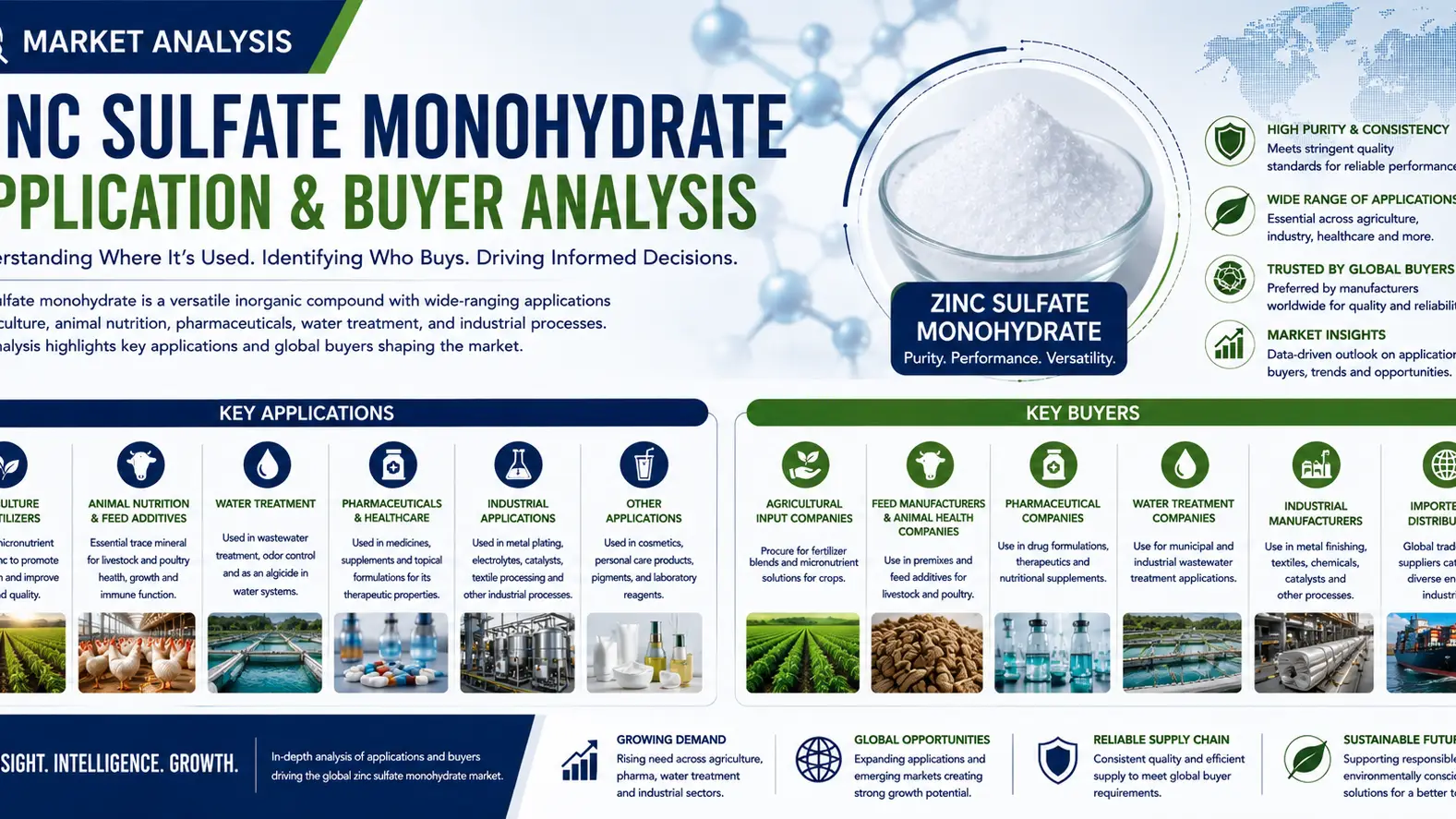
Zinc sulfate monohydrate has evolved into one of the most commercially significant zinc compounds in the global specialty chemicals industry. Widely recognized for its high solubility, stable zinc concentration, and cost-efficient formulation properties, the product serves as a platform chemical across agriculture, animal nutrition, industrial processing, pharmaceuticals, and emerging battery technologies. In 2026, the global zinc sulfate monohydrate market is estimated to exceed 2.4 million metric tons in annual consumption, supported by expanding micronutrient demand and tightening agricultural productivity targets worldwide. Average international prices have stabilized between USD 780–1,050/MT , depending on purity grade and regional zinc metal costs, while the market is projected to register a 5.8% CAGR through 2030. Agriculture Remains the Largest Consumption Sector Agriculture continues to dominate zinc sulfate monohydrate demand, accounting for nearly 58% of total global consumption in 2026. Large-scale fertilizer blenders and agrochemical distributors across India, China, Brazil, and Southeast Asia are increasing procurement volumes as zinc-deficient soils impact crop yields. The compound is extensively applied in cereals, rice, corn, and horticultural farming due to its ability to improve chlorophyll production and root development. Bulk buyers are prioritizing water-soluble grades with zinc content above 33% , particularly for fertigation and foliar spray applications. India alone is expected to consume more than 620,000 metric tons of zinc sulfate fertilizers in 2026, while agricultural-grade prices in Asia fluctuate between USD 790–920/MT amid raw zinc volatility and freight adjustments. Animal Nutrition Buyers Strengthen Long-Term Procurement Feed manufacturers represent another major buyer category, especially in poultry, swine, and cattle nutrition sectors. Zinc sulfate monohydrate functions as a critical trace mineral additive that supports immunity, enzyme activity, and growth performance in livestock production systems. Global feed-grade demand is forecast to surpass 410,000 metric tons in 2026, with multinational premix producers securing longer-term supply agreements to stabilize procurement costs. Europe and North America continue shifting toward highly standardized low-heavy-metal grades to comply with stricter feed safety regulations. Premium feed-grade material is currently traded between USD 980–1,150/MT , supported by strong demand from integrated animal protein producers. Industrial and Water Treatment Applications Gain Momentum Industrial applications are becoming increasingly diversified as manufacturers seek zinc-based compounds for rayon production, electroplating, flotation chemicals, and municipal water treatment systems. Water utilities in particular are expanding zinc sulfate usage in algae control and micronutrient balancing operations. The industrial segment is expected to grow at a 6.1% CAGR through 2030, driven by infrastructure development and rising industrial water recycling initiatives. China remains the leading production hub, contributing over 45% of global zinc sulfate monohydrate output, with several producers increasing refining capacity to meet specialty industrial demand. Battery and Advanced Materials Segment Creates New Demand A newer growth channel is emerging from battery precursor manufacturing and advanced material formulations. Zinc-based energy storage technologies, particularly aqueous zinc-ion batteries, are attracting research investments due to safety advantages and lower production costs compared to lithium systems. Although still representing less than 5% of overall market volume, battery-related demand is projected to expand rapidly after 2026. High-purity zinc sulfate monohydrate used in energy storage applications commands prices exceeding USD 1,300/MT , significantly above conventional agricultural grades. This premium segment is encouraging chemical suppliers to invest in purification technologies and specialized production lines. Conclusion As a versatile platform chemical, zinc sulfate monohydrate continues to secure its strategic role across agriculture, feed nutrition, industrial processing, and next-generation energy applications. The market’s resilience in 2026 reflects not only stable global zinc demand but also the growing importance of micronutrient efficiency and sustainable industrial chemistry. Buyers are increasingly seeking suppliers capable of delivering consistent quality, global logistics support, and customized sourcing solutions across multiple industries. In this evolving environment, Tradeasia International continues to strengthen its position as a trusted global chemical solution provider, supporting international buyers with integrated sourcing networks, competitive pricing structures, and reliable supply chain partnerships for zinc sulfate monohydrate and other industrial chemicals. Sources International Zinc Association US Geological Survey – Zinc Statistics and Information Food and Agriculture Organization
Most Popular Insights
Don't miss out on our updates! Subscribe to our newsletter now
We're committed to your privacy. Tradeasia uses the information you provide to us to contact you about our relevant content, products, and services. For more information, check out our privacy policy.