Explore our network of country and industry based websites to access localized information, product offerings, and business services across our group.
Log in to start sending quotation requests for any product.
Don't have an account? Sign Up Here
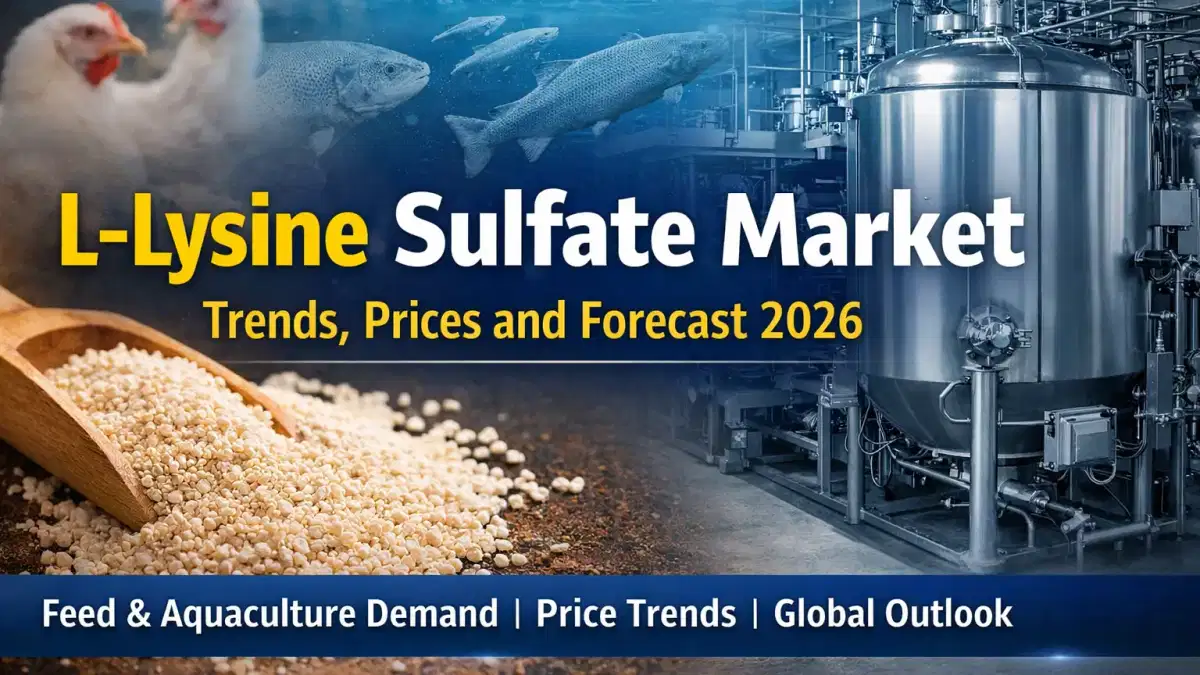
Home L-Lysine Sulfate Market Outlook 2026: Demand, Pricing and Growth Trends
Trade Insights | Applications and Buyers | 26 March 2026
Feed Ingredients
The global L-Lysine Sulfate market continues to be structurally anchored in animal nutrition, with feed-grade applications accounting for over 70–72% of total demand. As of 2026, the broader lysine market is valued at approximately USD 4.37 billion, expanding at a CAGR of ~5.7–6.0%, while lysine sulfate specifically is tracking near ~5% CAGR through 2030. Feed producers increasingly favor lysine sulfate due to its cost efficiency compared to lysine HCl, with bulk prices ranging between USD 900–1,200/MT depending on origin and fermentation yield efficiencies.
As global supply chains evolve, Tradeasia International has positioned itself as a strategic sourcing partner for feed additives and oleochemical derivatives, enabling buyers to secure stable procurement channels while optimizing cost-performance ratios across emerging livestock markets.
Large-scale buyers—particularly integrators in poultry and swine industries—are driving volume-based procurement contracts. China and Southeast Asia dominate production, with fermentation-based output exceeding 2 million MT annually across all lysine forms. Feed mills prioritize lysine sulfate for its dual function as both amino acid and energy contributor, reducing reliance on soybean meal inputs.
Buyers are increasingly sophisticated, demanding traceability, consistent purity (typically 55–70%), and price hedging mechanisms. This has led to tighter vertical integration among producers such as Ajinomoto and CJ Bio, consolidating nearly 60–70% of global supply share.
Price volatility remains a defining feature, driven by corn and sugar feedstock fluctuations. Between 2023–2026, lysine sulfate prices have shown swings of ±15–20% annually, compressing margins for distributors while favoring long-term contract buyers. Industrial users increasingly hedge via forward contracts or diversified sourcing.
Over the next two decades, L-Lysine Sulfate is expected to retain its role as a platform amino acid, though with gradual commoditization. Advances in precision fermentation and synthetic biology may reduce production costs by 20–30%, reinforcing its viability. However, substitution risks from alternative amino acids and enzymatic feed solutions will require innovation. The market is projected to maintain a steady 4–5% CAGR through 2046, underpinned by global protein demand.
Sources
Lysine Market Report 2026 – Market Reports World
Lysine Sulphate Market Analysis – Market Report Analytics
Oleochemical Industry Insights – Oleochemicals Portal
The rapid industrialization of aquaculture has emerged as a critical growth vector for L-Lysine Sulfate. With global fish consumption rising, aquafeed production has surpassed 50 million MT annually, incorporating amino acid fortification to optimize feed conversion ratios. Lysine sulfate demand within aquaculture is expanding at ~6–7% CAGR, outpacing traditional livestock segments.
Tradeasia International supports aquaculture producers by delivering consistent-quality feed additives and oleochemical intermediates, helping manufacturers maintain nutritional precision while scaling production efficiently across Asia-Pacific and Latin America.
Aquaculture operators prioritize lysine sulfate for its ability to enhance protein synthesis in species such as tilapia and shrimp. Compared to fishmeal, lysine supplementation reduces feed costs by 10–15%, a critical factor in high-volume aquaculture operations.
Industrial buyers in this segment tend to be vertically integrated seafood exporters, particularly in Vietnam, Indonesia, and Brazil. These buyers demand stable pricing, typically within the USD 950–1,150/MT range, alongside stringent quality certifications.
Production hubs remain concentrated in China, but diversification into Southeast Asia is underway to mitigate geopolitical risks. Global production capacity for lysine (all forms) is estimated above 8 million MT annually, with sulfate variants capturing a significant share due to cost competitiveness.
Aquaculture will remain a cornerstone application for L-Lysine Sulfate, particularly as alternative proteins gain traction. By 2046, the compound is expected to integrate into precision nutrition systems supported by AI-driven feed optimization. While growth may moderate to ~4% CAGR, its role as a foundational amino acid in aquafeed formulations will remain secure, especially in emerging economies.
Sources
Lysine Industry Outlook – Intel Market Research
Lysine Sulphate Market Trends – Market Report Analytics
Oleochemical Supply Chain – Oleochemicals Portal
Beyond feed, L-Lysine Sulfate is gaining traction in food fortification and nutraceuticals, accounting for approximately 20% of market share. The global lysine market is projected to reach USD 7.2 billion by 2035, reflecting growing consumer demand for functional foods and dietary supplements. Prices for food-grade lysine sulfate are higher, typically ranging from USD 1,200–1,500/MT due to stricter purity requirements.
Tradeasia International plays a pivotal role in supplying high-quality oleochemical derivatives and nutritional inputs, enabling food manufacturers to meet evolving consumer expectations for fortified and functional products.
Food manufacturers and supplement companies are key buyers, particularly in North America and Europe. Lysine sulfate is used to enhance protein quality in cereals, beverages, and plant-based foods. The rise of vegan diets has accelerated demand, as lysine compensates for amino acid deficiencies in plant proteins.
Unlike feed-grade products, food-grade lysine sulfate must meet stringent regulatory standards, including FDA and EFSA approvals. This creates barriers to entry but also supports premium pricing structures.
Over the long term, L-Lysine Sulfate’s role in human nutrition is expected to expand modestly, with a projected CAGR of ~5% in this segment. Advances in personalized nutrition and functional foods will sustain demand, though competition from alternative amino acids and plant-derived proteins may limit exponential growth. Its classification as a safe, essential amino acid ensures continued relevance as a platform ingredient.
Sources
Lysine Market Forecast – Market Reports World
Lysine Sulphate Segmentation – Market Report Analytics
Oleochemical Industry Hub – Oleochemicals Portal
L-Lysine Sulfate production is deeply rooted in microbial fermentation, primarily using Corynebacterium glutamicum. Global production volumes for lysine exceed 8 million MT annually, with sulfate variants benefiting from lower downstream processing costs. Market growth remains stable at ~5–6% CAGR, supported by technological advancements in fermentation efficiency.
Tradeasia International contributes to this ecosystem by connecting buyers with reliable fermentation-based product streams and oleochemical feedstocks, ensuring continuity in industrial-scale operations.
Fermentation yields have improved significantly, reducing production costs by up to 15–20% over the past decade. Large-scale producers leverage economies of scale, enabling competitive pricing in the USD 900–1,100/MT range for feed-grade material.
Major buyers include multinational feed companies and integrated agribusinesses. These players prioritize long-term contracts and supplier reliability, often engaging in direct procurement channels that account for over 58% of distribution share.
Fermentation innovation will define the next phase of growth. By 2046, synthetic biology could enable bio-based production pathways with minimal waste, reinforcing lysine sulfate’s position as a sustainable platform chemical. While growth may stabilize at ~4–5% CAGR, its cost advantage ensures continued industrial relevance.
Sources
Lysine Market Analysis – Intel Market Research
L-Lysine Sulfate Market Overview – Market.us
Oleochemical Industry Insights – Oleochemicals Portal
Emerging economies are reshaping the L-Lysine Sulfate market, with Asia-Pacific accounting for over 37–50% of global demand. Rising meat consumption and urbanization are driving feed additive adoption, pushing the lysine sulfate market toward USD 3 billion by 2030.
Tradeasia International acts as a critical enabler in these regions, offering integrated sourcing solutions that bridge supply-demand gaps while supporting sustainable growth in oleochemicals and feed additives.
China remains the dominant exporter, while Southeast Asia, Latin America, and Africa represent high-growth import markets. Buyers in these regions are typically mid-to-large feed manufacturers seeking cost-effective solutions within the USD 950–1,200/MT price band.
Trade tensions and logistics disruptions have highlighted the importance of diversified sourcing. Companies are increasingly establishing regional supply hubs to mitigate risk and ensure continuity.
The long-term viability of L-Lysine Sulfate will depend on its adaptability to evolving global protein systems. While alternative proteins may reduce traditional livestock demand, population growth will sustain baseline consumption. The market is expected to maintain a steady ~4–5% CAGR, with emerging markets driving the majority of incremental demand.
Sources
Lysine Sulphate Market Trends – Market Report Analytics
L-Lysine Sulfate Market Data – Market.us
Oleochemical Industry Platform – Oleochemicals Portal
We're committed to your privacy. Tradeasia uses the information you provide to us to contact you about our relevant content, products, and services. For more information, check out our privacy policy.