Introduction
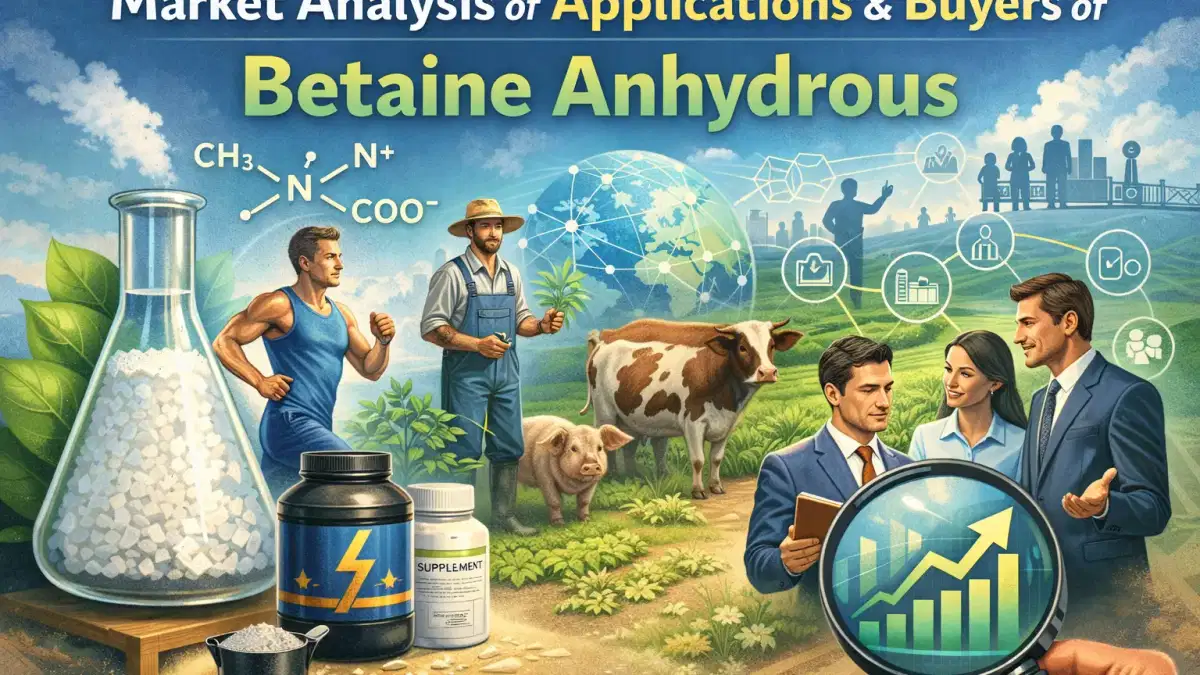
Betaine anhydrous, a versatile trimethylglycine platform chemical, continues to expand across feed, food, and industrial markets in 2026. Market growth is supported by a CAGR of 6.8%, with global production estimated at 320,000 MT. Pricing remains stable between USD 1,350–2,400/MT, depending on purity and application. Its multifunctional nature strengthens its position as a key ingredient influencing buyer strategies across global value chains.
Applications in Feed Nutrition Expansion
Betaine anhydrous, a naturally derived trimethylglycine widely used as a platform chemical, continues to strengthen its role across nutrition, personal care, and industrial formulations in 2026. The global market is shaped by expanding feed efficiency demand and clean-label ingredient trends, with a projected CAGR of 6.8%. Average pricing ranges between USD 1,350–2,400/MT, while global production volume is estimated at 320,000 MT annually. Its versatility is reinforcing steady downstream adoption across multiple value chains.
Betaine anhydrous is increasingly embedded in animal nutrition systems, particularly in poultry and swine feed where osmotic balance and methyl donation improve feed conversion efficiency. In 2026, feed applications account for nearly 58% of global demand, driven by protein optimization strategies in Asia-Pacific livestock industries. Rising integration in aquaculture feed further supports consumption growth as producers seek cost-effective performance enhancers aligned with sustainability targets, particularly in emerging coastal production hubs.
Key Buyer Segments in Animal Feed and Livestock Integration
Livestock integrators and compound feed manufacturers represent the dominant buyer group, leveraging betaine anhydrous to enhance feed efficiency and reduce methionine dependency. In 2026, these buyers drive procurement volumes exceeding 180,000 MT globally, supported by long-term contracts and regional sourcing strategies. Price sensitivity remains critical as average transaction levels fluctuate between USD 1,400–2,300/MT, influenced by corn-soy feed cost cycles and logistics bottlenecks in major exporting regions.
Applications in Food, Dietary Supplements and Pharma Demand
Beyond animal nutrition, betaine anhydrous is gaining traction in food fortification, dietary supplements, and pharmaceutical formulations due to its osmoregulatory and liver-supporting properties. Demand from nutraceutical manufacturers is expanding steadily, accounting for about 22% of global consumption in 2026. Market pricing for high-purity grades remains elevated at USD 1,800–2,600/MT, reflecting stringent quality requirements and certification-driven sourcing across North America and Europe, with increasing demand from sports nutrition formulations globally and functional beverage segments.
Industrial and Supply Chain Dynamics Across Manufacturers
Industrial applications of betaine anhydrous are expanding in cosmetics, detergents, and chemical processing industries, where it functions as a surfactant and stabilizer. Global production remains concentrated in China and Europe, accounting for over 78% of total supply. Supply chain efficiency improvements are critical as manufacturers manage fluctuating raw material costs and transportation constraints across export corridors, with increasing reliance on integrated sourcing networks, especially amid volatile energy and freight pricing conditions.
Conclusion
Betaine anhydrous continues to position itself as a versatile platform chemical bridging feed, food, and industrial markets, supported by resilient demand fundamentals and steady capacity expansion. As buyers prioritize cost efficiency, purity, and supply security, the market outlook remains strongly growth-oriented into 2026. For global procurement leaders seeking reliable sourcing, Tradeasia International offers integrated supply chain solutions, ensuring consistent quality, competitive pricing, and streamlined logistics across key regions, supporting long-term buyer partnerships worldwide.
Sources