1. Introduction: Calcium Sources—More Than Just a Mineral
Calcium is an essential mineral for all farm animals, critical for eggshell quality, bone strength, muscle function, and productivity. While both limestone and feed grade calcium carbonate are widely used calcium sources in animal diets, their performance isn’t identical. In 2025, nutritionists, producers, and feed manufacturers must select the best option for health, results, and cost-effectiveness as market standards and science evolve.
2. Feed Grade Calcium Carbonate—Purity, Consistency, and Results
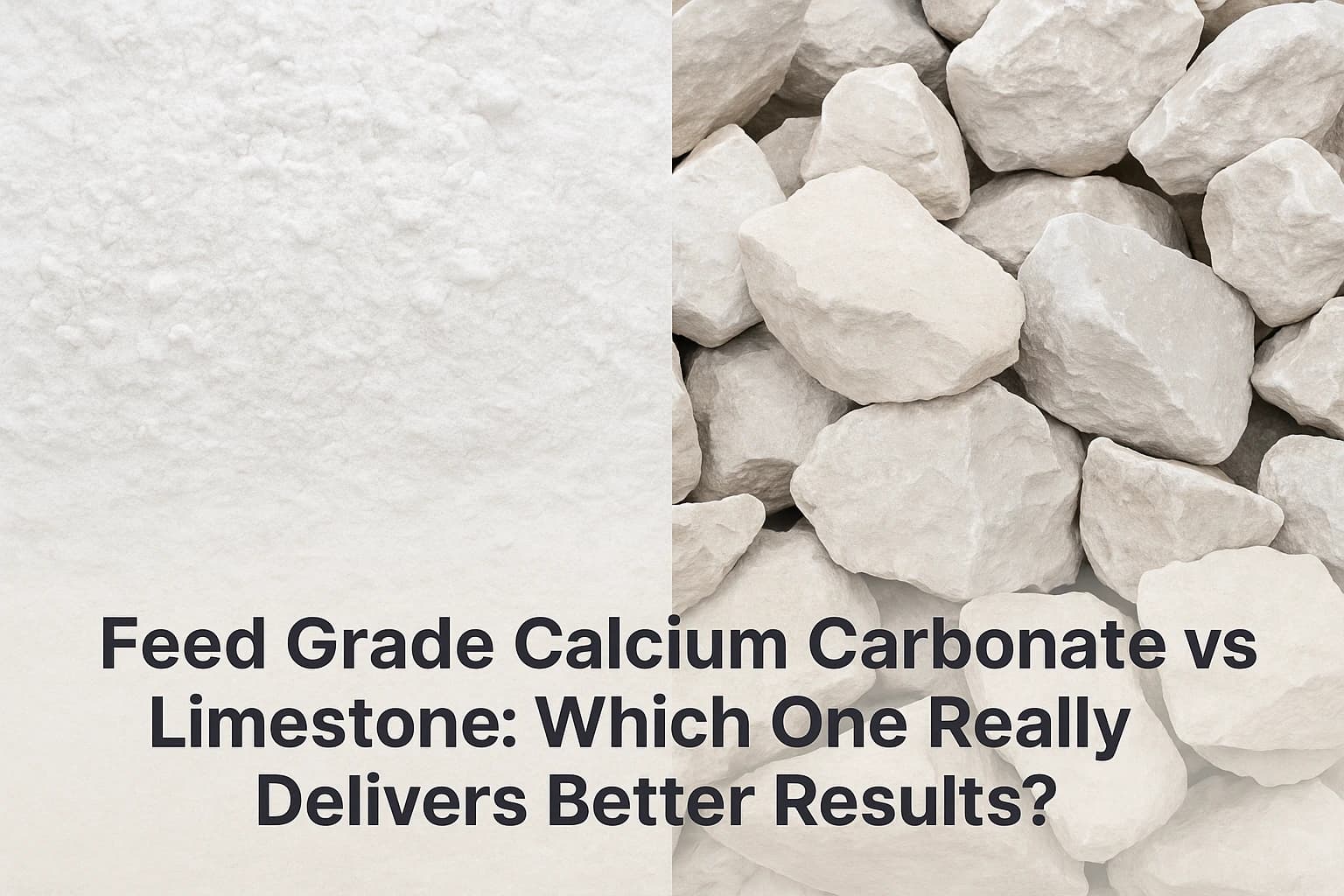
Feed grade calcium carbonate is a highly refined product, typically containing 95–99% pure CaCO3. Its main advantages:
-
Consistent purity and low impurities, minimizing risk from heavy metals and contaminants.
-
High solubility and bioavailability, ensuring rapid calcium absorption for strong eggshells and bones.
-
Standardized particle size and formulation, giving predictable results, easier feed mixing, and compliance in poultry, swine, and dairy diets.
Modern production and quality assurance make feed grade calcium carbonate a reliable, “no-surprise” option for high-output farms and integrators.
3. Limestone in Animal Feed—Tradition, Particle Size & Solubility
Limestone is the most common animal feed calcium source, sometimes used in various particle sizes (from powder to grit). Key features:
-
Solubility depends on particle size: finer limestone offers quick absorption, while coarse particles dissolve slowly, supporting calcium release when feed isn’t consumed (like nighttime in layers).
-
Natural variability: calcium content (85–97%) and impurities depend on mine origin and processing.
-
Cost-effectiveness: unprocessed limestone is low-cost, but variations in quality can lead to inconsistent eggshell or bone results.
Limestone grit is valuable for sustained eggshell calcification during non-feeding hours.
4. What the Science Says: Performance, Bioavailability & Risks
Research consistently shows that both forms can support animal health when sourced and used properly:
-
Feed grade calcium carbonate provides maximum consistency, purity, and rapid assimilation—vital for performance flocks or demanding production regimes.
-
High-quality limestone offers flexibility of use and both rapid and sustained calcium delivery due to its range of particle sizes.
-
Lower grade or poorly sourced limestone may harbor unwanted contaminants or insufficient calcium—posing health and productivity risks.
Modern studies confirm that high-purity, well-processed forms (whether limestone- or industrially-derived) maximize eggshell quality, bone mineralization, and overall productivity in layers and other livestock.
5. Market Trends, Supplier Selection & Practical Guidance
Global demand for feed minerals continues to rise, with Asia-Pacific leading growth due to expanding animal protein production. The best suppliers:
-
Offer guaranteed purity (≥95% CaCO3), low contaminant levels, and documented solubility/bioavailability
-
Provide technical support, quality assurance, and traceable sourcing (critical for export and regulated markets)
-
Supply both fine and coarse grades to match poultry/livestock needs
Producers should regularly test mineral feed sources, optimize particle size, and monitor calcium status for maximum efficiency.
6. Conclusion: Choosing the Right Calcium Source for Livestock
Both feed grade calcium carbonate and high-quality limestone can deliver excellent results. Feed grade CaCO3 is preferable when purity, consistency, and predictability matter. Limestone offers flexible release and cost effectiveness if sourced responsibly. The best outcomes come from well-chosen, verified sources and ongoing quality audits.